





Green gram cultivation guide for North Indian farmers

 Sep 04, 2026
 by Pankaj Sihag



Green gram cultivation guide for North Indian farmers
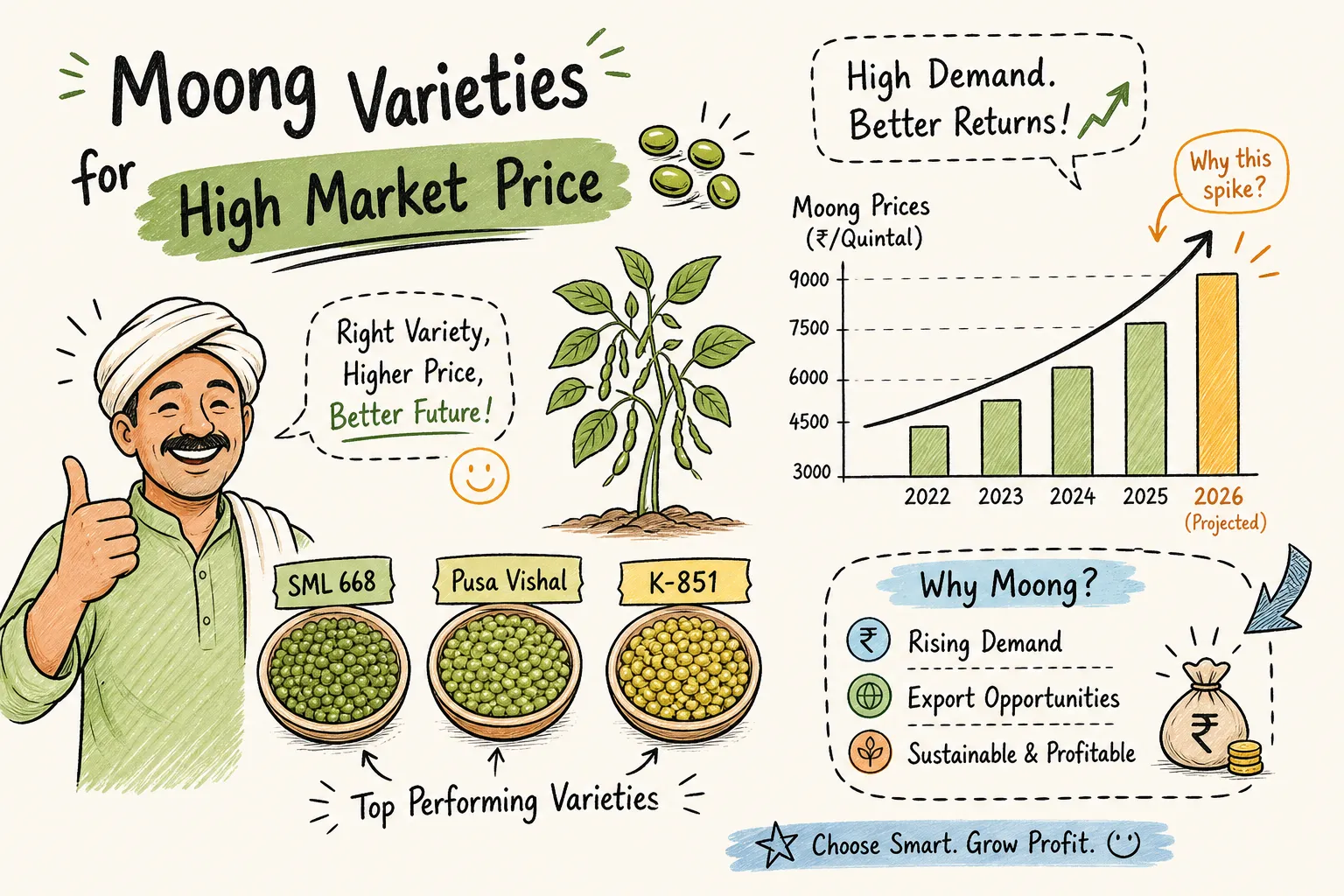
Moong (green gram), known botanically as Vigna radiata, is one of the few kharif crops that fits neatly into a 60, 75 day window, fixes nitrogen in the soil for the next fasal, and can return a decent munafa even in semi-arid conditions. For a Rajasthan or Haryana kisaan working with sandy loam soil and uncertain rainfall, that combination is hard to beat. The crop demands relatively modest inputs, matures before the kharif season becomes too unpredictable, and leaves the field in better shape for the following rabi crop.
This green gram cultivation guide addresses every stage from field selection to the mandi gate, so you can make informed decisions at each step. Early-season failures, poor variety choice, sowing two weeks too late, and skipping seed treatment, are a leading cause of yield loss in this belt, often before the first shoot has properly emerged. Follow KhetiKisaan for live moong mandi bhav rates to help you time your harvest and sale for maximum profit per quintal.
| Parameter | Details |
|---|---|
| Crop duration | 60, 75 days (most recommended varieties) |
| Seed rate (kharif) | 15, 20 kg per hectare |
| Expected yield (rainfed) | 6, 8 quintals per hectare |
| Expected yield (irrigated) | 10, 12 quintals per hectare |
| Water requirement | 300, 400 mm across the crop cycle |
 Table of Contents
- Green gram cultivation guide, quick start for North Indian farmers
- Picking the right green gram variety for your zone
- Land preparation and soil needs before sowing
- Green gram cultivation guide: sowing and spacing
- Fertiliser and manure schedule for a productive crop
- Irrigation management at each growth stage
- Green gram cultivation guide: pest, disease and harvest tips
- Harvesting, expected yield, and maximising your mandi price
- Check moong mandi bhav before you sell
- FAQs
Green gram cultivation guide, quick start for North Indian farmers
The 60, 75 day maturity of most recommended moong varieties is not just a convenience; it is an agronomic strategy built around the North Indian farm calendar. Wheat harvest in Rajasthan and Haryana generally finishes in April across most districts. Moong sown in June or early July is out of the field well before the next rabi sowing window opens in October. That gap is your opportunity to add a full crop cycle to your farm calendar without any clash with your primary crops.
The nitrogen fixation benefit is real and measurable. A healthy moong crop, well-inoculated with Rhizobium, returns measurable amounts of nitrogen to the soil through root nodules, reducing the subsequent nitrogen requirement for your next wheat or mustard crop and lowering your rabi urea bill. Over a few years, this effect becomes visible in your input cost sheet.
Basic economics: what does a moong crop actually earn?
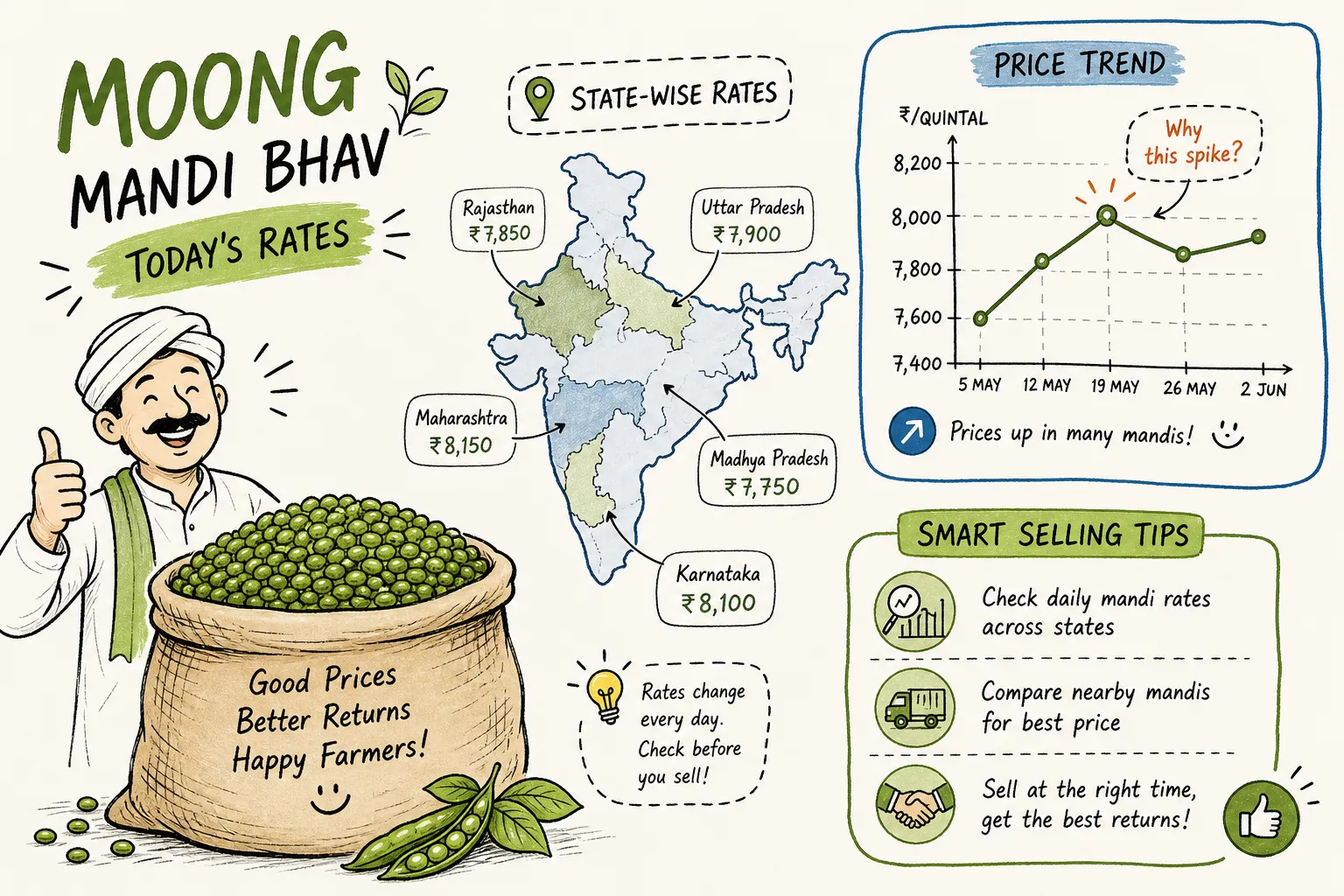
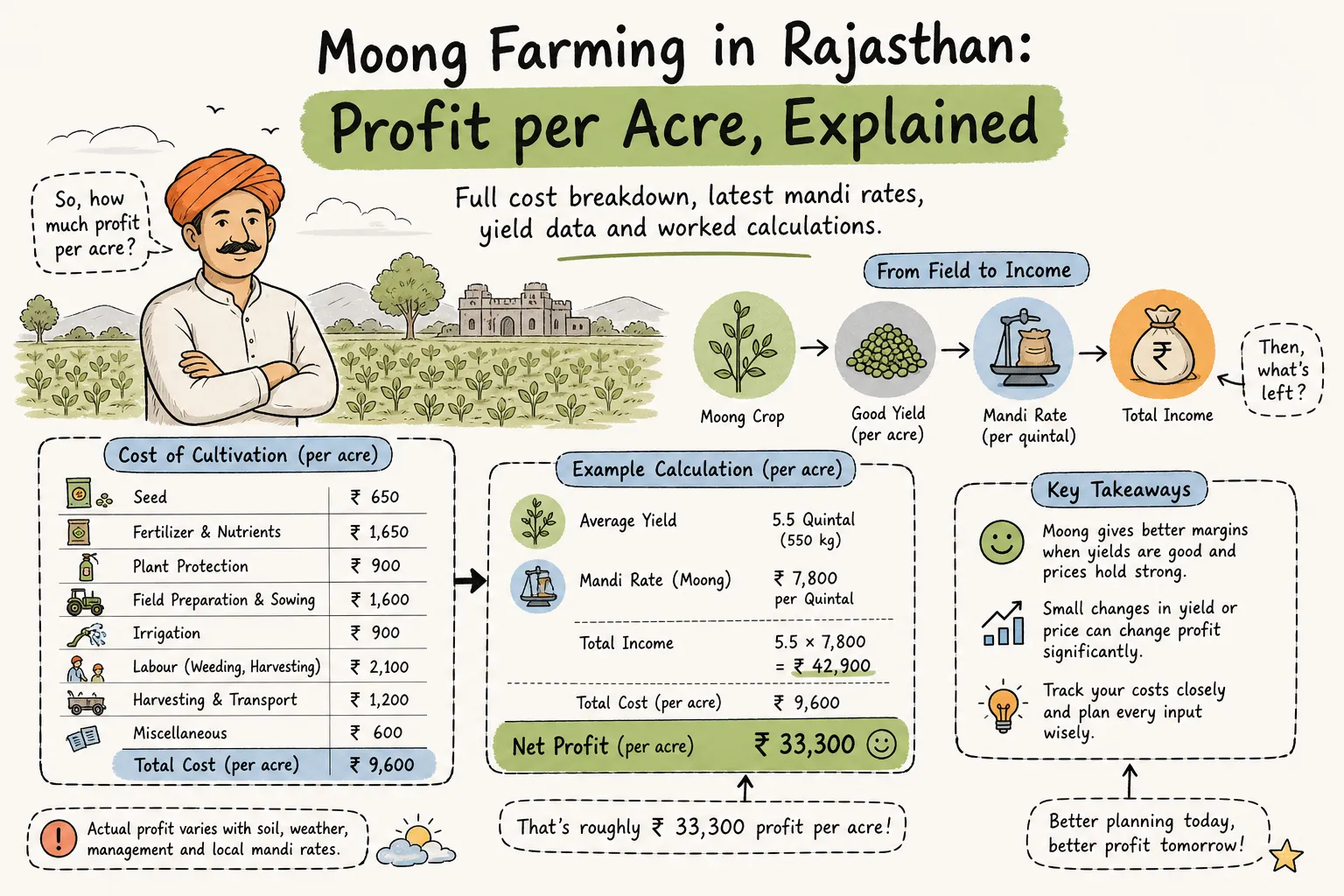
Under rainfed kharif conditions, a well-managed moong fasal in Rajasthan yields 6, 8 quintals per hectare on average. With supplemental irrigation and good variety selection, this rises to 10, 12 quintals per hectare. The government MSP for kharif 2026, 27 stands at ₹8,780 per quintal. Open-market mandi bhav in Rajasthan mandis varies by auction yard and date; prices near Sri Ganganagar have been recorded around ₹7,300 per quintal in recent cycles, with variations depending on arrivals and buyer demand.
Input costs for a rainfed moong crop, including seed, fertiliser, seed treatment, and hired labour for harvesting, are reported by farmers in the region at roughly ₹8,000, ₹12,000 per hectare, though actual costs vary by district and input source. At 7 quintals yield and ₹8,000 per quintal, gross returns come to ₹56,000 per hectare. Even after deducting inputs, the net munafa per hectare is meaningful, especially when you factor in the soil health benefit that reduces your rabi fertiliser bill.
Picking the right green gram variety for your zone
Variety selection is the single highest-impact decision you make all season. Planting the wrong variety for your zone can cause substantial, unrecoverable yield loss, once the crop is in the ground, there is no correcting that choice.
Top varieties for Rajasthan's semi-arid conditions
The table below covers the most recommended varieties for Rajasthan based on performance data from agricultural research stations and farmer field demonstrations.
| Variety | Maturity (days) | Yield potential (qt/ha) | Key traits |
|---|---|---|---|
| RMG-62 | 65, 70 | 8, 10 | Drought tolerant, widely adapted across Rajasthan |
| RMG-268 | 62, 70 | 8, 10 | Tolerant to yellow mosaic, good for semi-arid zones |
| RMG-344 | 62, 72 | 9, 11 | Moderate disease resistance, good pod set |
| SML-668 | 62, 70 | 9, 12 | Broadly adapted, good for both kharif and Zaid |
| GM-4 | 62, 68 | 8, 10 | Early maturing, suited to moisture-limited areas |
| Ganga-8 | 70, 72 | 10, 12 | Higher yield potential under irrigated conditions |
RMG-62 and SML-668 are the most widely grown in Rajasthan because of their consistent field performance across different soil types and rainfall patterns. If you are buying seed for the first time and are uncertain which variety to choose, either of these two is a safe starting point.
What Haryana farmers should look for
For Haryana, ML-1 and SML-668 are the primary recommended choices. ML-1 matures in about 90 days, making it better suited to the main kharif season (July sowing) where you have a longer window. SML-668, at 62, 70 days, is the better fit for the Zaid or summer crop window (February to March sowing) after wheat harvest, when heat stress is high and a faster-maturing variety reduces exposure risk.
Haryana farmers sowing moong in the Zaid window need to prioritise early maturity and heat tolerance above everything else. The April, May period brings rapid temperature spikes, and varieties with a 90-day cycle will be in their flowering stage exactly when daytime temperatures hit 40°C or above, which hammers pod set significantly.
Certified beej vs. farm-saved seed: which to use?
Farm-saved seed degrades in germination rate and genetic purity over successive generations. The yield gap between certified beej and farm-saved seed used for 4, 5 seasons can be substantial, farmers and extension workers commonly report differences in the range of 15, 20%, though the actual figure depends on how the seed has been stored and handled. Purchase certified seed from a registered government agri-centre or licensed seed dealer at least every 2, 3 years to maintain genetic vigour in your field.
Land preparation and soil needs before sowing
Ideal soil type and pH range for green gram
Moong performs best on well-drained loamy or sandy loam soils. Near-neutral to slightly alkaline soils, generally a pH of around 6.5, 7.5, are considered suitable based on standard legume agronomy guidance. Waterlogged conditions or heavy black cotton soils with poor drainage cause root rot, suppress Rhizobium nodulation, and effectively kill your nitrogen fixation benefit before it starts. If your field has low-lying patches that collect water after rain, raise the bed level or create drainage channels before sowing.
For Rajasthan farmers working with predominantly sandy soils, organic matter addition is especially important. Sandy soils lose moisture rapidly and have low nutrient retention. Incorporating farmyard manure (FYM) before sowing improves both water holding and nutrient availability, which pays back in more even crop establishment.
How to prepare your field in 3 steps
- Deep ploughing once after removing previous crop residue. This breaks up compacted layers and exposes soil to sunlight, which reduces some soil-borne pathogens.
- Two to three harrowing passes to create a fine, crumbly tilth. Moong seeds are small and need good seed-to-soil contact for even germination.
- Levelling to ensure uniform moisture distribution and eliminate waterlogging pockets.
Apply well-rotted FYM during the last harrowing pass, incorporated 2, 3 weeks before your planned sowing date. State extension recommendations on quantity vary; as a practical guide for smaller farms, 2, 3 tonnes per acre is a commonly applied rate, though higher quantities will further benefit sandy soils where organic matter is low. This timing allows the manure to partially decompose and integrate with the soil rather than sitting as a raw layer around germinating seeds.
Green gram cultivation guide: sowing and spacing
When to sow: kharif vs. Zaid timing in North India
For kharif, the ideal sowing window in Rajasthan and Haryana is 15 June to 15 July. Sowing before 15 June risks the crop sitting in dry soil waiting for the monsoon to establish. Sowing after 15 July shortens the effective growing period, exposes the crop to moisture stress at the pod-filling stage, and reduces yield noticeably. Early sowing within the window consistently outperforms late sowing in field trials across North India.
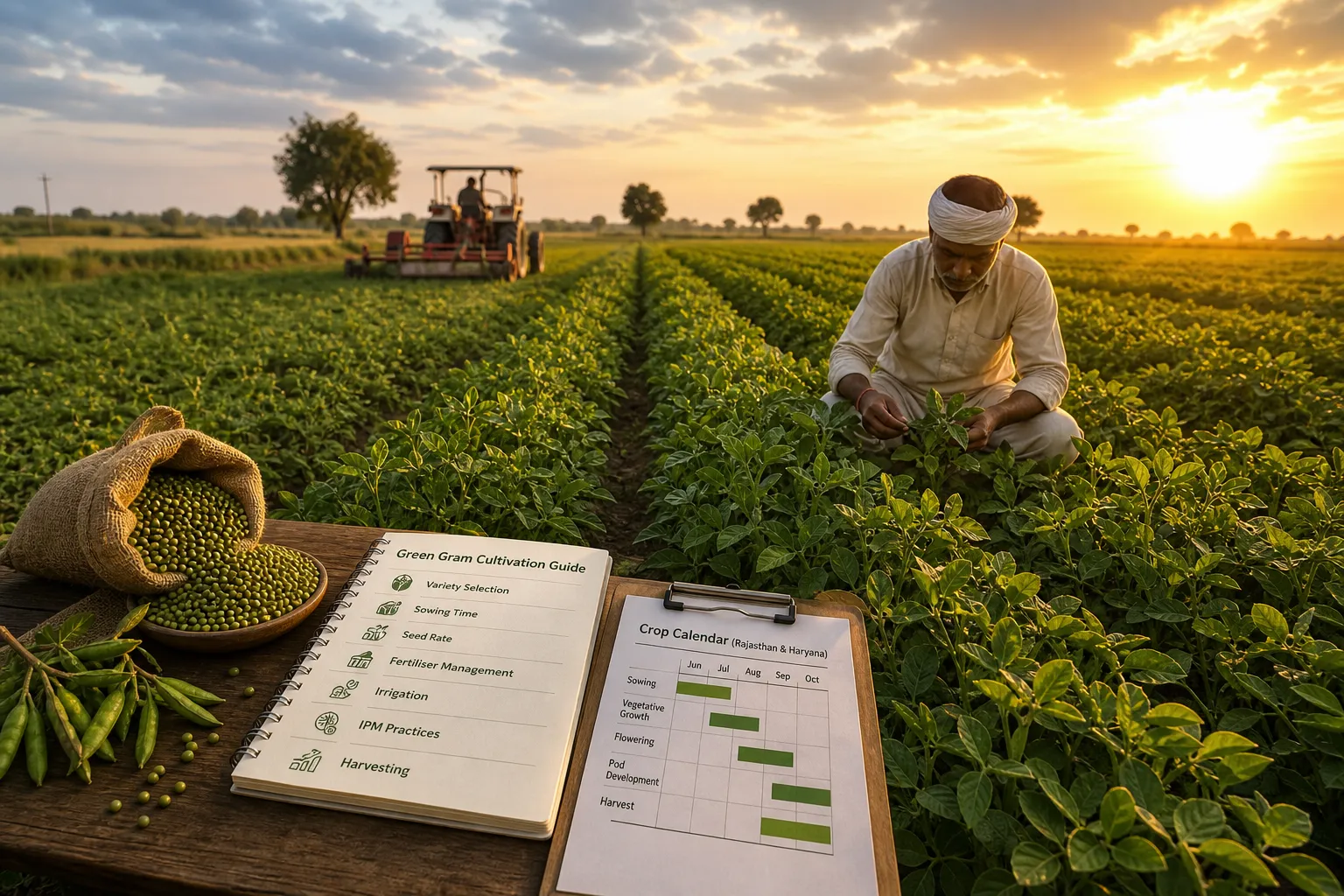
For the Zaid (summer) crop, sow between mid-February and March. The earlier end of this window gives the crop a better chance of completing pod filling before peak summer temperatures arrive in May.
Seed rate and sowing depth
For kharif, use 15, 20 kg of certified seed per hectare with row spacing of 30, 45 cm and plant-to-plant spacing of 10, 15 cm within the row. Sow at 4, 6 cm depth. For Zaid, increase the seed rate to 25, 30 kg per hectare and reduce row spacing to 20, 30 cm. The higher plant density in Zaid compensates for the faster germination losses that heat causes.
Correct spacing also reduces yellow mosaic disease pressure. Overcrowded rows create dense canopy conditions that favour whitefly populations; whiteflies are the primary vector that spreads yellow mosaic virus from plant to plant across the entire field. Maintaining the recommended row spacing is therefore not just about nutrient competition, it is part of your disease management strategy.
Seed treatment: the step most farmers skip
Seed treatment is a two-step process that takes under an hour but protects your entire crop from the moment of sowing. Most farmers skip it to save time. That decision can cost far more in lost germination and seedling rot than the treatment ever would.
- Fungicide treatment first: treat seed with carbendazim at 2 g per kg of seed. Mix the powder with a small amount of water and coat the seeds evenly. Allow to dry in shade before proceeding to the next step. This protects against seedling rot and anthracnose infection from soil-borne pathogens.
- Rhizobium inoculant second: once the carbendazim-treated seed is dry, coat it with Rhizobium culture at 10 g per kg of seed, using a small amount of jaggery solution as a sticker. Shade-dry again before sowing.
Always treat seed in shade. Direct sunlight kills the Rhizobium bacteria in the inoculant and makes the entire process pointless. Sow the treated seed within 24 hours of treatment.
Fertiliser and manure schedule for a productive crop
Basal dose at sowing: what to apply and how much
Because moong fixes its own nitrogen through Rhizobium, heavy nitrogen application is counterproductive and wastes money. The recommended NPK doses are as follows:
- Rainfed crop: 12, 15 kg N + 25 kg P₂O₅ + 12 kg K₂O per hectare
- Irrigated crop: 25 kg N + 50 kg P₂O₅ + 25 kg K₂O per hectare
In practical fertiliser terms for the rainfed dose, approximately 55 kg DAP per hectare covers most of the phosphorus requirement. Add a small quantity of MOP for potassium and a limited urea application for the nitrogen component. The full fertiliser dose is applied basally at sowing, placed in the furrow before seed placement. There is no top-dressing requirement in standard green gram agronomy.
Sulphur and micronutrient additions for Rajasthan soils
Rajasthan's sandy soils are frequently sulphur-deficient, and this deficiency directly limits protein content and seed quality in legume crops. Apply 20 kg sulphur per hectare for irrigated crops, preferably as gypsum incorporated at land preparation. Gypsum is also an inexpensive calcium source that improves soil structure in compacted areas.
Zinc deficiency is a secondary concern worth watching for. It shows up as interveinal chlorosis in young leaves, where leaf tissue between the veins turns pale yellow while the veins remain green. If you have seen this symptom in previous crops on the same field, a soil application of zinc sulphate at 25 kg per hectare at land preparation is the corrective measure.
Irrigation management at each growth stage
The total water requirement for a moong crop is 300, 400 mm across the full cycle. For a kharif rainfed crop, normal monsoon rainfall in Rajasthan and Haryana usually covers this. Even one or two well-timed supplemental irrigations can substantially increase yield by preventing moisture stress at the critical reproductive stages, the flowering and pod formation windows are where water availability matters most.
| Growth stage | Approximate timing | Irrigation action |
|---|---|---|
| Pre-sowing | Before sowing if soil is dry | Light irrigation to bring soil to field capacity |
| Vegetative | 20, 25 DAS | First supplemental irrigation if dry spell |
| Flowering | 30, 35 DAS | Essential; skipping here directly reduces pod count |
| Pod formation | 42, 45 DAS | Second essential irrigation; supports grain filling |
| Near maturity | After 50, 55 DAS | Stop irrigation; allow pods to dry down naturally |
Over-irrigation near maturity creates two problems at once. Fungal diseases like powdery mildew and Cercospora leaf spot thrive in moist conditions, and delayed pod drying means you arrive at the mandi with grain at 13, 14% moisture instead of the required below 10, 11%. Wet grain fetches a lower rate and can be rejected by buyers outright.
Green gram cultivation guide: pest, disease and harvest tips
The primary pest threat in moong comes from the sucking pest complex: aphids, jassids (leafhoppers), whiteflies, and thrips. These insects feed on plant sap, reduce photosynthetic efficiency, and, in the case of whiteflies, spread yellow mosaic virus from plant to plant across the entire field. Scouting should begin at 15 days after sowing and continue through pod formation.
For sucking pests, apply imidacloprid 17.8 SL at 0.3 ml per litre of water or thiamethoxam 25 WG at 0.25 g per litre at the first sign of significant infestation. Do not spray as a calendar routine; spray only when scouting confirms pest levels are building. The spotted pod borer (Maruca vitrata) is the main pod-stage pest. It bores into developing pods and destroys seeds directly. Emamectin benzoate applied at early pod formation stage is the recommended treatment when pod borer pressure is confirmed.
Major diseases and their control
Four diseases cause the most economic damage in Rajasthan and Haryana moong crops:
- Yellow mosaic virus (YMV): there is no chemical cure once a plant is infected. Rogue out infected plants immediately and destroy them away from the field. Control whitefly populations aggressively, and use tolerant varieties like RMG-268 in fields with a history of YMV pressure.
- Powdery mildew: a white, powdery fungal growth appears on leaf surfaces, typically in the second half of the crop cycle. Spray wettable sulphur or penconazole 10% EC at first appearance, and repeat after 10 days if the disease continues to spread.
- Anthracnose: causes dark, sunken lesions on pods, stems, and leaves. Seed treatment with carbendazim at sowing is the primary prevention. If an outbreak occurs in the field, apply a foliar spray of carbendazim combined with mancozeb.
- Cercospora leaf spot: circular brown spots with grey centres appear on older leaves and spread upward. Spray propiconazole or hexaconazole at 10-day intervals at the first sign of infection.
The IPM principle is worth stating plainly: monitor first, spray only when threshold levels are crossed, use the correct dose, and spray at the right time in the crop cycle. Routine calendar spraying without scouting wastes money and builds pesticide resistance in the pest population.
Harvesting, expected yield, and maximising your mandi price
When to harvest green gram
Green gram pods do not mature uniformly across a single plant, let alone across a full field. For small to medium farms, two to three manual pickings are recommended over a 10, 12 day period starting when the first pods turn dark brown to black. This approach maximises grain quality and reduces shattering losses compared to a single whole-plant harvest.
For larger farms using mechanical harvesting, wait until 80, 85% of pods have matured and the plant has naturally dried down before combining. In Rajasthan's hot and dry conditions, delaying mechanical harvest beyond this point leads to rapid shattering losses as pods split open in the heat. Time your harvest accordingly.
Expected yield and post-harvest handling
Realistic yield targets to plan against: 6, 8 quintals per hectare for rainfed kharif crops, and 10, 12 quintals per hectare under irrigated conditions with good crop management. After threshing, dry the grain to below 10, 11% moisture before storage or transport to the mandi. Use a hand moisture meter to verify; guessing moisture level often leads to rejection at the auction yard.
Clean the grain by removing chaff, weed seeds, and broken grains before taking it to the mandi. Clean, well-dried moong consistently fetches a higher price per quintal at auction because buyers, particularly exporters and dal mills, discount heavily for impurities or excess moisture. The post-harvest handling investment of a few hours directly adds to your per-quintal realisation.
Government seed and fertiliser subsidies
Government schemes for small farmers are worth checking before the season begins. Rajasthan has announced subsidised certified moong seed distribution covering approximately 2.6 lakh farmers, with up to 50% subsidy available through the Mukhyamantri Beej Swalamban Yojana via the Raj Kisan Saathi portal. Haryana has a separate 75% seed subsidy programme for summer moong. Both states benefit from the central Nutrient Based Subsidy on phosphatic and potassic fertilisers, which keeps DAP and MOP prices below their unsubsidised levels at registered dealers.
Check moong mandi bhav before you sell
Timing your sale matters as much as growing your crop well. Moong prices at APMC mandis in Rajasthan and Haryana can vary by several hundred rupees per quintal from week to week, depending on how much new grain is arriving at the yard and what demand looks like from traders and processors.
Before loading your moong on a trolley and heading to the nearest mandi, check the live moong mandi bhav on KhetiKisaan, which covers key mandis including Sri Ganganagar and Nohar in Rajasthan. Monitoring daily rates over a few days after harvest gives you a clear picture of whether prices are rising, falling, or stable, and can allow you to choose a better day or market to sell rather than going blind on the first available date.
Depending on arrivals and demand at the time, waiting for a better price window can add meaningfully to your per-quintal realisation at no additional input cost. That is pure munafa.