





Moong Farming in Rajasthan: Profit per Acre Breakdown
 Sep 04, 2026
 by Pankaj Sihag



Moong Farming in Rajasthan: Profit per Acre Breakdown
Quick Facts: How much profit can a farmer make per acre from moong cultivation in Rajasthan
- Typical moong yield per acre in Rajasthan by season: approximately 1.2 quintal/acre (rainfed kharif) to 6.1, 7.3 quintal/acre (zaid/summer irrigated)
- Typical cultivation cost per acre: ₹12,000 to ₹16,000 for an irrigated crop
- Current mandi bhav (market price): ₹5,500 to ₹8,400 per quintal across Rajasthan mandis
- Net munafa (profit) per acre: ₹2,000 to ₹25,000 depending on season, yield, and selling price
How much profit can a farmer make per acre from moong cultivation in Rajasthan? The answer ranges from a thin ₹2,000 in a rainfed kharif season to a genuinely strong ₹25,000 for well-managed summer (zaid) crop, and the gap between those two outcomes is almost entirely within a farmer's control. Most kisaans in Rajasthan know what they spend on seed and fertiliser. Where many fall short is in assembling a complete profit picture before the fasal (crop) reaches the mandi. Input costs shift with the season, yields differ sharply between irrigated and rainfed fields, and mandi bhav moves week to week. The result is that selling decisions often rest on gut feel rather than numbers.
This article works through all three pieces of that equation: realistic yield expectations for Rajasthan's different growing conditions, a full cost-of-cultivation breakdown, and current mandi rates from major Rajasthan APMC centres. Three worked calculations show exactly what net profit looks like across three common farming situations. Wherever live moong bhav figures matter to the calculation, KhetiKisaan tracks those prices daily from on-ground contacts at Rajasthan auction yards so you can plug in actual transaction rates rather than estimates.
 Table of Contents
- Moong yield per acre in Rajasthan: what to realistically expect
- Top moong varieties for Rajasthan and their yield advantage
- Full cost of cultivation per acre: where your money actually goes
- How much profit can a farmer make per acre from moong cultivation in Rajasthan
- Practical levers to increase your net income per acre
- Tracking live moong bhav to sell at the right time
- Making the profit calculation work for your farm
- FAQs
Moong yield per acre in Rajasthan: what to realistically expect
Yield is the income ceiling. Before any cost or price discussion makes sense, you need an honest picture of how much moong your field can produce, because the range in Rajasthan is enormous.
Rainfed vs irrigated: a gap that changes everything
Rainfed moong in Rajasthan farmer-field evaluations delivers between 118 and 208 kg per acre (roughly 1.2 to 2.1 quintal/acre). Irrigated fields in the same evaluations produce 239 to 358 kg per acre (2.4 to 3.6 quintal/acre). Doubling water access does not double your cost, but field evaluations consistently show irrigation yields the largest incremental gain a moong farmer can make in a water-limited zone, adding one or two reliable waterings can push output well beyond the rainfed ceiling, as the three worked scenarios below confirm.
| Growing condition | Yield range (kg/acre) | Yield range (quintal/acre) |
|---|---|---|
| Rainfed kharif | 118, 208 kg | 1.2, 2.1 quintal |
| Irrigated kharif/rabi | 239, 358 kg | 2.4, 3.6 quintal |
| Zaid/summer (irrigated) | 607, 728 kg | 6.1, 7.3 quintal |
Zaid/summer moong: where the real yield potential sits
Rajasthan cultivation guidance consistently reports 15 to 18 quintal per hectare for summer moong under good management, which translates to 6.1 to 7.3 quintal per acre, well above the green gram yield per acre achievable in kharif. Summer moong outperforms kharif for three clear reasons: longer and more consistent sunlight during grain filling, lower pest pressure compared to the kharif season, and fewer competing weeds. The main constraint for zaid moong in Rajasthan is water. Farmers without reliable borewell access during March to June will find this season difficult to exploit, but those who do have water access will find moong one of the stronger earning options in their cropping calendar.
State average vs what good farmers actually achieve
The official Rajasthan state average for moong sits at approximately 236 kg per acre (2.36 quintal/acre). This figure gets cited often, but it is a blended number that includes poor-management fields, drought-affected seasons, and below-par seed use dragging the average down. Demonstration plot data tells a different story: irrigated demonstration plots in Rajasthan average near 397 kg per acre, and the best-performing trials record 480 kg per acre and above. The state average is not a ceiling on what a careful farmer can achieve. It simply reflects what happens across all management levels combined.
Top moong varieties for Rajasthan and their yield advantage
Variety selection is one of the highest-leverage decisions in moong farming. Certified high-yielding varieties often outperform local undocumented seed by a substantial margin on the same plot with the same inputs (see yield comparisons below).
IPM 410-3 (Shikha) and MH 1142: the two strongest picks
IPM 410-3 (Shikha) is specifically recommended for summer and spring sowing in Rajasthan. It matures in 65 to 70 days, carries Yellow Mosaic Virus (MYMV) resistance, and delivers 11 to 12 quintal per hectare under good management, equivalent to 4.4 to 4.8 quintal per acre. MH 1142 is the preferred kharif option, maturing in 60 to 65 days with moderate resistance to anthracnose and powdery mildew, also at 11 to 12 quintal per hectare. Both varieties consistently beat local seed in yield trials and carry disease resistance that reduces plant protection spend.
GM-4, RMG-268 and SML-668: dependable alternatives
GM-4 matures in 62 to 68 days with uniform maturity that suits mechanical or simultaneous hand harvesting, and produces 10 to 12 quintal per hectare. In western Rajasthan farmer trials, GM-4 recorded the highest seed yield among several tested varieties. RMG-268 is drought-tolerant with low pest incidence, making it the practical choice for the drier western Rajasthan belt where irrigation access is limited. SML-668 carries broad disease resistance and suits areas where anthracnose and leaf-spot pressure is higher during kharif. Certified seed for all these varieties is available through state agricultural universities and accredited dealers, not just private traders.
Matching variety to your district and season
For irrigated zones during zaid, IPM 410-3 (Shikha) is the go-to choice because of its MYMV resistance and high yield potential in summer conditions. For kharif across eastern and central Rajasthan, MH 1142 covers most situations well. GM-4 is a versatile fallback where specific seed availability is limited at your local dealer. In the dryland western belt (Barmer, Jaisalmer, Bikaner fringe areas), RMG-268's drought tolerance makes it the most reliable option even if its yield ceiling is a bit lower.
Full cost of cultivation per acre: where your money actually goes
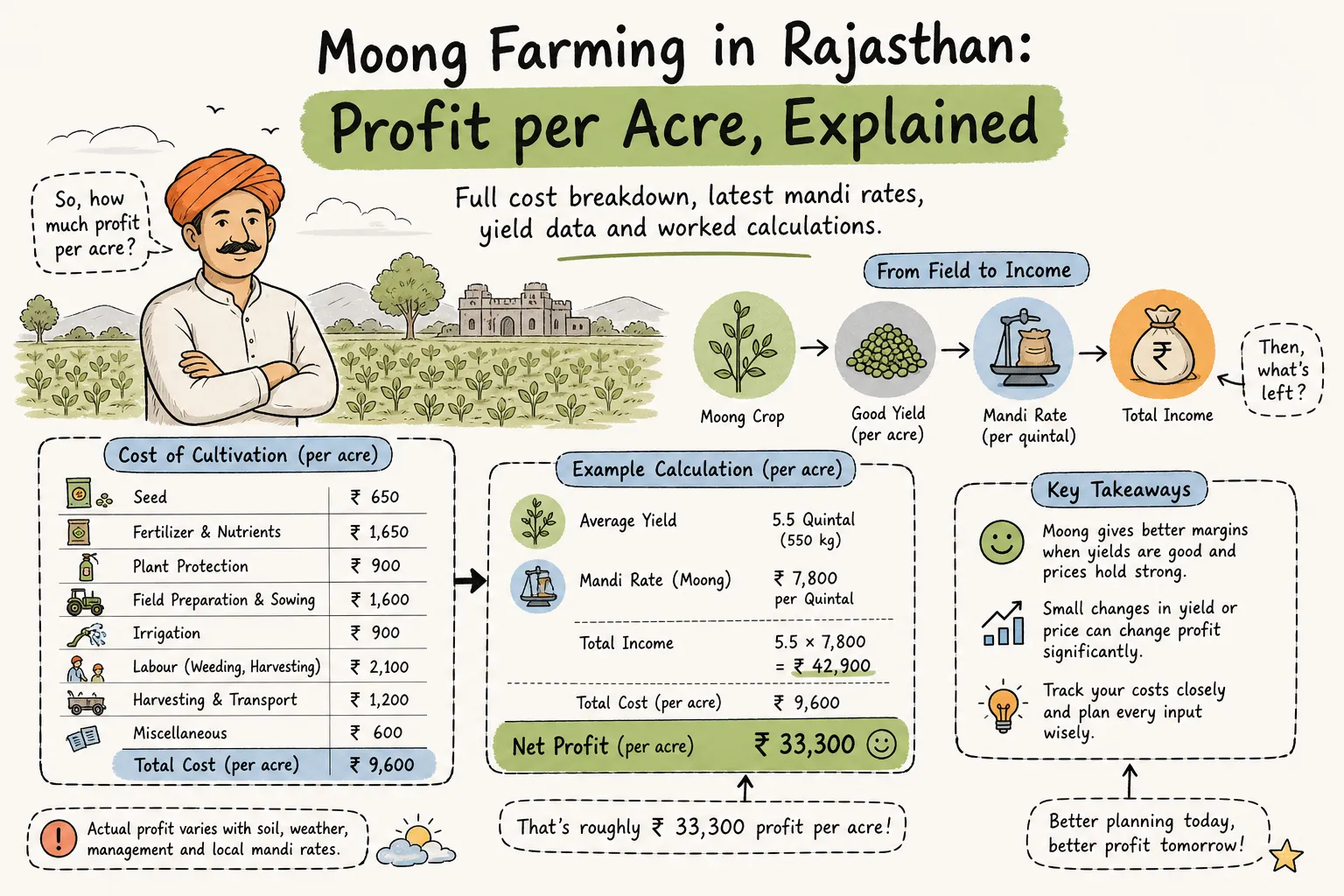
The Rajasthan benchmark for moong cultivation cost from documented farm studies sits at approximately ₹13,170 per acre (based on a 2022 study converted from ₹32,520 per hectare). Factoring in input cost inflation since then, a realistic 2026 range for a standard irrigated crop is ₹13,000 to ₹16,000 per acre. Here is where that money goes.
| Cost item | Minimum (₹) | Midpoint (₹) | Maximum (₹) |
|---|---|---|---|
| Seed (6, 8 kg/acre, certified variety) | 1,200 | 1,350 | 1,500 |
| Fertiliser (DAP/SSP + minor nutrients) | 1,800 | 2,050 | 2,300 |
| Plant protection (fungicide + insecticide) | 1,300 | 1,400 | 1,500 |
| Labour (sowing, weeding, harvesting) | 3,000 | 3,750 | 4,500 |
| Irrigation (1, 3 waterings) | 1,000 | 1,500 | 2,000 |
| Land preparation (ploughing, harrowing) | 2,500 | 3,250 | 4,000 |
| Harvesting and threshing | 600 | 800 | 1,000 |
| Transport and mandi charges | 350 | 525 | 700 |
| Total | 11,750 | 14,625 | 17,500 |
One important cost advantage moong has over wheat and other cereals: it is a legume that fixes its own nitrogen through Rhizobium bacteria in the soil, which means the fertiliser bill is genuinely lower than for a cereal crop of similar value. Over-applying urea on moong is a common and unnecessary expense in Rajasthan. Focus phosphorus application through DAP or SSP and skip the heavy nitrogen top-dressing that some farmers carry over from their wheat habits.
Zaid moong requires three to four irrigations (the first around 30 to 32 days after sowing, then every 10 to 12 days), which pushes the irrigation line item toward the higher end of the range above. Kharif moong, sown into pre-monsoon moisture, typically needs no irrigation unless rainfall fails, bringing the seasonal total cost down to approximately ₹9,000 to ₹12,500 per acre for a rainfed kharif crop.
How much profit can a farmer make per acre from moong cultivation in Rajasthan
Here are three realistic scenarios based on Rajasthan conditions. Each uses actual yield ranges, mandi bhav, and the cost structure above.
Scenario 1: Rainfed kharif moong (conservative case)
| Item | Figure |
|---|---|
| Yield per acre | 2.5 quintal |
| Mandi price | ₹5,800/quintal (lower harvest-season rate) |
| Gross revenue | ₹14,500 |
| Total cultivation cost | ₹12,500 (rainfed, no irrigation cost) |
| Net profit | ₹2,000/acre |
The margin here is thin but positive. Rainfed kharif moong in this situation is viable as a rotation crop that improves soil nitrogen, but it is not a primary income crop at this yield level. A farmer relying on rainfall alone and selling at harvest without checking other mandi options will find moong barely worth the effort. The fix is either securing one irrigation or improving the selling strategy, not abandoning the crop.
Scenario 2: Irrigated kharif moong (average management)
| Item | Figure |
|---|---|
| Yield per acre | 4 quintal |
| Mandi price | ₹6,700/quintal (Nagaur modal rate) |
| Gross revenue | ₹26,800 |
| Total cultivation cost | ₹14,500 (includes 2 irrigations) |
| Net profit | ₹12,300/acre |
This is the realistic target for a Rajasthan farmer using certified seed, two irrigations, and selling at a major APMC yard at the modal price. The jump from Scenario 1 to Scenario 2 is primarily driven by yield (2.5 to 4 quintal), not price. Improving field management has a bigger impact on profit than most price negotiation strategies.
Scenario 3: Irrigated zaid/summer moong (good management)
| Item | Figure |
|---|---|
| Yield per acre | 6 quintal |
| Mandi price | ₹6,850/quintal (Kota-equivalent, off-peak supply) |
| Gross revenue | ₹41,100 |
| Total cultivation cost | ₹16,000 (includes 3 irrigations) |
| Net profit | ₹25,100/acre |
This is the strongest return profile available from moong in Rajasthan. Summer moong benefits from lower market supply during April to June when most pulse markets have worked through kharif arrivals, which supports firmer prices. The higher irrigation cost (three waterings versus one to two in kharif) is more than recovered through yield. The constraint for reaching this scenario is borewell or canal water access during the summer months.
Practical levers to increase your net income per acre
The gap between Scenario 1 and Scenario 3 above is ₹23,100 per acre. Most of that gap is within a farmer's control through specific decisions, not luck.
Variety and timing: the two highest-impact decisions
Switching from local undocumented seed to IPM 410-3 (Shikha) or GM-4 can substantially increase yields on the same plot with the same fertiliser and water inputs (variety yield comparisons above show what is achievable). This is the highest-return change available to most moong farmers and it costs nothing beyond the seed price difference. Sowing timing is equally critical and costs nothing extra: for zaid moong, aim for sowing before 15 March to capture full summer sunlight during grain filling; for kharif, sow in late June after the first pre-monsoon moisture arrives. Late sowing is one of the most common and most fixable causes of yield loss in Rajasthan moong fields.
Cutting input waste without cutting yield
Three areas commonly drain moong profit in Rajasthan without improving output. First, heavy nitrogen fertiliser application: moong fixes its own nitrogen through Rhizobium bacteria, so applying urea beyond a small starter dose is wasteful spending. Second, untargeted pesticide spraying before confirming whether pest numbers have actually crossed the economic threshold. Third, skipping seed treatment entirely, treating seed with Rhizobium culture plus a fungicide costs approximately ₹50 to ₹80 per acre and directly protects germination. Addressing all three can save an estimated ₹600 to ₹1,200 per acre with no reduction in yield.
Hold or sell at harvest: the storage decision
Moong prices historically firm up four to eight weeks after harvest as market arrivals decline and dal mill demand stabilises. Market data shows that farmers who store three to four quintals in a dry, pest-free space for six to eight weeks typically earn ₹400 to ₹800 more per quintal than those who sell at the harvest-season low, though this premium is not guaranteed and prices do not always rise after harvest. Basic storage conditions are simple: moisture content below 10%, covered storage with polythene or jute sacks in a ventilated space, and a light dusting of approved grain protectant if storing for more than four weeks. This is exactly why tracking live mandi bhav during your storage window is essential before making a final selling decision.
Tracking live moong bhav to sell at the right time
The worked calculations above are only as useful as the price figure you plug into them. Getting that price figure right is the part that most farmers shortcut by asking a neighbour or calling their arhatiya (commission agent), both of whom may not be giving you the full picture.
Why mandi prices vary by date and location in Rajasthan
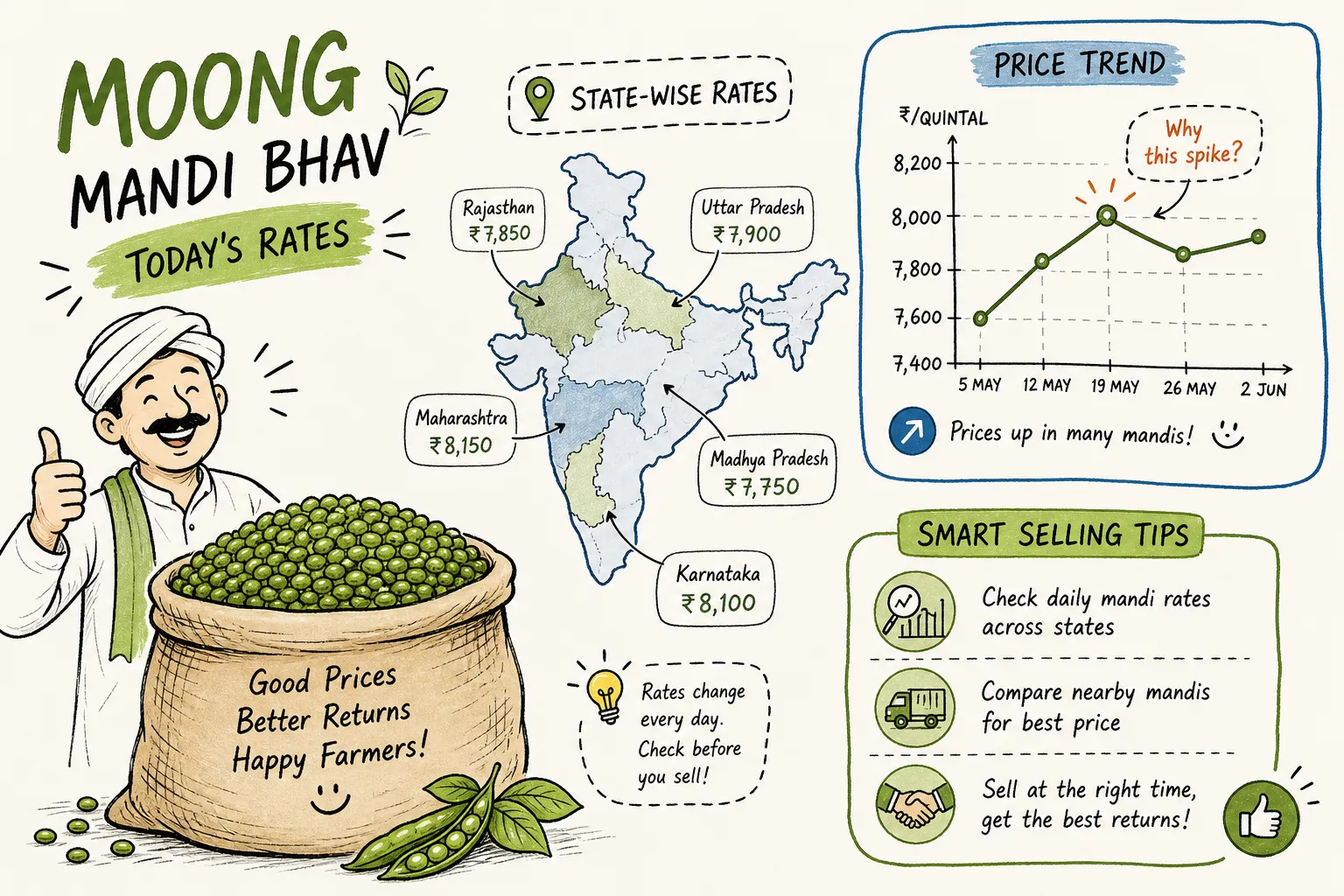
Moong prices at Rajasthan mandis shift daily based on arrival volumes, national demand from dal mills, and export activity through Rajasthan-based traders. The same quality moong sold at Malpura (Tonk) versus Nagaur on the same day can fetch a ₹200 to ₹500 per quintal difference, as the mandi price table above shows. Farmers who do not check current rates across multiple mandis either accept their local yard's rate without question or travel to a mandi without knowing whether it is the best option that day.
How KhetiKisaan's real-time mandi data changes the calculation
KhetiKisaan sources moong bhav from on-ground contacts who are physically present at live APMC auctions across Rajasthan, including Nagaur, Hanumangarh, Khajuwala (Bikaner), Kota, Chaksu (Jaipur), and other key centres. These are actual transaction prices captured during live bol-chaal, not delayed government portal updates or averaged estimates. A farmer who checks KhetiKisaan before loading produce for the mandi can compare rates across three or four nearby yards and choose the one paying the most that day. At a ₹300 per quintal difference across four quintals, that is ₹1,200 more in your pocket from a five-minute check.
Using price data to build a selling strategy
A simple two-step approach works well for most Rajasthan moong farmers. First, check live mandi rates across three or four nearby mandis on KhetiKisaan on the morning before you plan to travel. Second, compare that day's rates against your stored crop's break-even hold price (your cost per quintal plus any storage expense) and decide whether selling today or waiting another week makes better financial sense. Combined with the storage guidance in the Hold or Sell section above, this approach converts a reactive selling habit into a deliberate strategy. The key is having access to accurate daily prices rather than relying on word of mouth.
Making the profit calculation work for your farm
The core framework has three parts: know your realistic yield for your season and water access, build an honest cost picture using the line-item breakdown above, then track live mandi bhav to sell at the best available price rather than the most convenient one. In short, how much profit can a farmer make per acre from moong cultivation in Rajasthan depends on water access, variety choice, and selling strategy, with realistic ranges running from ₹2,000 per acre for rainfed kharif to ₹25,000 per acre for well-managed zaid. That variability is not random. It is driven by decisions: which variety you plant, which season you choose, how accurately you track input spending, and where and when you sell your fasal.
Government support for moong farmers in Rajasthan is also improving. The national pulses mission includes subsidised certified seed distribution for moong, urad, and arhar, with Rajasthan sanctioning ₹135 crore to cover seed costs for 2.6 lakh farmers. Processing and packaging unit subsidies of up to ₹25 lakh are also available for farmers and entrepreneurs looking to add value locally. These schemes lower the input cost bar further, making the profit scenarios above even more achievable.
For daily moong bhav updates from Nagaur, Hanumangarh, Khajuwala, Kota, Chaksu, and other major Rajasthan APMC centres, visit KhetiKisaan. The prices are sourced from on-ground contacts at live auctions, not delayed government portals, so you get the real transaction rate before you make your selling decision. Check it every morning during your selling window, it is the most direct way to add a few hundred rupees per quintal to every batch you sell.