







Best Moong Varieties for High Yield in North India

 Aug 20, 2026
 by Pankaj Sihag



Best Moong Varieties for High Yield in North India
| Quick Facts | Details |
|---|---|
| Best sowing seasons | Kharif (mid-June to early July) and Zaid/Spring (mid-March to April) |
| Top varieties | Pusa Vishal, MH-421, SML-668, Virat (IPM 205-7), ML 818, Sheela |
| Average yield range | 8, 13 q/ha in official trials; exceptional irrigated plots with intensive management may reach higher depending on variety and water availability |
| Biggest disease threat | Yellow Mosaic Virus (YMV), spread by whitefly |
| Key states covered | Rajasthan, Haryana, Punjab, Uttar Pradesh |
What is the best variety of moong for high yield in North India? It is the question KhetiKisaan hears from farmers across Rajasthan and Haryana every single season, and the honest answer is that it depends on your soil, your water, and the disease pressure in your area. Moong (green gram) is one of the most profitable kharif fasals in North India, but choosing the wrong beej (seed variety) can quietly cost you 30, 40% of the yield you should be getting. The soil you farm, the water you have access to, and the disease pressure in your area all determine which variety will actually perform, and which one will disappoint you by September. At KhetiKisaan, we track moong prices and work with farmers across Rajasthan and Haryana every season. This guide answers the variety question directly, using official trial data and on-ground performance figures.
We have compared the top ICAR and state-recommended green gram cultivars using official trial data, state agriculture department guidance, and on-ground performance. There is no generic advice here, just the variety comparisons, yield figures, and key agronomic traits you need to make the right call for your zameen (land) and season.
 Table of Contents
- What is the best variety of moong for high yield in North India?
- Top moong varieties for North India: A direct comparison
- Pusa Vishal: the high-yield benchmark for Punjab and Haryana
- MH-421 and SML-668: Haryana's field-proven varieties
- Virat, ML 818, and Sheela: strong alternatives worth knowing
- Yield data and maturity window: what ICAR and state trials show
- Which high-yield moong variety suits your soil and zone?
- Disease resistance traits that protect your moong fasal
- Sourcing certified seed and planning your moong sale for maximum returns
- Final takeaway: match your variety to your field, then sell smart
- FAQs
What is the best variety of moong for high yield in North India?
In North India, yield differences between moong varieties range from roughly 8 q/ha to 13 q/ha in official trials. The biggest factor driving that gap is not fertiliser or irrigation scheduling; it is whether the variety is suited to your specific soil type and agro-climatic zone. A variety that performs brilliantly in a Punjab trial can significantly underperform in the sandy-loam soils of Rajasthan's Bikaner or Ganganagar belt, where water retention is low and temperatures spike earlier.
The sandy-loam soils of northern Rajasthan drain quickly and heat up fast, which rewards short-duration, drought-tolerant varieties. The alluvial, relatively moisture-retentive soils of Haryana's Hisar, Sirsa, and Fatehabad districts suit higher-yielding varieties that need moderate but consistent irrigation. Variety-soil and agro-climatic match is among the primary determining factors for yield outcomes. Everything else comes after.
Maturity duration is the second non-negotiable filter. Short-duration moong (about 60, 65 days) allows farmers to fit the crop neatly into paddy-wheat rotations, which are common across Haryana and Punjab. If you sow after wheat harvest in June and need the field clear for transplanting paddy by late July, a 60-day variety is your only realistic option. Medium-duration varieties (70, 80 days) deliver higher yields but tighten the crop window considerably, making them more suitable for dedicated moong plots or Zaid (spring) sowing.
Top moong varieties for North India: A direct comparison
The best-performing mungbean varieties currently recommended by ICAR and state agriculture departments for North India are Pusa Vishal, MH-421, SML-668, Virat (IPM 205-7), ML 818, and Sheela. Each is suited to slightly different conditions, which is why selecting based on your zone and irrigation access matters more than simply picking the variety with the highest peak yield. Note that commercial moong hybrid varieties remain limited; the recommended options below are all open-pollinated released varieties from ICAR and state breeding programmes.
| Variety | Yield (q/ha)* | Days to maturity | YMV resistance | Suitable zones | Irrigation need |
|---|---|---|---|---|---|
| Pusa Vishal | 11, 14 | 60, 65 | Resistant | Punjab, Haryana, Delhi, West UP, North Rajasthan | Irrigated |
| MH-421 | 8, 10 | 60, 70 | Resistant | Punjab, Haryana, West UP, North Rajasthan, Uttarakhand | Moderate |
| SML-668 | 10, 12 | 60, 65 | Resistant | Haryana, Punjab, NW Plains | Low to moderate |
| Virat (IPM 205-7) | 10, 11 | 65, 70 | Resistant | Haryana (primary recommendation) | Moderate |
| ML 818 | 10, 11 | 65, 70 | Moderate | Haryana, Punjab, UP, Uttarakhand (NW Plains Zone) | Rainfed or irrigated |
| Sheela | 12, 15 (intensive irrigated management) | 65, 75 | Moderate | North India (irrigated plots) | Well-irrigated |
Pusa Vishal: the high-yield benchmark for Punjab and Haryana
Pusa Vishal was released by IARI for the North-Western Plain Zone and remains one of the most widely trusted varieties for irrigated plots across Punjab, Haryana, and northern Rajasthan.
Punjab trial data places its average yield at approximately 1,203 kg/ha (just over 12 q/ha), with some intensive management plots reaching toward 14 q/ha.
It matures in 60, 65 days, which fits kharif sowing windows comfortably, and its resistance to Yellow Mosaic Virus makes it a reliable choice in areas with documented whitefly pressure.
Growers in Haryana and Punjab commonly report that Pusa Vishal's bold, shiny seeds attract competitive bids at the mandi.
MH-421 and SML-668: Haryana's field-proven varieties
MH-421 is among the most widely grown improved moong varieties in Haryana. It matures in 60, 70 days, delivers 8, 10 q/ha under typical field conditions, and carries official YMV resistance.
KVK Hanumangarh demonstration data recorded 10.63 q/ha in field trials, confirming its performance on the loamy soils of northern Rajasthan as well. It is also recommended for spring and summer sowing across Punjab, Haryana, western UP, and the northern Rajasthan plains, making it one of the most versatile options on this list.
SML-668 is a short-duration variety that matures in about 60, 65 days and is resistant to both YMV and powdery mildew. Its yield in adaptive trials ranges from roughly 985 kg/ha under stress conditions to approximately 1,460 kg/ha in favourable management trials.
Field observations from Haryana's Hisar and Fatehabad districts consistently report 10, 12 q/ha under moderate irrigation. It is particularly valued for uniform maturity and marketability: pods are ready to harvest at a similar time, which reduces labour and post-harvest losses.
Virat, ML 818, and Sheela: strong alternatives worth knowing
Virat (IPM 205-7) is a Haryana-focused recommendation yielding 10, 11 q/ha with a maturity window of 65, 70 days. A Dr. PDKV Akola trial (2015, 16) showed Virat out-yielding PUSA-9531 by approximately 14% under comparable conditions; note this is older trial data rather than a recent ICAR notification, but it remains a useful reference for comparative performance.
ML 818 is officially recommended for the entire North-Western Plains Zone, covering Haryana, Punjab, UP, and Uttarakhand, with yields in the 10, 11 q/ha range and good adaptability across both rainfed and irrigated conditions.
Sheela stands apart with reported yields of 12, 15 q/ha under well-irrigated, intensively managed North Indian conditions, making it the highest-potential variety in this group. It is more demanding on water and management inputs, so it is best suited to farmers with reliable irrigation access and experience with intensive green gram cultivation.
Yield data and maturity window: what ICAR and state trials show
Official trial data from ICAR and state agricultural universities confirms that yield gaps between top and average moong varieties in North India can run to 30, 40%. That gap translates directly into munafa (profit) at harvest time.
In Punjab comparative trials, Pusa Vishal delivered 1,203 kg/ha while ML 818 recorded 991 kg/ha and SML-134 returned 1,039 kg/ha under similar growing conditions. At current mandi rates for moong in Rajasthan and Haryana (approximately ₹5,600, ₹8,800 per quintal depending on grade and market), a 2, 3 quintal per hectare yield difference equals ₹11,200, ₹26,400 per hectare in additional income from the same field and the same inputs.
Under irrigated conditions in North India, top varieties typically yield up to about 12, 13 q/ha in official trials; exceptional results with intensive management on specific varieties may exceed this figure, but farmers should plan around trial averages rather than peak outliers.
Under rainfed conditions in Rajasthan's arid belt, yields realistically fall to 8, 10 q/ha even with the best varieties. Farmers in the Bikaner and Jaisalmer belts should plan budgets around the rainfed range, not trial-data peaks, to avoid financial shortfalls. Matching variety choice to actual water availability is as important as the variety itself.
Must Read: High-Yield Variety (HYV) Seeds for Kharif Crops in India
Which high-yield moong variety suits your soil and zone?
When asking what is the best variety of moong for high yield in North India, the answer shifts depending on where you farm. The table above provides a starting point, but here is a quick zone-level filter to narrow your choice further.
For Punjab and irrigated Haryana, Pusa Vishal and SML-668 are the most consistent performers with documented YMV resistance. For northern Rajasthan's sandy-loam belt, MH-421 is the strongest recommendation backed by KVK Hanumangarh trials.
Farmers across the broader North-Western Plains Zone looking for flexibility between rainfed and irrigated conditions will find ML 818 the most adaptable option. Sheela is worth considering only if you have access to reliable irrigation and the management bandwidth for a more input-intensive crop.
Disease resistance traits that protect your moong fasal
Yellow Mosaic Virus (YMV) is the single biggest yield destroyer in moong across North India. Research from multiple ICAR and state trials documents severe yield losses from YMV in susceptible varieties; the actual damage in any given season depends on timing of infection, whitefly pressure, and crop stage at first infection.
YMV is spread by whitefly (safed makkhi) and causes characteristic yellow patches on leaves that spread rapidly, stunting the plant and destroying pod formation. Choosing a YMV-resistant variety is your first line of defence, not an optional upgrade.
Varieties like Pusa Vishal, MH-421, SML-668, and Virat carry confirmed resistance or strong tolerance to YMV. It is worth understanding the difference: resistant varieties show little or no infection even under high whitefly pressure; tolerant varieties may show some infection but continue to produce an acceptable yield. For fields with a history of YMV outbreaks, stick to varieties classified as resistant rather than merely tolerant.
Powdery mildew and Cercospora leaf spot are secondary threats relevant to Rajasthan and Haryana, particularly during humid spells or in late-season crops. SML-668 has recorded powdery mildew tolerance in official evaluations.
Regardless of variety, managing whitefly populations through timely neem-based sprays and avoiding excessive nitrogen application reduces disease pressure across the board. No variety, however resistant, replaces sound crop management.
Sourcing certified seed and planning your moong sale for maximum returns
Choosing the right variety is step one. Buying certified beej from an authorised source ensures that variety's actual genetic potential reaches your field. Seed sold without a certification tag can be contaminated, mislabelled, or simply old stock with poor germination, and no amount of irrigation or fertiliser fixes a bad seed lot.
For certified moong seed in North India, the most reliable sources are:
- Rajasthan State Seeds Corporation (RSSC) depots for farmers in Rajasthan
- Haryana Seeds Development Corporation (HSDC) outlets for Haryana-based kisaans
- Krishi Vigyan Kendra (KVK) outlets, which often stock ICAR-recommended varieties at reasonable prices
- ICAR-authorised agri-dealers in your district, always ask for the certification tag, lot number, and germination percentage before purchasing
Certified moong seed from authorised sources typically carries a price premium over retained farm seed. The exact rate varies by variety and season, so verify current prices directly with your state seed corporation or local KVK before the sowing window opens. In most cases, the yield advantage and disease resistance traits of certified varieties more than recover that additional cost over the season.
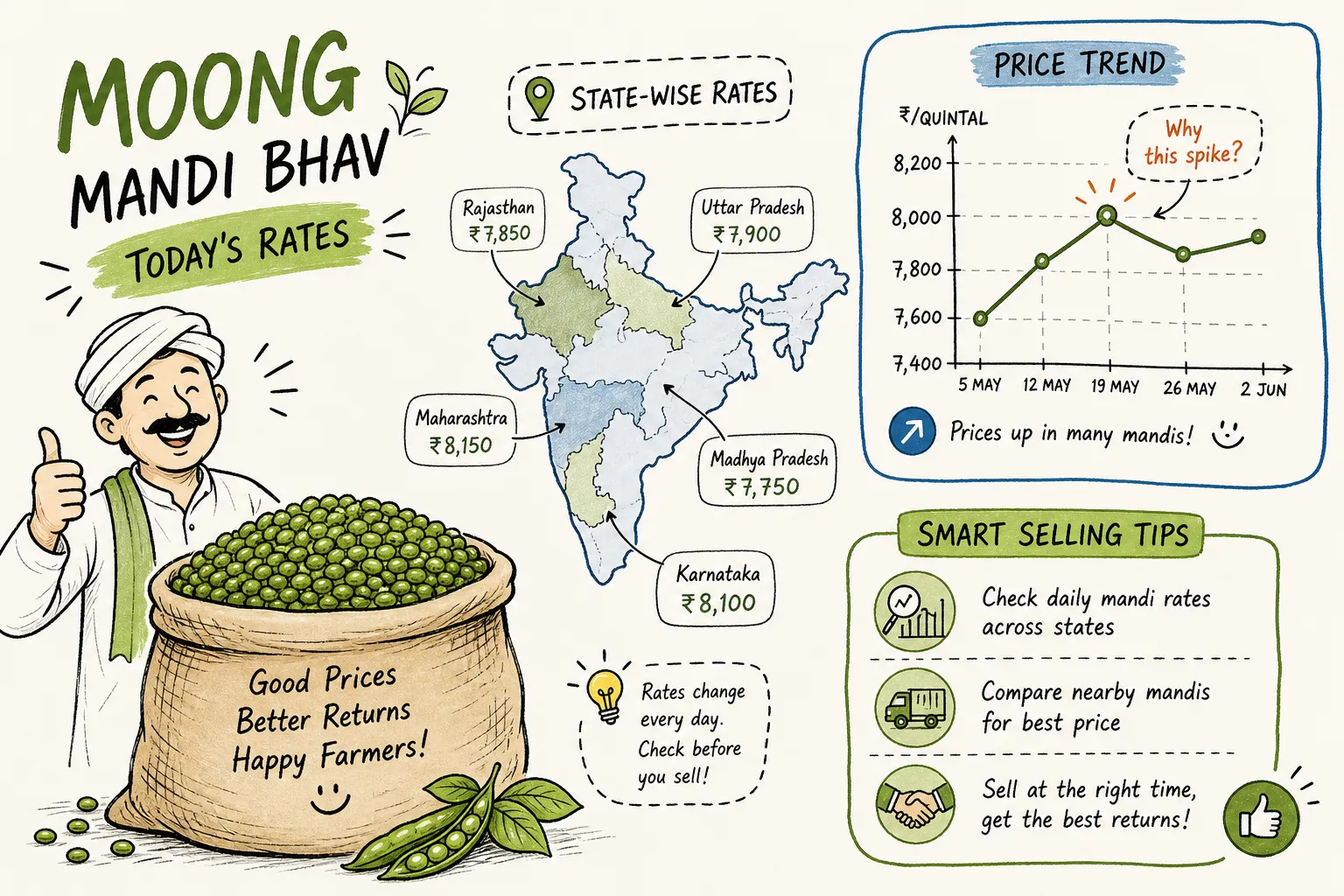
Once the right variety is in the ground and harvest approaches, the next profit lever is timing your sale. Moong mandi bhav (market rates) fluctuate significantly across APMC yards in Rajasthan and Haryana, and price differences between mandis on the same day can be material.
KhetiKisaan publishes real-time moong mandi bhav updates sourced from live APMC auction yards in Sri Ganganagar, Nohar, and other major centres across Rajasthan and Haryana. Instead of relying on arhatiya (commission agent) word-of-mouth for price information, you can check which mandi is offering the best rate on any given day and make an informed decision about where and when to sell your fasal.
Final takeaway: match your variety to your field, then sell smart
What is the best variety of moong for high yield in North India? The answer comes down to three things: your soil type, your water availability, and the disease pressure in your area.
Varieties like Pusa Vishal, MH-421, SML-668, and Virat deliver proven results when matched to the right zone. Sheela offers a higher yield ceiling under intensive irrigated management, but it demands the inputs and experience to get there.
Always buy certified beej from an authorised source, follow the recommended sowing window for your season, and set a realistic yield target based on your actual field conditions rather than peak trial data. The right variety gives you the yield. Tracking live moong mandi bhav on KhetiKisaan before you load the tractor gives you the munafa.
FAQs
Related Blogs

Sep 04, 2026
by Pankaj Sihag
Sep 04, 2026
by Pankaj Sihag