





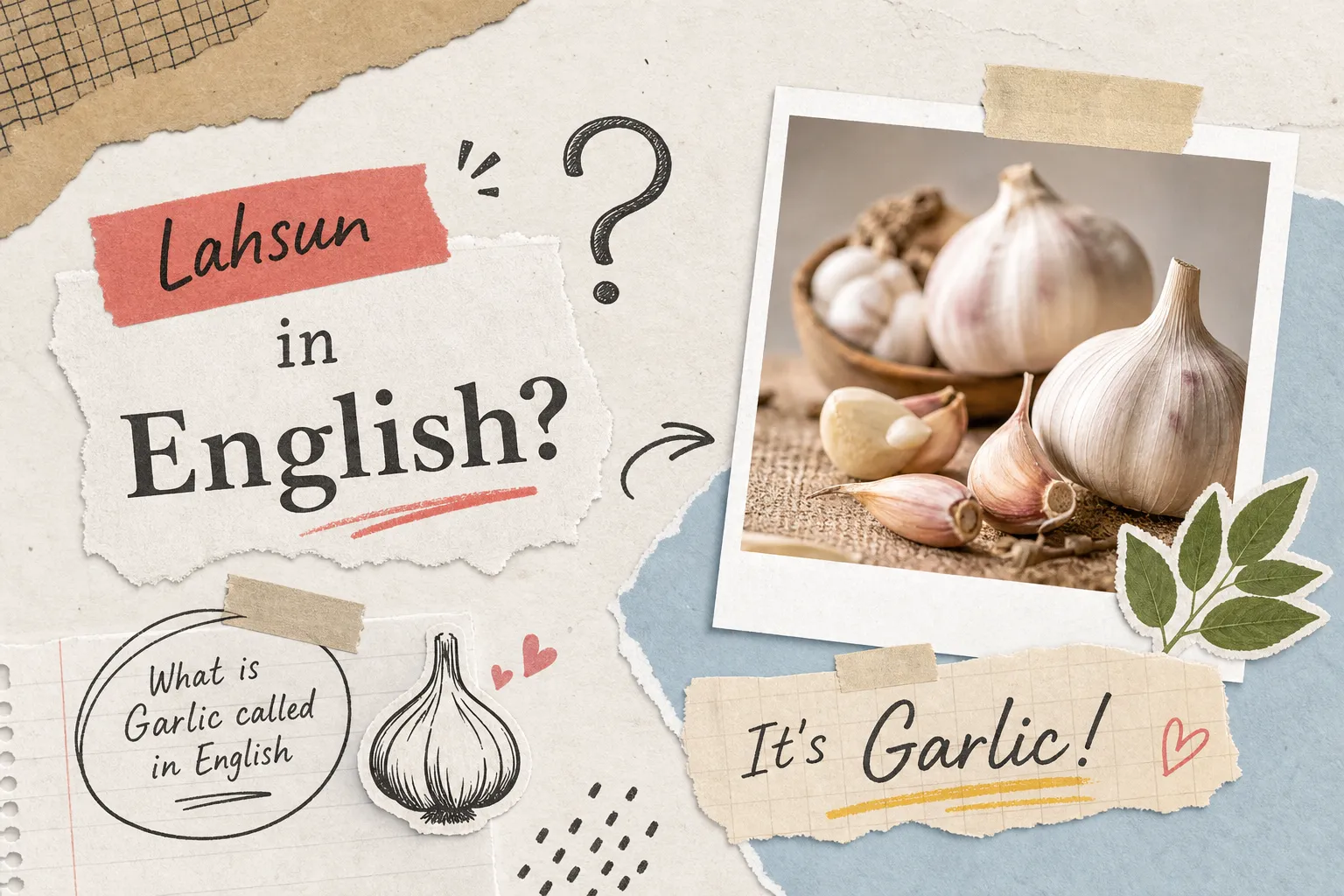
Lahsun in English: What is Garlic Called in English?
 Oct 08, 2026
 by Pankaj Sihag



Lahsun in English: What is Garlic Called in English?
| Hindi word | लहसुन (lahsun / lehsun) |
|---|---|
| English meaning | Garlic (Allium sativum) |
| Pronunciation | Lahsun = luh-sun | Garlic = GAR-lik |
| Lahsun ki kali | A clove of garlic (one individual segment) |
| Lahsun patta | Garlic leaf / garlic greens / green garlic |
| Poora lahsun | Garlic bulb (the complete head) |
| Mandi trading name | Lahsun (used directly in APMC records) |
| Botanical name | Allium sativum |
 Table of Contents
- Why this translation matters beyond the dictionary
- The direct translation: what garlic means and where the word comes from
- Parts of the garlic plant and their English names
- Common English sentences using garlic, clove, and bulb
- Lahsun in English on the farm: garlic as a Rabi crop in India
- How lahsun is traded in Indian mandis
- What affects lahsun ka bhav: price factors and where to track rates
- The clear picture: lahsun, garlic, and why both words matter
- FAQs
Why this translation matters beyond the dictionary
Lahsun in English is garlic . That one-word answer is the core of this article, but knowing just the translation is not enough. Garlic is one of India's most commercially traded Rabi crops, national production reached approximately 3.16 million tonnes in 2021, 22 (as per National Horticulture Board estimates), and it moves through a chain of mandis, cold stores, export consignments, and government records, all of which use the English term "garlic" in official documentation. A farmer who knows only the Hindi name risks misreading an export contract, an e-NAM listing, or an APMC quality certificate. Each of these documents is in English and can directly affect what they earn from their fasal.
Understanding what lahsun is called in English also helps farmers track market intelligence more effectively. Platforms like KhetiKisaan, which publishes daily mandi bhav for crops including lahsun, sarso, chana, moong, and guar, use both Hindi and English commodity names so farmers can cross-reference local mandi rates with national data. The more clearly you understand the terminology on both sides, the easier it is to interpret price tables, government notifications, and export advisories without needing a middleman to explain them.
Who needs to know the English name for lahsun
One group is students and language learners who encounter the word in school textbooks, vocabulary exercises, or English conversations and simply need an accurate, reliable answer. Another group has real money at stake: garlic-growing farmers in Madhya Pradesh, Rajasthan, and Gujarat who interact with exporters, FPO representatives, and government agri-officers who communicate in English. When an exporter asks for "Grade A garlic bulbs, 45 mm minimum diameter," you need to know immediately that they are referring to your poora lahsun, not something else.
Traders and commission agents (arhatiyas) form a third group. APMC documentation, e-NAM lot records, and quality certificates all carry English commodity names. Knowing that "garlic" on a trade document refers to the same lahsun you handle every day at the mandi is not obvious to everyone, this article makes that connection explicit.
The direct translation: what garlic means and where the word comes from
Lahsun (लहसुन) means garlic in English. Its botanical name is Allium sativum, and it belongs to the same plant family as onion (pyaaz), leek, and chives. As an etymological note, the English word "garlic" traces back to Old English garleac, where "gar" referred to a spear (alluding to the plant's pointed leaves) and "leac" meant plant or herb. That history is a small curiosity; what matters practically is that "garlic" covers the entire plant, the cured bulb sold in markets, and the ingredient used in cooking. In everyday Hindi, people use "lahsun" loosely for all three, but in English, more specific terms exist for each, the next sections cover those distinctions clearly.
How to say it: pronunciation guide for both words
Lahsun is pronounced luh-sun . The first syllable sounds like the "u" in "but," and the "h" is a soft, barely voiced breath between the two syllables, not a hard "H" sound. The second syllable, "sun," rhymes with the English word for the star. In IPA notation it is /ləɦ.sʊn/, but the simple phonetic spelling luh-sun is all you need for practical use.
Garlic is pronounced GAR-lik , with the stress firmly on the first syllable. The "G" is hard, as in "good," and the second syllable is a quick, unstressed "-lik." Regional and colloquial pronunciations may differ, some speakers place stress on the second syllable, but the standard English stress falls on the first. When speaking to an English-speaking exporter, procurement officer, or quality inspector, saying GAR-lik signals confidence and familiarity with the term.
Alternate spellings: lehsun, lasun, lasan, all mean garlic in English
Across India's many languages and regions, the word for garlic is spelled differently in Roman script depending on local pronunciation and transliteration habits. None of these regional variants maps to a different English ingredient, they all mean garlic in English.
| Regional spelling | Language / usage | English equivalent |
|---|---|---|
| Lahsun / Lehsun (लहसुन, لہسن) | Hindi, Urdu | Garlic |
| Lasun / Lasoon (लसुन, लसूण) | Marathi, variant Hindi | Garlic |
| Lasan (લસણ) | Gujarati, some Hindi dialects | Garlic |
| Lassan / Lashun | Punjabi and related spellings | Garlic |
| Rosun / Rashun (রসুন) | Bengali, Assamese | Garlic |
| Lashuna / Lasuna | Sanskrit-derived forms | Garlic |
The spelling differences reflect regional pronunciation, not different varieties or meanings. "Lehsun" attempts to represent the soft "h" sound that Hindi and Urdu speakers voice in the word, while "lasun" and "lasan" drop or soften that sound. When you see any of these spellings on packaging, recipes, or trade documents, the English translation is always garlic.
Parts of the garlic plant and their English names
Most people know the word "garlic," but confusion arises when a recipe says "two cloves" or an export certificate says "garlic bulbs, Grade A." These are specific terms for specific parts of the same plant, and getting them right matters whether you are cooking in a kitchen or loading a truck at the mandi. Here is how each part of the lahsun plant maps to its English name.
What is a garlic bulb (poora lahsun)?
A garlic bulb is the complete, rounded structure you lift from the ground at harvest time and buy at the market. It is the whole head, enclosed in dry, papery outer skin called the tunic. When a mandi record says "lahsun arrivals: 500 quintals," it is referring to garlic bulbs. In most mandi and export records, "garlic" commonly refers to the cured bulb sold by weight, typically recorded per quintal; however, documents may explicitly specify other forms such as green garlic or processed products.
In cooking and everyday English, "garlic bulb" and "head of garlic" are used interchangeably. A few natural example sentences:
- "Store the garlic bulb in a cool, dry place away from moisture."
- "The recipe calls for one whole garlic bulb, roasted until soft."
- "Separate the cloves from the garlic bulb before peeling them."
For farmers, the practical takeaway is straightforward: when documentation says "garlic bulb," it means your poora lahsun, exactly as it comes off the farm after curing.
What is a clove of garlic (lahsun ki kali)?
A clove of garlic is one single segment inside the bulb, wrapped in its own thin, papery skin. This is what home cooks peel, crush, and add to the tawa. A bulb contains multiple cloves; the number varies by variety, desi lahsun commonly has more, smaller cloves, while some hybrid varieties have fewer but larger ones.
Example sentences to use in context:
- "Peel a clove of garlic and mince it finely."
- "The recipe calls for three cloves of garlic, crushed."
- "Rub a clove of garlic over the toasted bread for extra flavour."
There is one important point of confusion that catches many Indian readers: in Hindi, laung (लौंग) is the spice called "clove" in English, coming from the plant Syzygium aromaticum. But "a clove of garlic" uses "clove" in an older English sense meaning a wedge or segment. These two uses of the word "clove" are completely unrelated. Laung is not lahsun ki kali, and this distinction matters when reading English recipes.
What is lahsun patta in English?
Lahsun patta (लहसुन पत्ता) means garlic leaf or garlic greens in English, also called green garlic. These are the soft, green shoots of the young garlic plant, harvested before the underground bulb has fully developed and dried. In North Indian kitchens, lahsun patta is used fresh in sabzis, chutneys, and parathas, particularly during winter months.
In English culinary writing, you will see these referred to as "garlic greens," "green garlic tops," or simply "green garlic." One important distinction: garlic chives (Allium tuberosum) are a separate plant species that looks similar but has a milder, grassier flavour. Do not confuse lahsun patta with garlic chives; they come from different plants, even though both are sometimes loosely called "garlic leaves" in English.
Common English sentences using garlic, clove, and bulb
Knowing the translation is useful; being able to use the terms naturally in conversation or writing is what gives you a real advantage. These example sentences are drawn from everyday cooking, shopping, and farming contexts, so they will feel familiar and immediately usable.
Garlic in everyday cooking sentences
Use "garlic" as the general term when talking about the ingredient without specifying a quantity of cloves or bulbs. These sentences reflect how an English-speaking cook or recipe writer would naturally use the word:
- "Fry the onion and garlic until golden brown."
- "This curry gets its flavour from fresh garlic and ginger."
- "The smell of garlic filled the kitchen as soon as the oil was hot."
- "The recipe calls for two teaspoons of minced garlic."
- "She avoids raw garlic because the flavour is too strong for her."
Using "a clove of garlic" and "a garlic bulb" correctly in context
Use "a clove" when a recipe specifies individual segments. Use "a bulb" when referring to the whole head, whether for storage, purchase, or roasting. The distinction is practical: "I bought two garlic bulbs at the market" means you bought two whole heads. "She added four cloves of garlic to the dal" means she peeled and used four individual segments from one or more bulbs.
For traders and farmers dealing with export paperwork, this distinction is professionally significant. Export invoices, quality certificates, and phytosanitary documents use "garlic bulbs" as the measured commodity unit. Knowing that "garlic bulbs" on an English certificate refers to your poora lahsun, weighed per quintal, gives you confidence when reviewing documents without needing a translator for every line.
Lahsun in English on the farm: garlic as a Rabi crop in India
India is one of the world's largest garlic producers, and lahsun is a commercially significant Rabi crop that supports the livelihoods of hundreds of thousands of kisaans across several states. For farmers, understanding what lahsun in English means is not just a vocabulary exercise, it directly affects how they read export contracts, government crop data, e-NAM listings, and APMC auction records.
Top garlic-growing states and the crop season
Madhya Pradesh dominates national garlic production by a wide margin, contributing approximately 62.85% of India's total output. Rajasthan follows at 16.81%, with Uttar Pradesh, Gujarat, and Punjab accounting for much of the remainder. Together, Madhya Pradesh and Rajasthan alone produce nearly 80% of India's garlic (as per NHB 2021, 22 state-wise production data). This concentration means that weather conditions in these two states have an outsized impact on national lahsun prices in any given season.
Garlic is a Rabi crop: cloves are planted in October to November and the crop develops through December and January. Harvesting begins as early as February in some central Indian regions and runs through March and April in Rajasthan and North India. The peak mandi arrival season, when lahsun floods APMC yards and prices typically soften, falls in March and April. Farmers in Rajasthan often grow lahsun alongside other Rabi crops such as sarso (mustard) and chana, using the same winter growing window.
Why garlic matters commercially for Indian kisaans
When market conditions are favourable, lahsun delivers better per-quintal returns than many other Rabi crops. Export demand from South-East Asia and the Middle East feeds into domestic mandi prices, meaning a strong overseas buying season can lift local bhav significantly. For small and marginal farmers, this export connection is real but often invisible without access to reliable price information.
Knowing the English term for lahsun also removes a practical barrier. When an exporter's representative visits a village, or an FPO (Farmer Producer Organisation) receives a purchase inquiry in English, the ability to confirm they are selling "garlic" and recognise terms like "Grade A bulbs" or "per quintal FOB price" gives farmers a genuine negotiating advantage. Dependence on intermediaries for translation is a hidden cost that better language awareness can reduce.
How lahsun is traded in Indian mandis
In APMC mandis, garlic is listed and auctioned as "lahsun" in Hindi-language mandi records. But official government data systems, e-NAM, and export documentation use the English commodity name "garlic." A single consignment of your crop may appear as "lahsun" on the farmer's patti (settlement document) and as "garlic" on the e-NAM lot record and the export phytosanitary certificate. Knowing both names and recognising that they refer to the same commodity is practically essential.
Mandi grades and trade descriptions for garlic
Garlic arrives at mandis in different grades based on bulb size, variety, and quality. Common trade descriptions you will encounter include desi lahsun (local open-pollinated varieties), hybrid lahsun (commercially bred varieties, often with larger bulbs), and single-clove lahsun, which is sometimes marketed in export contexts as Kashmiri lehsun, Himalayan garlic, or snow mountain garlic. These are not different English translations; they are market grades and variety descriptions for the same crop. The English commodity name remains "garlic" for all of them.
Formal AGMARK grading for garlic uses three classes: Extra Class (minimum bulb diameter 45 mm), Class I, and Class II (minimum 30 mm). In day-to-day mandi trade, you are more likely to encounter informal labels such as "General," "FAQ" (Fair Average Quality), "A Grade," or "Super." These are trade shorthand, not statutory grades, and they exist alongside the official AGMARK classification.
How garlic moves from farm to mandi to export
- Farmer cures and packs harvested bulbs. After lifting from the ground, garlic must be dried and cured to extend its shelf life. Properly cured bulbs fetch better prices and travel better to distant markets.
- Lahsun arrives at the APMC mandi for auction. During the bol-chaal (open bidding), the modal price is set. Mandi records note the lot as "lahsun," along with variety, grade, and price per quintal. The farmer receives a patti showing the net payment after deductions.
- Traders procure and move to wholesale or export. At this stage, documentation switches to English: export certificates, e-NAM transaction records, and buyer invoices all use the term "garlic." Knowing this link helps farmers and traders read both sets of documents without confusion.
What affects lahsun ka bhav: price factors and where to track rates
Garlic prices in Indian mandis are more volatile than those of many other Rabi crops. The main reason is that garlic cannot be sold immediately after harvest without curing, and its storage behaviour (weight loss, sprouting, and spoilage) creates ongoing supply variability throughout the year. Understanding what drives lahsun ka bhav helps you decide whether to sell at harvest or store and wait.
Key factors that drive garlic mandi prices up or down
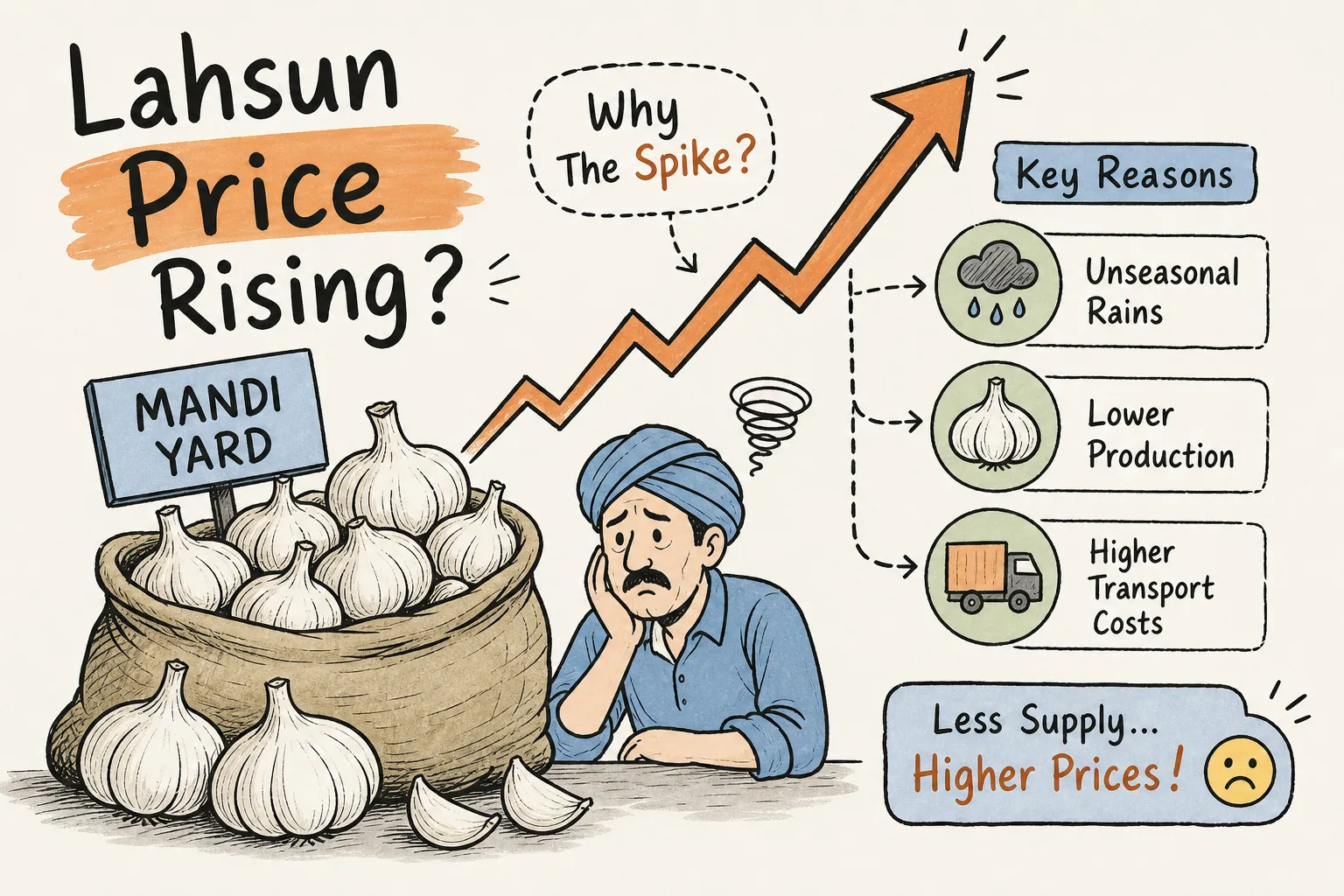
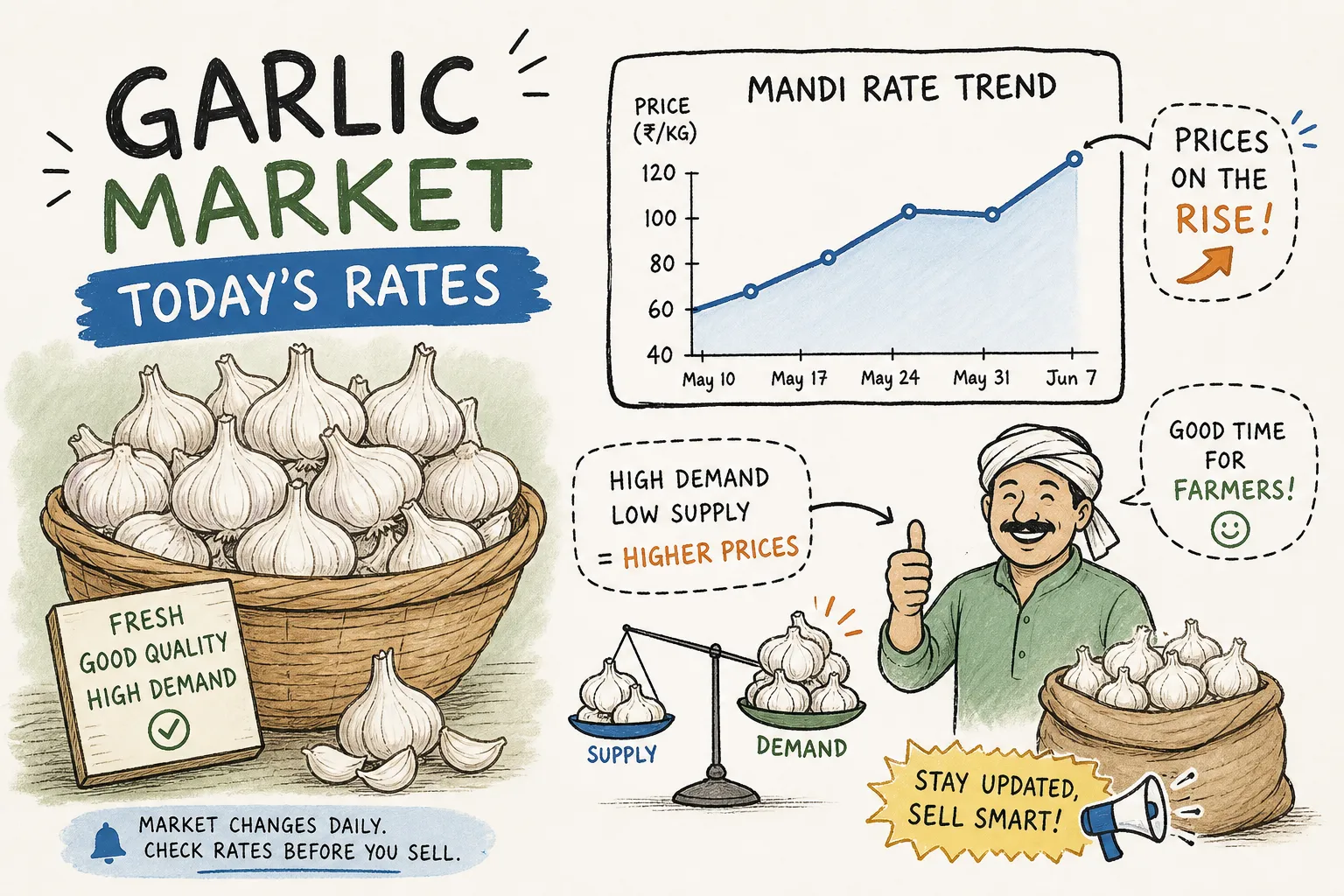
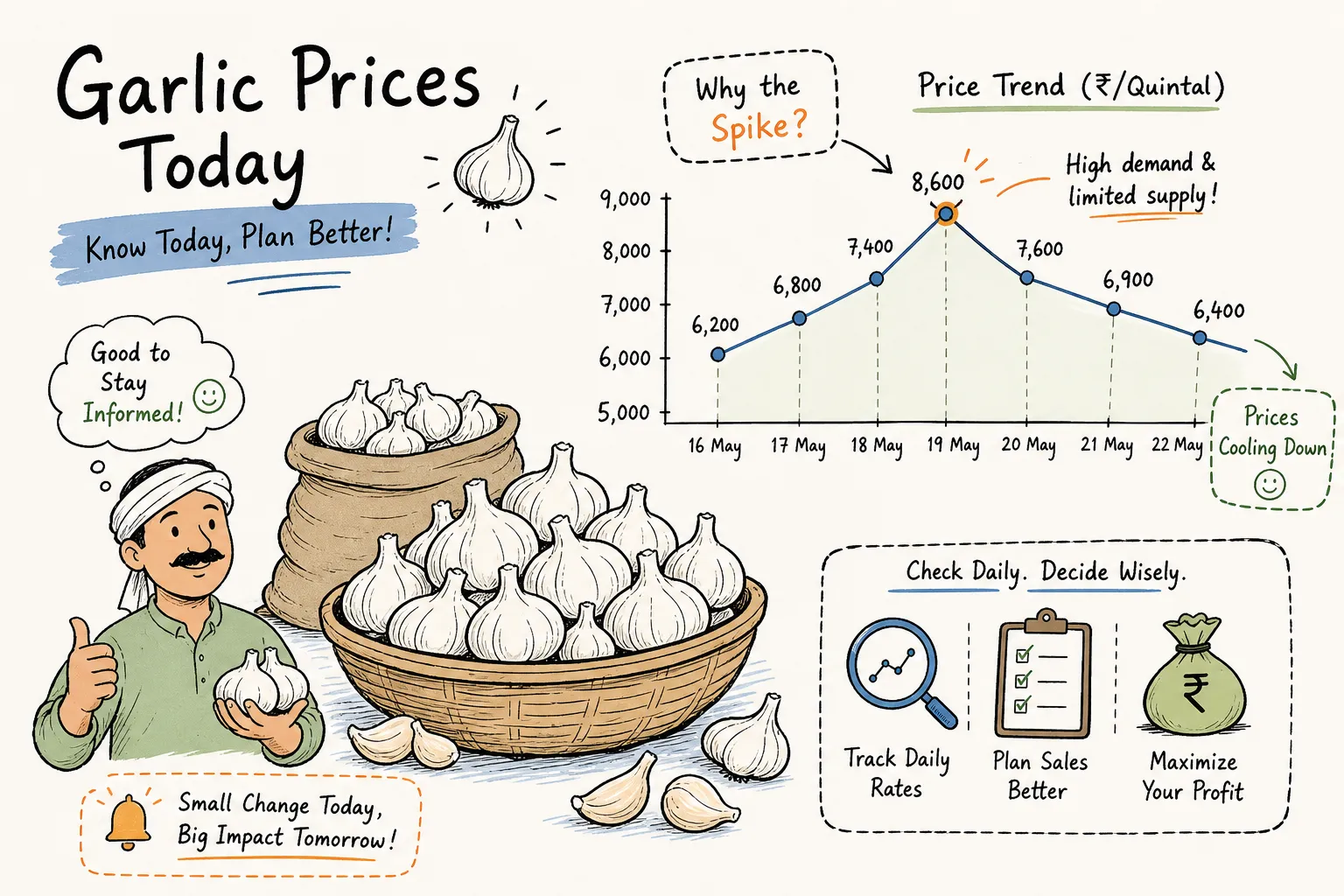
Seasonal arrivals are the single biggest short-term driver. When large volumes of freshly harvested lahsun hit mandis in March and April, prices typically fall because supply temporarily exceeds demand. Prices usually recover as peak arrivals subside and the market shifts to consuming stored stock. As of now, modal prices across approximately 228 reporting mandis ranged from around ₹5,000 per quintal in some Madhya Pradesh markets to over ₹20,000 per quintal in parts of Tamil Nadu, illustrating how wide the regional spread can be.
Export policy has an outsized effect on domestic prices. When the government imposes export restrictions or minimum export prices, more garlic stays inside India and domestic mandi rates soften. When export is encouraged or global demand is strong from buyers in South-East Asia and the Gulf, prices in producing-belt mandis in Madhya Pradesh and Rajasthan rise. Cold storage capacity also matters: limited or costly storage means farmers sell faster, adding to arrival pressure and keeping prices low. Farmers who are able to store and release stock strategically often obtain higher prices than those forced to sell into the harvest glut.
Tracking live lahsun mandi bhav before you sell
Before loading your garlic for the mandi, knowing the prevailing rate gives you a stronger negotiating position. KhetiKisaan publishes daily lahsun mandi bhav sourced from live APMC auction yards, with prices listed per quintal and updated through the active trading season. You can compare what different mandis are offering on the same day, which helps you decide whether to sell locally or transport your crop to a market with a better rate. This kind of price intelligence has always been available to arhatiyas, KhetiKisaan puts it directly in the farmer's hands, without any intermediary.
The clear picture: lahsun, garlic, and why both words matter
Lahsun in English is garlic. That answer does not change regardless of whether you spell it lahsun, lehsun, lasun, or lasan, the translation is consistent, and the English word "garlic" covers the same crop in all its forms: the whole bulb you sell at the mandi, the individual clove you peel in the kitchen, and the young green shoots you harvest early in the season.
The key distinctions covered in this article are worth keeping in mind. Poora lahsun is a garlic bulb. Lahsun ki kali is a clove of garlic. Lahsun patta is garlic greens or green garlic. And laung, the spice, is a completely separate ingredient from "a clove of garlic," even though the English word "clove" appears in both. For Indian farmers dealing with exporters, e-NAM listings, and APMC documentation, understanding these terms removes a real barrier to better market access.
The smarter approach to selling your lahsun fasal combines language knowledge with live market intelligence. Knowing what garlic is called in official documentation is one part of it. Knowing what price different mandis are paying on any given day is the other. Check live lahsun mandi bhav on KhetiKisaan before your next sale, knowing the current rate across multiple mandis gives you a concrete negotiating position every time you walk into the mandi.