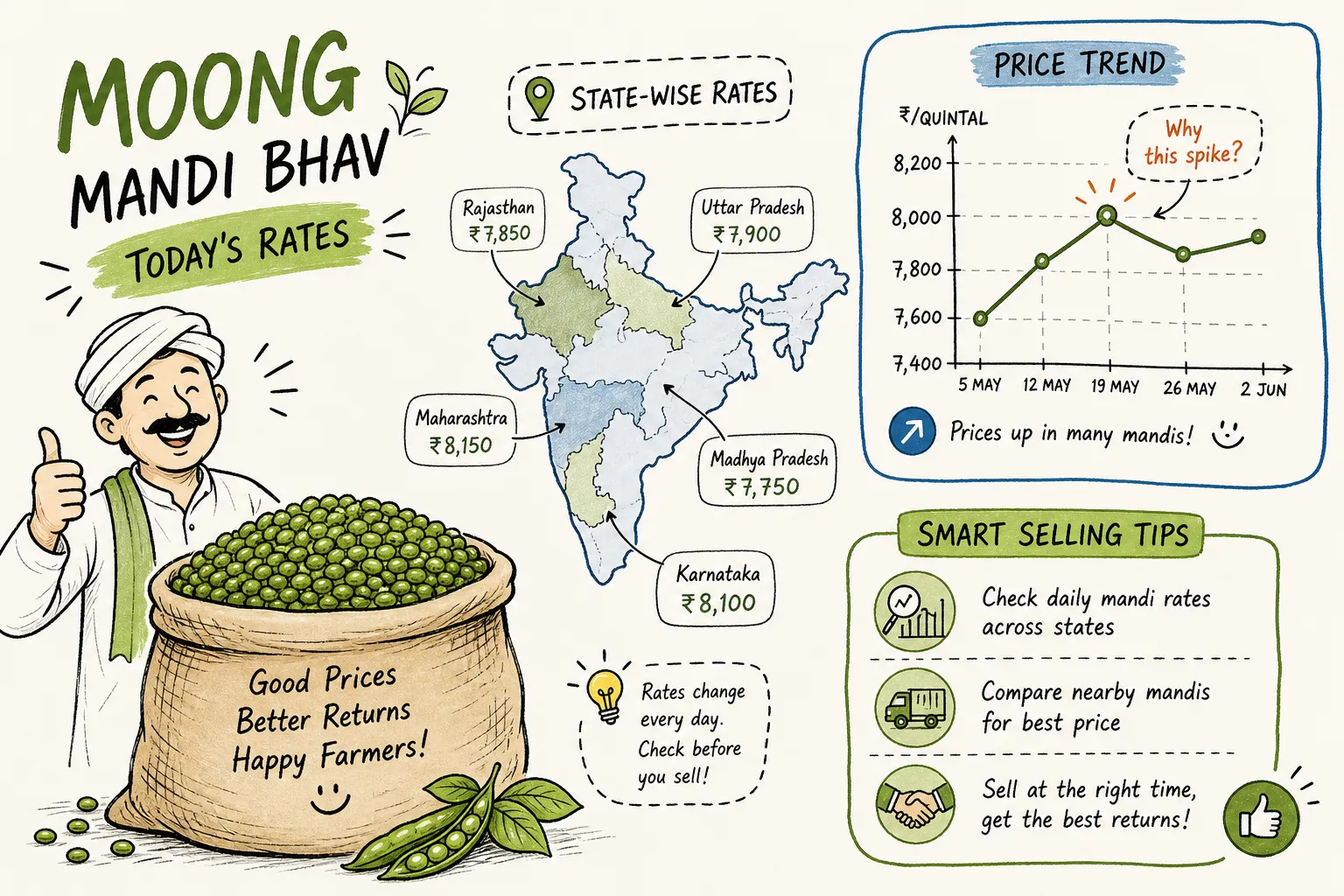






Dhaniya Mandi Bhav Today: Latest Coriander Prices
 Oct 03, 2026
 by Pankaj Sihag



Dhaniya Mandi Bhav Today: Latest Coriander Prices
| Quick Facts | Dhaniya (Coriander Seed Crop) |
|---|---|
| Crop type | Rabi (cool season) |
| Sowing window | October-end to first week of November |
| Average yield (rainfed) | 1.5, 2 quintals per acre |
| Average yield (irrigated) | 4, 5 quintals per acre |
| Major mandis in Rajasthan | Ramganj (Kota district), Kota APMC, Baran, Jhalawar |
| Current price range | ₹12,500, ₹16,000 per quintal (grade-dependent) |
| Ramganj Mandi latest bhav | ~₹14,020 per quintal |
| Kota APMC latest bhav | ~₹14,000 per quintal |
Every dhaniya grower in Rajasthan knows the frustration: you spend four months managing your fasal carefully, you harvest on time, and then you rush to the mandi because everyone else is rushing too. The result is that you sell at the season's lowest rate, watch prices climb steadily through June and July, and wonder what went wrong. Nothing went wrong with your crop. The problem was the timing of your sale.
Coriander mandi prices can vary by ₹1,500, ₹2,500 per quintal between peak-arrival season and off-season peaks. On a 10-quintal lot, that gap is ₹15,000, ₹25,000 in your pocket or out of it. This guide covers the full coriander crop calendar, realistic yield expectations for Rajasthan conditions, how prices move across the season in Ramganj and Kota, and a practical framework to help you pick the right day and the right mandi for your sabut dhaniya.
 Table of Contents
- Why dhaniya ki kheti remains one of Rajasthan's most profitable Rabi crops
- Dhaniya sowing season and the Rabi crop calendar
- Realistic yield expectations from your coriander fasal
- How dhaniya mandi bhav moves through the season
- Major Rajasthan mandis where coriander prices are set
- The right time to sell your dhaniya for maximum munafa
- Checking real-time dhaniya bhav before you go to mandi
- Conclusion
- FAQs
Why dhaniya ki kheti remains one of Rajasthan's most profitable Rabi crops
The demand side: domestic spice market and export pull
Rajasthan is India's single largest coriander-producing state, and Indian sabut dhaniya is the default supply source for spice processors, curry-powder manufacturers, and exporters across South-East Asia, the Middle East, and Europe. Domestic demand, from everything including hara dhaniya in household cooking to processed coriander powder in packaged spice blends, adds a layer of year-round offtake that keeps a price floor under the crop even in weak years.
Whole coriander seeds and dhaniya powder appear in virtually every spice blend made in India. This breadth of use means demand never collapses entirely, even if a bumper crop temporarily pressures mandi rates. The export channel, particularly orders from Bangladesh, Malaysia, and the UAE, can pull Ramganj prices sharply upward within a matter of days when overseas buyers enter the market in volume.
Why input costs remain relatively manageable
Coriander is a low-water crop well-suited to the dry conditions of Baran, Jhalawar, and Kota districts. It fits naturally into the rotation after kharif crops, making use of residual soil moisture and reducing the need for intensive pre-sowing irrigation. Input costs per acre, covering seed, fertiliser, and one or two supplemental irrigations, are typically lower in intensity than for wheat or sarso, which makes the net margin per quintal more attractive when market timing is handled correctly.
The price volatility problem every grower faces
The flip side of this profitability is sharp price volatility. Coriander prices move with arrivals, export sentiment, monsoon expectations, and trader stock levels. Farmers who sell at harvest because they need cash after input costs often capture the weakest rates of the year. Understanding why prices move the way they do is the first step toward making a better decision about when to sell.
Dhaniya sowing season and the Rabi crop calendar
When to sow for optimal yield and market timing
Dhaniya thrives in cool, dry conditions. In Rajasthan, the sowing window runs from mid-October through to mid-November, but the sweet spot for most districts is October-end to the first week of November. Sowing too early risks aphid and bollworm pressure while temperatures are still warm; sowing too late shortens the vegetative phase, reduces branching, and ultimately cuts seed yield. Sow in October, November and apply the first irrigation immediately after sowing. The second critical irrigation falls at the flowering stage in December, January.
Soil preparation, seed rate, and key varieties
Loamy to sandy-loam soils with good drainage suit coriander well. Waterlogging at any stage is damaging, so avoid fields with poor drainage, particularly in heavier soils. For mandi premium, variety choice matters significantly. Bold-seeded varieties fetch better rates at Ramganj and Kota because spice processors and exporters prefer larger, greenish seed.
- RCr-41: The most widely grown commercial variety in Rajasthan; large, bold seeds, good essential-oil content, matures in 110, 120 days, and carries some stem-gall resistance.
- RCr-435: Bushy, erect plants with bold seeds; moderately resistant to root-knot and powdery mildew; well-suited to irrigated fields in central and eastern Rajasthan.
- RCr-436: Earlier at 90, 100 days, bold-seeded, and specifically adapted to heavy Rajasthan soils under dryland or moisture-limited conditions.
- Gujarat Coriander-2: High-yielding with large umbels and bold seed; best suited to fields with assured irrigation and good soil fertility.
- Pratap Raj Dhaniya-1 (RKD-18): A Rajasthan-specific variety notified in 2015 as a high-yielding option; worth trialling alongside RCr-41 before committing full acreage.
Seed rate for broadcast sowing is often in the range of 12, 15 kg per acre in many districts, confirm the recommendation with your local KVK before the season. Always use certified seed from a reliable source: it reduces disease pressure, particularly stem gall.
From field to mandi: the crop timeline
Most varieties reach maturity between 110 and 130 days, placing harvest in February, March. After threshing and proper drying, the bulk of dhaniya arrivals reach Rajasthan mandis between March and April. This timing directly shapes the price cycle, and understanding it tells you when to sell and when to hold.
Realistic yield expectations from your coriander fasal
Average yield range per acre under normal conditions
Under rainfed conditions, a well-managed dhaniya crop in Rajasthan typically yields 1.5, 2 quintals per acre. With one or two supplemental irrigations at the right growth stages, yield climbs to 4, 5 quintals per acre. Top-performing varieties like Gujarat Coriander-2 under good irrigation and soil fertility can approach 6 quintals per acre. These are realistic targets for seed production; yields below 1.5 quintals per acre usually signal disease pressure, late sowing, or drought stress at flowering.
Factors that push yield higher or pull it down
The two biggest yield killers in Rajasthan's coriander belt are stem gall disease and late January frosts. Stem gall can cause significant yield loss in severe cases; the most practical protection is using resistant varieties like RCr-41 and sourcing certified seed. For frost, there is no intervention once it hits, but sowing at the right time reduces the window of vulnerability.
On the positive side, the single most effective yield booster is timing the irrigation at flowering precisely. One well-timed watering at the flowering stage, combined with a balanced NPK application before sowing, often gives a large yield response, separating lower-performing rainfed fields from well-managed irrigated ones. Do not skip the flowering irrigation to save cost; the yield response more than pays for itself at current mandi rates.
How yield volume affects your mandi bargaining position
Farmers arriving at the mandi with 5 or more quintals of clean, dried coriander have genuine negotiating leverage. They can discuss grade, bag weight, and sometimes payment timing with commission agents. Smaller lots of 1, 2 quintals typically go at whatever rate the arhatiya offers. If you are a small holder with limited acreage, coordinate with two or three neighbouring kisaans to bring a pooled lot to the mandi together. A combined 6, 8 quintal lot negotiates far better than three separate 2-quintal arrivals on the same day.
How dhaniya mandi bhav moves through the season
The harvest-arrival crash: why March, April rates are usually the lowest
When all farmers harvest at roughly the same time and bring produce to mandi simultaneously, supply spikes and prices fall. This is basic supply and demand, and it is entirely predictable. March and April are the weakest months for coriander prices across Rajasthan. Historical data from Ramganj indicates that rates during peak arrival season can be ₹1,500, ₹2,500 per quintal below their off-season levels. This is precisely when most farmers sell, because harvest costs create immediate cash pressure.
The post-arrival recovery: May onwards price behaviour
Once new-crop arrivals taper off from May, June onwards, processor and trader stocks begin drawing down and prices firm up. A historical example from Ramganj Mandi illustrates the pattern: coriander traded at roughly ₹6,000 per quintal in March 2015, climbed to ₹12,700 by May, and held around ₹12,000 through October of that year. The July, September window is typically when arrivals fall below 6,000 quintals per month at Ramganj, and reduced supply supports firm to rising rates. By September, Ramganj prices ranged from ₹12,500 to ₹16,000 per quintal by grade, with a modal price near ₹13,700 per quintal.
Export demand and how it creates sudden price spikes
A strong export order cycle from Bangladesh, Malaysia, or the UAE can push Ramganj prices up sharply within days. Exporters booking stock ahead of festive seasons, combined with limited domestic arrivals, create a situation where buyers compete for available inventory. Unseasonal rain during harvest, which damages seed quality and disrupts transport, has the same short-term effect. Farmers who are monitoring the market during these events can capture ₹500, ₹1,000 per quintal above the prevailing rate simply by knowing when to release their stored stock.
Major Rajasthan mandis where coriander prices are set
Ramganj Mandi: India's largest coriander trading hub
Ramganj Mandi in Kota district is the single most important dhaniya trading centre in India. Rates set here during the daily bol-chaal (live auction) are referenced by traders, exporters, and spice processors across the country. If Ramganj prices move, every other coriander market in India takes notice within hours. The daily auction typically runs in the morning, with arrivals from the surrounding Hadoti region forming the bulk of traded volume during the March, May peak season.
Understanding Ramganj's role is critical for every kisaan in the coriander belt. The commission agents (arhatiyas) operating there have established relationships with large processors and export buyers. This is advantageous for price discovery but can work against an uninformed farmer who arrives without knowing the day's going rate. Knowing the Ramganj bhav before you arrive at any mandi gives you a benchmark against which to measure every offer you receive.
Kota APMC and surrounding district mandis
Kota APMC sees active coriander trading through the March, May arrival season and tracks Ramganj closely. As of 23 September 2026, Kota APMC was quoting approximately ₹14,000 per quintal, essentially in line with Ramganj's ₹14,020. Day-to-day, prices between Ramganj and Kota can differ by ₹100, ₹300 per quintal depending on daily arrivals and buyer presence. The mandis in Baran and Jhalawar also see substantial volumes; Baran in particular draws growers from the southern parts of the district, so check transport costs carefully before deciding which market to target.
Grade and quality standards that determine your price
At Rajasthan mandis, coriander seeds are graded informally by seed size, colour, cleanliness, and moisture. The premium grade, commonly called "Parrot Green" or "Indori," consists of bold, greenish, clean seeds and commands the highest rates. The "Eagle" or FAQ grade is brownish-gold and fairly uniform. Darker or mixed-grade "Badami" lots trade at a discount. Proper drying to below 10% moisture and cleaning before bringing produce to mandi can add a meaningful premium to your final realisation, many experienced growers report gains of ₹100, ₹300 per quintal, though the exact amount varies by grade and season. This is low-effort value addition that every farmer can do before loading the trolley.
The right time to sell your dhaniya for maximum munafa
Avoid the harvest rush: the case for holding at least 4, 6 weeks
The single most profitable decision most coriander farmers can make is not selling at harvest peak. If you have storage, hold cleaned and dried coriander seeds in jute bags in a cool, dry space for a minimum of 4, 6 weeks after the March, April harvest rush. Historical patterns from Ramganj indicate that rates 6, 8 weeks after peak arrivals are often ₹1,000, ₹2,000 per quintal higher than harvest-time lows. On a 4-quintal lot at ₹1,500 per quintal difference, that is ₹6,000 of additional munafa for the cost of storage time.
The May, June window and the festive demand cycle
Two windows historically show stronger coriander mandi prices: the post-arrival May, June price recovery, and the August, October period ahead of festive and export demand. Spice companies plan their Diwali-season stock purchases between August and October, creating buying pressure that lifts rates. If your storage conditions are good, targeting either of these windows is worth the wait. The risk of holding beyond 8, 10 months is moisture absorption, aroma loss, and a potential price reversal if the next season's crop looks like a bumper. Reassess your holding decision every four weeks against current market rates.
Holding vs. selling: a simple decision framework for farmers
Use these three questions before deciding to sell or hold your dhaniya stock:
- Is the current mandi bhav above your break-even cost per quintal by a meaningful margin? As a rough guide, at least ₹500, ₹700 above total input and transport cost is a reasonable starting threshold, though your actual break-even will depend on your specific input expenses.
- Do you have clean, dry storage for at least four more weeks without risk of moisture or pest damage?
- Is the next crop's outlook showing signs of a bumper season, which would push future prices downward?
If the answer is yes to the first two questions and no to the third, holding makes sense. If storage is a problem or your break-even is already covered by a comfortable margin, sell now and move on. Do not hold on hope alone; hold on logic and market data.
Checking real-time dhaniya bhav before you go to mandi
Why relying on your commission agent's word is risky
Commission agents earn their income on the margin between what they pay the farmer and what they recover from the buyer. Arriving at the mandi without knowing the day's going rate puts you in the weakest possible negotiating position. Even a difference of ₹200 per quintal on a 5-quintal lot is ₹1,000 that transfers from your pocket to the arhatiya's. On a 10-quintal lot at ₹500 per quintal below market, that is ₹5,000 lost in a single transaction. The solution is straightforward: know the day's bhav before you load your trolley.
How KhetiKisaan gives you ground-level price intelligence
This is where having a reliable price reference before you leave home changes the equation entirely. KhetiKisaan tracks live dhaniya mandi bhav from Ramganj, Kota, and other major APMC centres through a network of on-ground contacts who are physically present at live auctions during the bol-chaal. This is not delayed government-feed data or estimated averages: it reflects actual transaction rates from that day's auction. Before heading to the mandi, you can check which market has the stronger rate, giving you a genuine negotiation position when you sit across from the commission agent. The platform also shows price movement over time, so you can see at a glance whether rates are rising, falling, or holding steady before you make a hold-or-sell call.
Unlike many agritech platforms built for urban audiences, KhetiKisaan communicates in the vocabulary that actually matters to a Rajasthan coriander grower: local mandi names, prices per quintal, and grade-level distinctions. Checking the KhetiKisaan platform the evening before your mandi trip takes two minutes and can shift the opening negotiation in your favour.
Practical steps to use mandi price data effectively
- Check coriander mandi prices on KhetiKisaan the evening before or the morning of your planned mandi trip. Note the rate at Ramganj and Kota for your grade.
- Compare rates across at least two nearby mandis. If transport cost to Ramganj versus your local mandi is ₹150 per quintal, and Ramganj is quoting ₹300 higher, the trip pays. Do the arithmetic before loading.
- Use that day's published rate as your opening position with the commission agent. If the day's Ramganj bhav is ₹14,000 per quintal and the arhatiya opens at ₹13,600, you have a factual basis to push back. You are not guessing; you are quoting verified data.
Conclusion
Whether you are sowing for the first time or refining your marketing strategy after years in the trade, the fundamentals of dhaniya farming reward preparation over instinct. Choose the right variety for your soil and water conditions, time your irrigations carefully, and resist the urge to sell into the harvest rush. Most importantly, know the price before you go to the mandi. Use KhetiKisaan to check today's dhaniya mandi bhav and enter every bol-chaal with the information you need to negotiate from a position of strength.
FAQs
Related Blogs
Sep 28, 2026
by Pankaj Sihag
Sep 28, 2026
by Pankaj Sihag
Sep 28, 2026
by Pankaj Sihag
Sep 23, 2026
by Pankaj Sihag