





Store wheat after rabi harvest or sell it right away?

 Aug 27, 2026
 by Pankaj Sihag



Store wheat after rabi harvest or sell it right away?
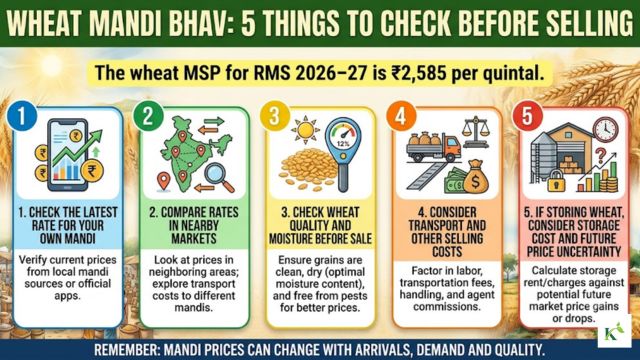
The moment gehun (wheat) arrives at the threshing floor, the pressure begins. Buyers are calling, the mandi is buzzing, and you are staring at a storage shed that may or may not be ready. Should you store wheat after the rabi harvest or sell immediately? This is one of the most financially significant calls a kisaan makes each year. Get it right and you capture an extra ₹100, ₹200 per quintal. Get it wrong and you lose money to spoilage, interest costs, or a price that never recovered. The good news: this decision does not have to be a gut call. It comes down to three hard numbers, your current mandi bhav, the MSP floor, and your monthly storage cost.
Platforms like KhetiKisaan are used by farmers across Rajasthan, Haryana, and Punjab to pull live APMC auction rates before deciding which route to take. Real data beats guesswork.
| Quick Fact | Detail |
|---|---|
| Wheat MSP (Rabi 2025-26) | ₹2,425 per quintal |
| Wheat MSP (Rabi 2026-27) | ₹2,585 per quintal |
| Current mandi range (North India) | ₹2,425, ₹2,750 per quintal |
| Government procurement window (RMS) | 1 April to 30 June (extensions possible) |
| Safe storage moisture threshold | 12, 13% |
| Typical lean-season price recovery | October to February |
 Table of Contents
- Should you store wheat or sell immediately after the rabi harvest?
- Strong reasons to sell wheat immediately at the mandi
- When storing wheat after rabi harvest actually pays off
- Calculating your break-even storage cost
- How live mandi bhav data helps you time your wheat sale
- Should you store wheat after rabi harvest or sell immediately? The bottom line
- FAQs
Should you store wheat or sell immediately after the rabi harvest?
Both choices carry genuine risk, and that is where most advice falls short. It either tells you to always sell quickly or always hold for better prices. The reality is more nuanced. Selling too early means leaving money on the table in a year when the lean-season recovery is strong. Holding too long means grain quality losses that cut your effective price worse than any market dip.
The MSP floor price: what it protects and what it does not
The MSP is the minimum price at which government agencies commit to buy your wheat. It is not a guaranteed open-market price. For Rabi 2026-27, the wheat MSP is ₹2,585 per quintal, a jump of ₹160 over the previous season. When open-market mandi bhav falls below that level, FCI and state agencies like Rajfed, HAFED, and NCCF step in to procure through designated mandis. The critical catch: the procurement window runs only from 1 April to 30 June, with occasional extensions. Miss that window and the MSP safety net disappears entirely, leaving you fully exposed to whatever the open market offers.
How seasonal gehun prices move after harvest
There is a well-established inverse relationship between wheat arrivals and mandi prices. March to June sees the heaviest arrivals and the weakest rates. Mandis like Sri Ganganagar show peak arrival indices right after harvest, with price indices consistently below the seasonal average during those months. From October onwards, as supply tapers and stocking demand rises, prices typically firm up. However, this pattern is not guaranteed every year. Government open-market sales from FCI buffer stocks, changes in import policy, and carry-over stock levels can all flatten or delay the lean-season recovery. Assuming the recovery will arrive is a risk in itself.
Strong reasons to sell wheat immediately at the mandi
The case for selling right away is stronger than many farmers acknowledge. Holding grain is not a passive act, it costs money, time, and carries quality risk every day.
When to sell immediately after rabi harvest: the RMS window
In Rajasthan, the 2026 RMS procurement ran from 10 March to 30 June. Farmers who registered on the state food department portal and delivered FAQ (Fair Average Quality) wheat to designated centres received ₹2,585 per quintal directly into their Jan Aadhaar-linked bank accounts. Farmers who waited beyond the window lost that assured buyer entirely. If your mandi bhav is already at or near MSP, there is very little upside to holding grain in pursuit of a higher rate, especially when a guaranteed buyer exists right now with no quality risk attached.
Moisture and quality losses can erase your price advantage
Fresh wheat at harvest typically carries 14, 16% moisture (as per ICAR and FCI guidance), which is already above the safe storage threshold of 12, 13%. Grain stored above 15% moisture without active drying enters the spoilage zone quickly, particularly as post-harvest temperatures climb through April and May. Insect infestation, mould growth, and lustre loss are not just quality problems, they directly reduce the price buyers will pay. FCI procurement centres reject grain above 14% moisture outright. A farmer who expects stored wheat to fetch ₹150 more per quintal but loses ₹80 per quintal to quality cuts and spoilage has gained nothing.
When storing wheat after rabi harvest actually pays off
Storage does pay, under the right conditions. Seasonal data from North Indian mandis, including Sri Ganganagar and Sirsa, consistently shows that wheat price indices move above the seasonal average between October and February. The question is not whether the lean-season recovery exists; it is whether your specific situation allows you to capture it profitably.
The lean-season price recovery: what the data shows
In normal years, the gap between peak-harvest mandi rates (April, June) and lean-season rates (October, February) has historically ranged from ₹100 to ₹200 per quintal across North Indian markets. That recovery premium is the maximum available to a farmer who stores wheat through the harvest glut. But that ₹100, ₹200 gap is the gross opportunity, before you subtract storage charges, interest on tied-up capital, and any quality losses. Your net gain after all those deductions is what actually matters.
Conditions that make on-farm storage a sound choice
Storage works in your favour when several conditions line up together:
- Your grain moisture is at or below 13%.
- You have clean, pest-free storage, a pucca godown or sealed bins, not open or poorly maintained gunny bag stacks.
- You are not under immediate cash pressure that would force a distress sale.
- The current mandi bhav is visibly below the seasonal average, meaning there is real room for a recovery to develop.
Farmers with access to a CWC-registered warehouse get the additional advantage of a negotiable warehouse receipt, which most banks and cooperative credit societies accept as collateral for a short-term kisan loan.
Calculating your break-even storage cost
This is where the decision becomes concrete. You do not need to guess whether storage will be profitable. You can calculate the minimum price rise required to cover your costs.
What different storage options cost per quintal per month
The three main options come with different cost profiles:
- Gunny bags, on-farm: Roughly ₹9, ₹17 per quintal per month in basic storage charges. Add interest on tied-up capital at your applicable Kisan Credit Card rate (currently variable; check the latest KCC terms with your bank or cooperative) and the all-in cost rises meaningfully.
- CWC or state warehouse (hired): Around ₹10, ₹22 per quintal per month, based on the CWC published charge of approximately ₹10.20 per quintal per month for 2024-25 (verify current rates with your nearest CWC branch). The key advantage here is the warehouse receipt, which lets you access credit without selling.
- On-farm silo or sealed bin: Higher upfront capital cost, but lower running cost per month over time. Best suited for farmers with regular large-volume storage needs across multiple seasons.
The break-even formula: how many rupees does the price need to rise?
The calculation is straightforward. Use this formula before you make any storage decision:
Minimum required price rise = (Monthly storage cost × months held) + interest cost + estimated quality loss
For example: if your all-in storage cost is ₹25 per quintal per month and you plan to hold for four months, you need the mandi rate to rise by at least ₹100 per quintal just to break even. Any recovery above that figure is your actual munafa (profit). If you hold in a CWC warehouse at ₹13 per quintal per month over five months, your break-even rises to ₹65 per quintal, still very achievable if the lean-season recovery delivers. Run this number against today's mandi bhav and your estimate of where prices will go. If the gap looks marginal, sell. If there is clear headroom, storage makes sense.
How live mandi bhav data helps you time your wheat sale
Knowing your break-even number is only half the job. The other half is knowing exactly what buyers are paying right now, not last week, not the monthly average, but today's actual auction rate at your nearest APMC yard.
Why real-time APMC auction rates matter more than weekly averages
A weekly or monthly price average smooths out the very peaks that storage is designed to capture. The lean-season recovery does not arrive on a fixed calendar date, it arrives when arrivals drop and stocking buyers step in. What you need is the live bol-chaal (bidding) rate at your nearest mandi this morning. Compare that number against your break-even threshold and you have a clear, data-driven answer: load the tractor or hold back.
How KhetiKisaan tracks live wheat rates across mandis
KhetiKisaan sources mandi bhav directly from on-ground contacts physically present at live APMC auctions in Sri Ganganagar, Nohar, and other major wheat-trading centres across Rajasthan, Haryana, and Punjab. These are actual transaction rates from the bol-chaal session, not delayed government data feeds or estimated averages. A farmer holding stored wheat can check today's rate, compare it against their calculated break-even price, and make a call the same morning before the auction closes. The platform also tracks MSP procurement news and mandi-wise arrival data, giving a clearer picture of whether the seasonal price recovery has actually arrived or is still weeks away.
Should you store wheat after rabi harvest or sell immediately? The bottom line
Both options can be right, it depends entirely on your specific numbers. Store wheat after the rabi harvest if your grain is dry and clean at 12, 13% moisture, your calculated break-even leaves meaningful headroom against a likely price recovery, and you are not under immediate cash pressure. Sell promptly at MSP or the open-market rate if your moisture levels are high, your storage conditions are poor, or the RMS procurement window is about to close and your mandi bhav is already near MSP. A guaranteed rate today is almost always better than chasing a higher one on uncertain terms.
Use the break-even formula above as your starting point. Then check today's live wheat mandi bhav on KhetiKisaan before you make the final call. The platform shows real auction rates from APMC yards across Sri Ganganagar, Nohar, and other North Indian centres, so you can compare your break-even price against what buyers are actually paying this morning.
Check today's wheat mandi bhav across North Indian APMC yards on KhetiKisaan before the morning auction closes. Knowing the current rate takes just a few moments and could be worth hundreds of rupees per quintal.