





How to Grow Isabgol in Rajasthan for Maximum Yield
 Sep 09, 2026
 by Pankaj Sihag



How to Grow Isabgol in Rajasthan for Maximum Yield
Learning how to grow isabgol crop in Rajasthan for maximum yield is one of the most valuable agronomic decisions a rabi-season farmer can make. Isabgol (psyllium husk, botanically Plantago ovata) is among the most profitable winter crops available in the state. Kisaans who ask us at KhetiKisaan about high-value winter alternatives consistently return to isabgol, and for good reason. Rajasthan produces over 80% of India's total isabgol output. Demand from pharmaceutical and food export markets remains steady year after year. And the crop fits Rajasthan's agro-climate like few others do.
This guide covers everything you need to plan and execute isabgol crop cultivation in Rajasthan that delivers maximum yield: variety selection, soil preparation, sowing dates and seed rates, fertiliser schedules, irrigation timing, pest and disease management, and finally, how to harvest at the right moment and sell at the best mandi rate. Follow this end-to-end, and you will understand exactly why some farmers consistently pull 7, 8 quintals per acre while others struggle to cross 5.
| Crop type | Rabi (winter) medicinal crop |
|---|---|
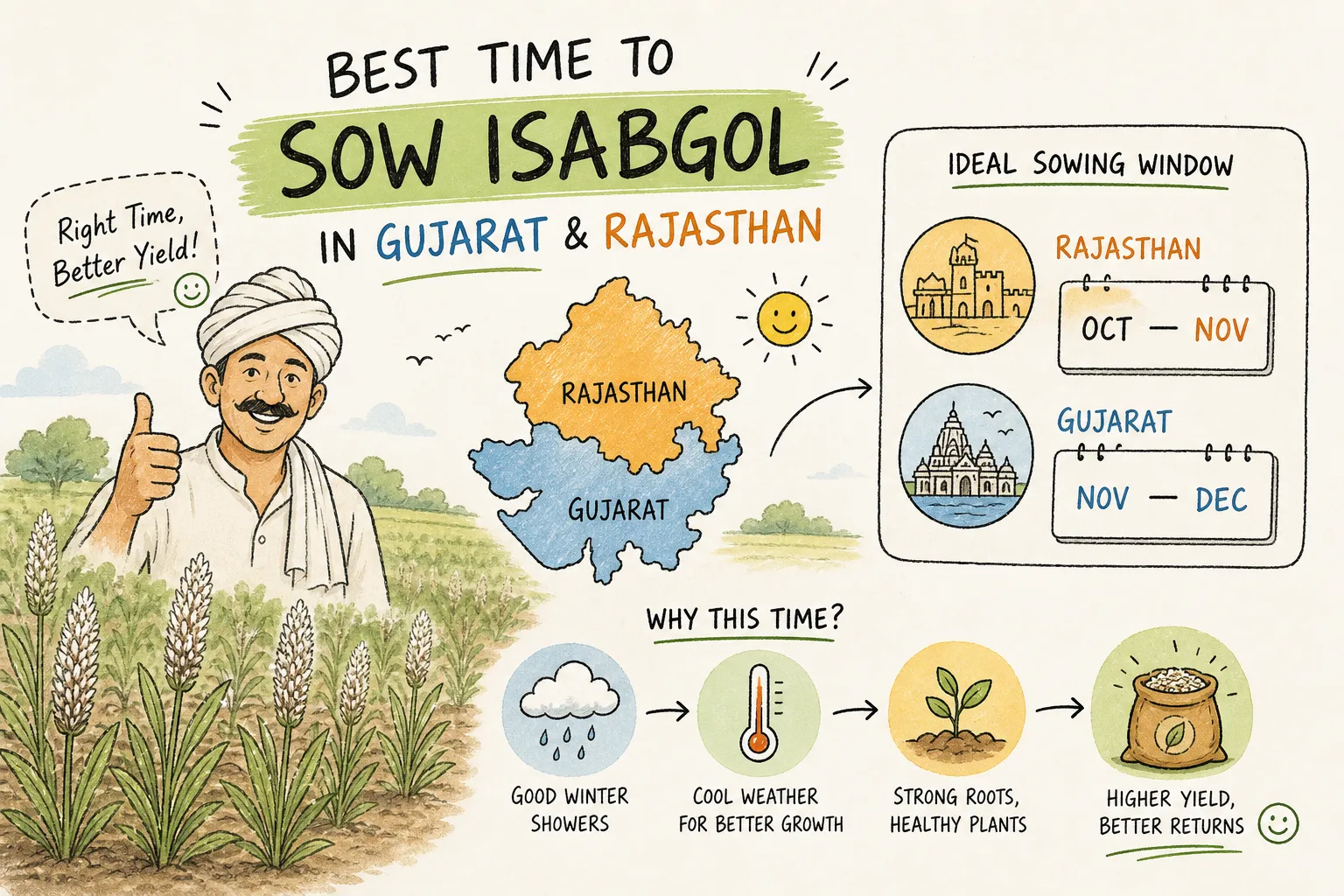
| Sowing window | First half of November (Rajasthan) |
| Harvest time | February to March |
| Average yield (good management) | 6, 8 quintals per acre |
| Water requirement | Low (7, 10 light irrigations per season) |
| Key disease risk | Downy mildew |
| Input cost (per acre) | Approx. ₹14,000, ₹16,200 |
| Net profit potential (per acre) | Approx. ₹44,500, ₹64,700 |
 Table of Contents
- Why Rajasthan is India's isabgol heartland
- How to Grow Isabgol Crop in Rajasthan: Choosing the Right Variety
- Soil Preparation: Getting Your Zameen Ready for Isabgol
- How to Grow Isabgol Crop in Rajasthan, Sowing Calendar and Seed Rate
- How to Grow Isabgol Crop in Rajasthan, Fertiliser and Irrigation Management
- Pest and disease management: protecting your isabgol from its biggest threats
- Harvesting, expected isabgol yield per acre, and selling at the right price
- FAQs
Why Rajasthan is India's isabgol heartland
Rajasthan's dry, cool winters are almost tailor-made for psyllium farming. The vegetative stage needs temperatures between 15°C and 25°C, which the state delivers reliably from November through January. Cool nights during grain filling improve husk content, and critically, low humidity at harvest time prevents post-maturity mould and protects the white colour of the bhusi (husk), which buyers pay a premium for.
In humid states, downy mildew pressure is far harder to manage and post-harvest drying becomes a serious problem. Rajasthan's dry winter air is not merely a convenience, it is a fundamental quality advantage that no agronomic input can substitute. This is why isabgol cultivation has concentrated here naturally over decades.
Key isabgol-growing districts in Rajasthan
The core production belt covers Jalore, Barmer, Pali, Nagaur, Churu, and parts of Sirohi. Jalore alone accounts for a significant share of state production. Each district has slightly different optimal sowing windows tied to local weather, which the sowing calendar section below covers in detail. If your field is in any of these districts, you are growing in the right place. The task now is to get the agronomy right.
How to Grow Isabgol Crop in Rajasthan: Choosing the Right Variety
RI 1: the benchmark variety for Rajasthan
RI 1 is the most recommended isabgol variety for arid and semi-arid Rajasthan. It carries moderate resistance to downy mildew, the single biggest disease risk for this crop, and produces seed yields of 12, 16 quintals per hectare (roughly 5, 6.5 q/acre) under good management. It suits the sandy loam soils common across Rajasthan's production belt.
Disease tolerance is the decisive advantage here, not the yield number alone. A variety that delivers 14 q/ha without succumbing to mildew is more valuable than one claiming 16 q/ha potential but requiring constant fungicide applications to stay clean. For most Rajasthan farmers, RI 1 is the safest and most consistent choice.
GI-2 and GI-1: Gujarat varieties that work in Rajasthan
Gujarat Isabgol-2 (GI-2) offers a yield potential of around 10 q/ha and is widely grown across Rajasthan's production belt. GI-1 yields 8, 9 q/ha and suits areas with marginally better soil moisture. Both varieties are productive, but they require tighter disease monitoring compared to RI 1, especially during cool, humid spells in December and January.
Variety comparison at a glance
| Variety | Seed yield (q/ha) | Downy mildew tolerance |
|---|---|---|
| RI 1 | 12, 16 | Moderate (best among common varieties) |
| GI-2 | 10 | Low to moderate |
| GI-1 | 8, 9 | Low to moderate |
Soil Preparation: Getting Your Zameen Ready for Isabgol
What type of soil isabgol actually needs
Isabgol grows best in well-drained, light sandy loam soil with a pH of 7.0 to 8.0. It does not tolerate waterlogging or heavy clay soils under any circumstances. The slightly alkaline soils common across Rajasthan's semi-arid belt are naturally suitable, provided drainage is adequate. Poor drainage is the fastest route to germination failure and root rot, even in otherwise ideal conditions.
How to prepare a fine, clod-free seedbed
Start with two cross-ploughings, follow with a planking pass to break clods, and finish with a final levelling before sowing. This sequence matters because isabgol seed is extremely small. Broadcasting, mixing seed with sand before spreading, is simpler but produces an uneven stand. Uneven or cloddy soil causes patchy germination, which no amount of fertiliser or irrigation can later compensate for. The seedbed must be as fine and level as possible; this single preparation step has an outsized effect on final plant stand and isabgol yield per hectare.
FYM and pre-sowing soil amendments
Incorporate 10, 15 tonnes of well-decomposed FYM (gobar khad) per hectare during the last ploughing. This improves soil structure, water retention in sandy soils, and microbial activity. Zinc deficiency has been documented across many North Rajasthan districts; where it is present, apply zinc sulphate at the rate indicated by a soil test. A pre-sowing soil test costs very little and saves you from applying inputs your soil does not need.
How to Grow Isabgol Crop in Rajasthan, Sowing Calendar and Seed Rate
Timing is everything with isabgol. Sow too early and you raise downy mildew risk significantly. Sow past 20 November and yield drops because the crop misses the optimal cool vegetative period. The first two weeks of November are the sweet spot for most of Rajasthan.
| District / Zone | Recommended sowing window |
|---|---|
| Jalore | 1, 30 November (first half preferred) |
| Churu | 1, 15 November |
| Nagaur / Pali | First week of November (optimal) |
| Sub-Humid Southern Plains / Aravalli Zone | Around 5 November (experimentally confirmed) |
| Sandy soils (Jobner belt) | Last week of October to first two weeks of November |
Seed rate and spacing: the numbers that matter
Field trials at Jobner, Rajasthan, confirmed that 8 kg seed per hectare with 25 cm row spacing delivers the highest seed yield, best net returns, and highest benefit-to-cost ratio. For per-acre reference, that is approximately 3.2 kg seed per acre. The 25 cm spacing was at par with 20 cm and 30 cm treatments but recorded the top yield, making it the practical recommendation for isabgol cultivation in Rajasthan.
Line sowing in rows gives better plant stand uniformity, easier irrigation management, and cleaner weeding compared to broadcasting. For farmers willing to put in a little extra effort at sowing, row sowing consistently pays off at harvest.
Sowing depth and post-sowing irrigation
Cover seed with a very thin layer of soil, 1 to 1.5 cm maximum. Deep sowing causes uneven emergence because the seed is too light to push through heavy soil cover. Follow immediately with a light irrigation (paleva) to ensure good soil-seed contact and uniform germination across the field.
How to Grow Isabgol Crop in Rajasthan, Fertiliser and Irrigation Management
The right NPK dose for Rajasthan's isabgol fields
The state extension-level recommendation for Rajasthan is 50 kg N + 25 kg P₂O₅ + 30 kg K₂O per hectare. For per-acre application, that works out to approximately 20 kg N + 10 kg P₂O₅ + 12 kg K₂O per acre. Apply phosphorus and potassium as a basal dose at sowing, mixed into the seedbed during final field preparation, so they are available from the moment roots begin to develop.
How to split nitrogen for maximum uptake
Apply half the nitrogen dose at sowing as basal. Top-dress the remaining half approximately 30 days after sowing, when the plant is actively tillering and can use the nutrient efficiently. Applying all nitrogen at once at sowing wastes the nutrient and risks salt stress on small seedlings. This split-application schedule is backed by Rajasthan-specific trials and is straightforward to implement on any farm size.
Micronutrient notes: when zinc makes a difference
In zinc-deficient soils, which are common across many North Rajasthan districts, applying zinc sulphate at sowing can measurably improve yield. The trigger for zinc application should always be a soil test result, not a blanket seasonal decision. Over-application of any micronutrient without testing is money spent without a return, and isabgol's profitability depends on keeping input costs lean.
How many irrigations isabgol actually needs
Isabgol requires only 7, 10 light irrigations across the entire season. This is far less than wheat or mustard, making it particularly attractive for water-scarce areas of Rajasthan. The emphasis is on "light", heavy irrigation or waterlogging after establishment damages the crop and creates conditions for root diseases and downy mildew to take hold.
Timing the critical irrigation stages
- At sowing: light paleva immediately after sowing to ensure soil-seed contact.
- 3 weeks after sowing: second light irrigation to support early establishment and root development.
- At spike (kali) formation: third irrigation, this is the single most yield-critical water application in the entire season. Skipping it directly cuts seed yield.
- Continue at 10, 15 day intervals as needed, reaching a total of 7, 10 irrigations by harvest time.
The spike-formation irrigation deserves special attention. This is when the crop is setting seeds, and water stress at this stage translates directly into fewer seeds per spike and lower husk content, both of which reduce the value you realise at the mandi.
What to watch for: signs of stress and overwatering
Yellowing lower leaves combined with poor plant vigour indicate either waterlogging or a nutrient issue. Standing water even for 24 hours after irrigation can invite root diseases and accelerate downy mildew spread. In fields with heavier soils or imperfect drainage, raised beds or ridged field surfaces help excess water drain quickly and are worth the extra effort at land preparation.
Pest and disease management: protecting your isabgol from its biggest threats
Downy mildew: the primary disease risk in isabgol
Downy mildew (caused by Peronospora plantaginis) is the most serious disease threat to isabgol in Rajasthan. Symptoms include yellow or chlorotic patches and streaks on leaves, with ashy-white to grey downy growth on the underside of leaves. In severe cases, leaves curl, brown, and dry up; spikes become blighted and produce poor-quality or no seed at all.
The disease spreads fastest during cool, humid weather with prolonged leaf wetness, typically in December and January. Early-sown crops and dense plantings are most vulnerable. Your first line of defence is choosing RI 1 for its moderate disease tolerance and sticking to the recommended sowing window. If symptoms appear, spray Mancozeb 64% + Metalaxyl 4% WP at 400 g per acre in 200 litres of water, and repeat after 10, 15 days. Copper oxychloride 50% WP at 600 g per acre in 200 litres is an effective alternative. Metalaxyl seed treatment at 5 g per kg seed before sowing also reduces early infection pressure significantly.
Common insect pests and their management
Aphids (maahu, specifically Aphis gossypii) are the most commonly reported insect pest of isabgol in semi-arid Rajasthan. They typically appear 50, 60 days after sowing, sucking plant sap and causing leaf curling and yellowing. Thrips are also part of the sucking-pest complex and can damage young plants during dry December spells.
Start with neem-based formulations as a first spray, these are effective against early aphid populations and carry no residue risk. If populations are above control threshold, two sprays of 0.025% oxydemeton methyl (Metasystox 25 EC), applied in the first fortnight of February and again 15 days later, are the chemical option. Scout your field every 7, 10 days during the vegetative stage; catching an aphid build-up early costs one spray, catching it late costs yield.
Weed management: an often-overlooked yield loss factor
Isabgol seedlings are tiny and extremely slow to establish, making them poor competitors against early-season weeds. A pre-emergence herbicide application or hand-weeding at three weeks after sowing is critical to protect the crop's early growth. After 5, 6 weeks, the canopy closes and weed pressure reduces naturally. One timely weeding operation in those first three to four weeks protects yield as effectively as many later inputs combined.
Harvesting, expected isabgol yield per acre, and selling at the right price
How to know when isabgol is ready to harvest
Isabgol matures 100, 120 days after sowing, typically in February or early March in Rajasthan. The harvest signal is clear: lower leaves turn yellow-brown and spikes turn light golden. Harvesting too early reduces husk content and undermines the price you will receive at the mandi. Harvesting too late causes shattering and physical seed loss in the field.
Cut the crop close to the ground with a sickle, ideally in the morning to reduce shattering losses. Leave the cut plants in small stacks in the field for 2, 3 days to sun-dry before threshing. Thresh using bullocks, a tractor, or a threshing machine; winnow to remove chaff and straw; clean through sieves to remove dust and stones; and bag in clean, dry sacks. Ensure the seed is fully dry before storage or transport to mandi, as any residual moisture degrades husk quality quickly.
Expected yield per acre: realistic benchmarks for planning
- Average farmer yield under normal management: 5, 6 quintals per acre
- Good agronomic management (right variety, optimal sowing, full NPK, timely irrigation): 6, 8 quintals per acre
- Research trial peak (RI 1 at 8 kg/ha seed rate, 25 cm spacing at Jobner): equivalent to approximately 6, 6.5 quintals per acre
The gap between 5 q/acre and 8 q/acre is not one big decision, it is a series of small, consistent agronomic choices executed at the right time. Husk content (isabgol bhusi) as a percentage of seed weight also affects the final value: higher husk percentage means better mandi price per quintal, so do not compromise on harvest timing or post-harvest drying quality.
Tracking isabgol mandi bhav before you sell
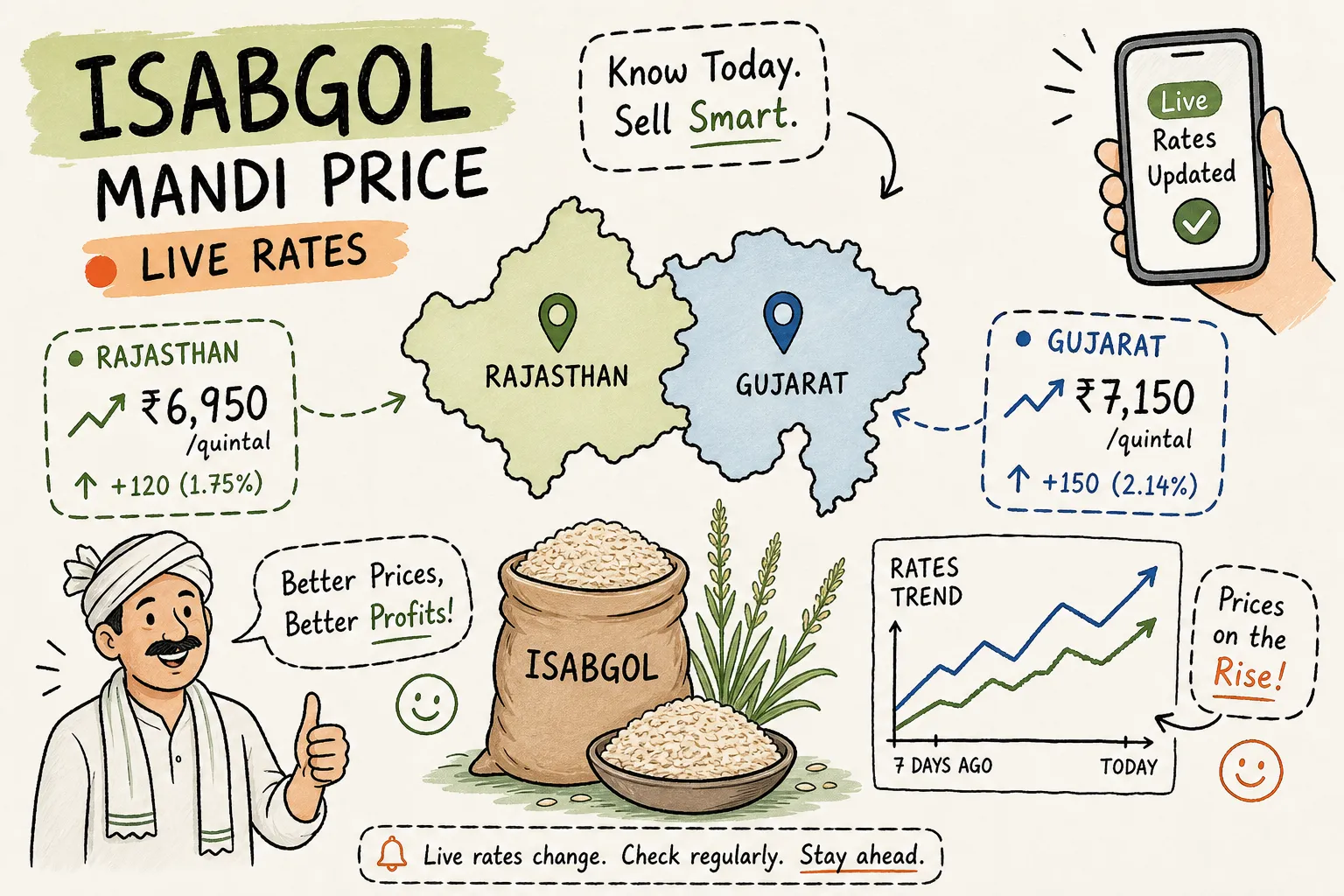
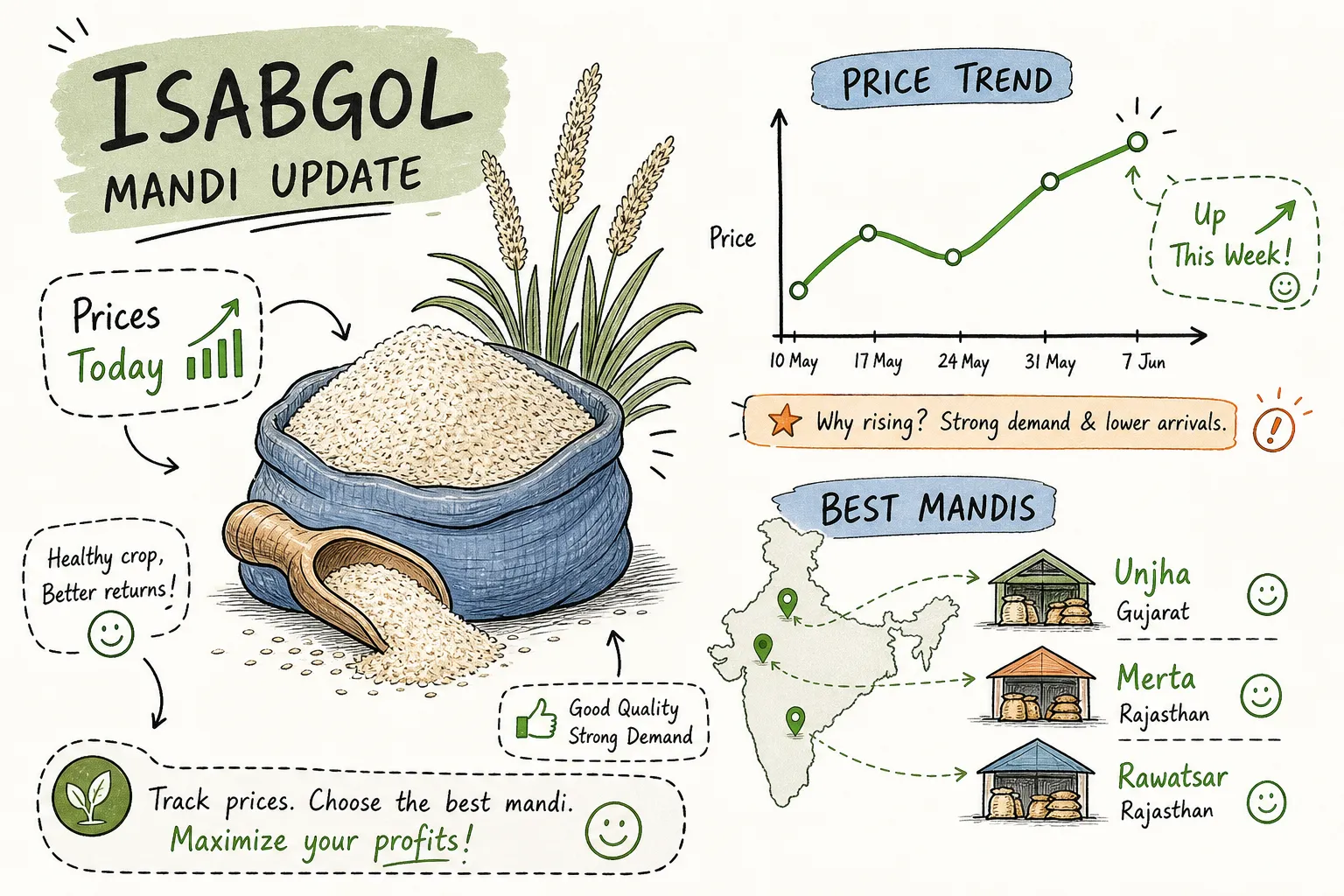
Once the crop is threshed and bagged, the next decision is where and when to sell. Isabgol mandi rates fluctuate across APMC yards in Rajasthan, prices at Jalore, Bhinmal, and other major mandis often differ on the same day, sometimes significantly. Before loading your crop onto a trolley and heading to the nearest market, check live isabgol mandi bhav on KhetiKisaan. The platform tracks daily auction prices sourced directly from ground-level contacts at APMC yards during live bol-chaal (bidding), giving you real transaction rates rather than delayed averages. Selling when local rates are at a relative peak, rather than rushing to market out of habit, can meaningfully improve your net return per quintal and make your entire season's mehnat (hard work) count.
FAQs
Related Blogs

Oct 08, 2026
by Pankaj Sihag
Sep 23, 2026
by Pankaj Sihag

Sep 19, 2026
by Pankaj Sihag

Sep 08, 2026
by Pankaj Sihag