





Isabgol cultivation guide for Rajasthan and Gujarat farmers
 Sep 07, 2026
 by Pankaj Sihag



Isabgol cultivation guide for Rajasthan and Gujarat farmers
| Crop type | Rabi (winter season) |
| Key growing states | Rajasthan, Gujarat |
| Sowing window | Mid-November to mid-December |
| Expected seed yield | 8, 12 quintals per hectare |
| Expected husk yield | Approx. 3, 4 quintals per hectare (≈25, 30% of seed weight) |
| Primary use | Psyllium husk for pharmaceutical and food export markets |
| Scientific name | Plantago ovata |
This isabgol cultivation guide for Rajasthan and Gujarat farmers covers every key step from sowing to mandi sale, giving you a working plan you can follow from field preparation through to the APMC yard. Isabgol, known as psyllium in export markets, is one of the most profitable rabi fasal (winter crops) in western India when managed correctly from day one. Rajasthan's Jalore, Barmer, and Pali districts and Gujarat's Banaskantha belt are the backbone of India's psyllium husk supply to global pharmaceutical and food companies. Yet many kisaans (farmers) in these very belts harvest well below their land's potential, mistimed sowing and careless water management at the critical milk stage are among the most common and correctable causes, alongside soil preparation and input choices.
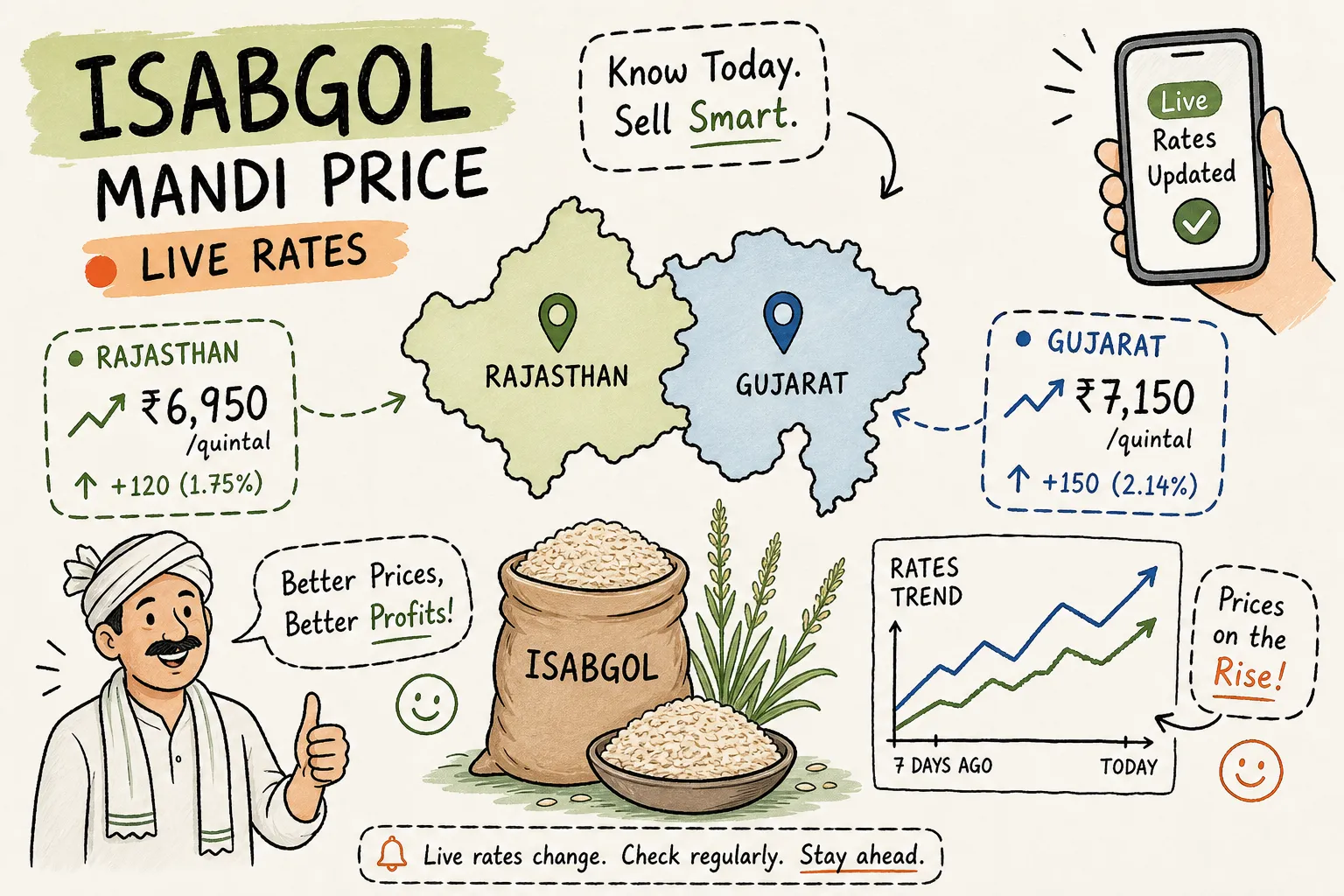
Before you commit land and money to this fasal, check current isabgol mandi bhav (market prices) across Rajasthan's APMC yards to confirm that demand is strong. KhetiKisaan publishes daily auction rates sourced from ground-level contacts at live APMC bol-chaal (bidding), giving you a real-time picture of transaction prices to plan your production and market decisions together, not as two separate steps.
This isabgol cultivation guide covers everything a farmer or agricultural adviser needs to take action: soil and climate suitability, land preparation, the sowing calendar for the rabi season, fertiliser scheduling, irrigation at each growth stage, integrated pest and disease management, harvesting and husk extraction, and a realistic look at cost and return per hectare.
 Table of Contents
- Is your soil and climate ready for isabgol?
- Isabgol cultivation guide: sowing calendar and seed rate for Rajasthan and Gujarat
- Land preparation: getting the seedbed right before sowing
- Fertiliser schedule: basal dose and top dressing per hectare
- Irrigation at every critical growth stage
- Managing pests and diseases with an integrated approach
- Harvesting, threshing, and husk extraction
- Isabgol mandi prices, profitability, and when to sell your crop
- Your isabgol cultivation plan: key takeaways
- FAQs
Is your soil and climate ready for isabgol?
Isabgol grows best in well-drained sandy loam or loamy soil with a pH of 7.0 to 8.0. It cannot tolerate waterlogging at any stage, and heavy clay soils damage germination and root health before the crop ever establishes properly.
Isabgol cultivation guide: soil type and pH requirements
Sandy loam dominates the farmland in Rajasthan's Jalore district and Gujarat's Banaskantha belt, which is precisely why these two regions became the national hub for Plantago ovata cultivation. The soil structure allows roots to develop without restriction and drains excess moisture quickly, both essential throughout the isabgol life cycle. A pH range of 7.0 to 8.0 is ideal; saline patches and acidic soils both suppress germination and reduce husk recovery in the final produce. Get a basic soil test done before your first sowing season. It costs very little compared to the loss you face from sowing into unsuitable ground.
Climate conditions isabgol needs
Isabgol is a cool, dry weather crop that prefers mild temperatures for germination and steady cool conditions through the dry rabi season. The real danger arrives at the flowering-to-milk stage: if humidity rises or unseasonal rain arrives during this window, husk quality drops sharply and downy mildew spreads fast. This is the core reason why sowing timing is not flexible, you need the crop to finish flowering and spike-filling before the weather warms and humidity builds in March and April.
What to avoid: common land mistakes
Waterlogged fields, heavy clay patches, and land with a persistent history of powdery mildew or rhizoctonia wilt should be avoided or corrected before sowing isabgol. Crop rotation is not optional here; sowing isabgol on the same plot year after year allows soil-borne disease pressure to build steadily. Rotate with cereals like wheat or barley to break the disease cycle and restore soil health between isabgol seasons.
Isabgol cultivation guide: sowing calendar and seed rate for Rajasthan and Gujarat
The sowing window for isabgol farming is tight. Get it right and germination is uniform; miss it by three to four weeks and the crop runs into warm spring temperatures during flowering, which collapses husk quality and reduces your marketable yield.
State-wise sowing window for the rabi season
| State / District | Ideal sowing window | Notes |
|---|---|---|
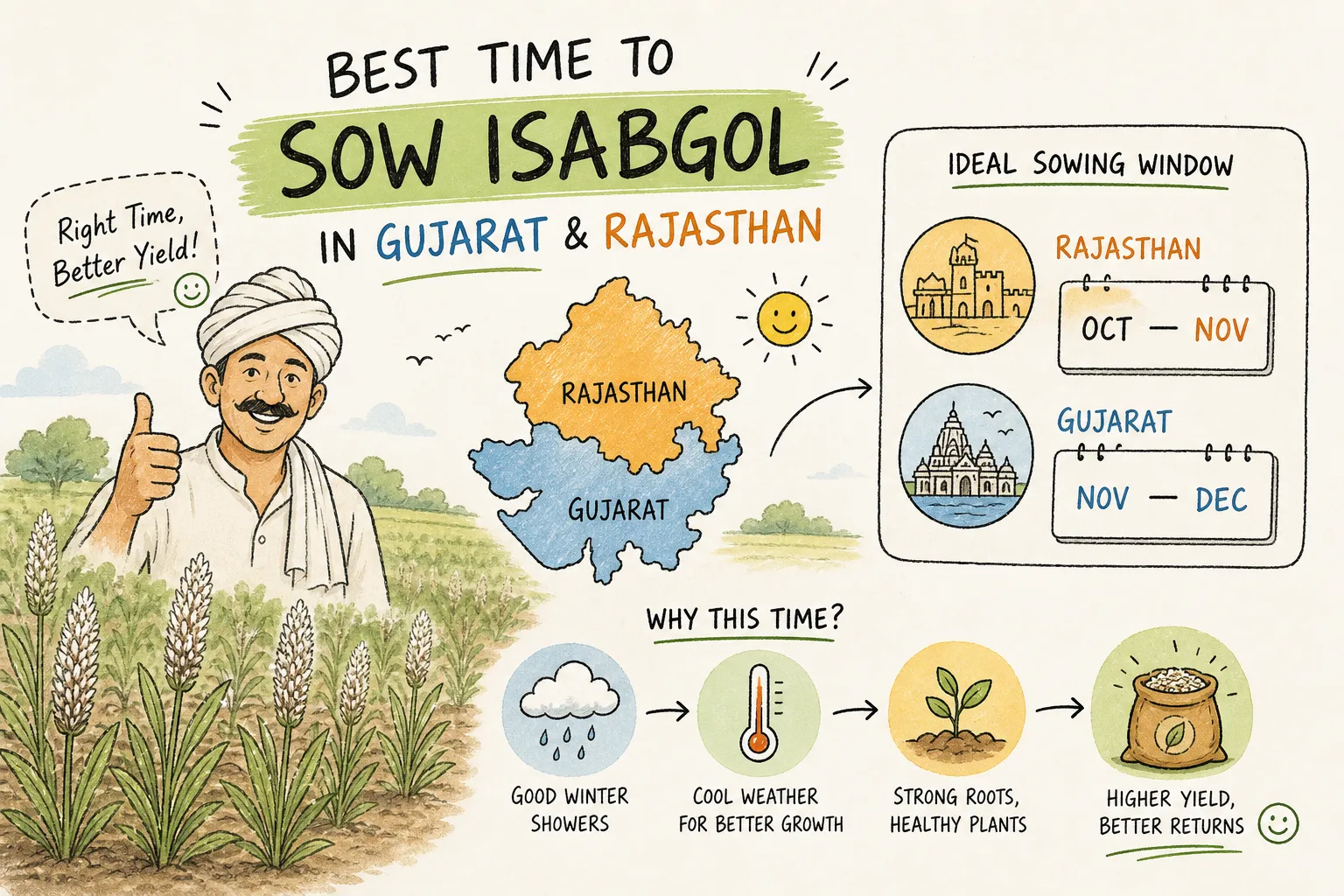
| Rajasthan (Jalore, Barmer, Pali) | Mid-November to late November | November sowing consistently gives best performance in Rajasthan's agro-climatic zone |
| Gujarat, Banaskantha | 15 November to 15 December | Classic isabgol belt; stick close to mid-November for best results |
| Gujarat, Middle Gujarat (Anand) | Around 30 November | Later sowing specifically recommended to reduce downy mildew infection risk at the seedling stage |
The reason Anand district recommends sowing closer to 30 November is practical and evidence-backed: earlier sowing in Middle Gujarat's slightly more humid conditions puts young seedlings through a higher-humidity window, which is exactly when downy mildew strikes hardest. Delaying by two to three weeks reduces that risk without pushing the crop into warm spring weather at flowering.
Seed rate, variety selection, and seed treatment
The recommended seed rate is 4 to 6 kg per hectare, with row spacing of 20 to 25 cm. For Rajasthan and Gujarat farmers, the best-performing varieties combining regional suitability with strong yield and husk recovery are GI-2 (Gujarat Isabgol-2), HI-5, and GI-3. If your priority is maximum husk yield per hectare, HI-34 has shown strong results in variety trials. Treat all seed with metalaxyl before sowing; this single step significantly reduces downy mildew infection at the seedling stage and costs very little relative to the protection it provides.
Sowing method: broadcast versus line sowing
Line sowing at 20 to 25 cm row spacing is clearly superior to broadcasting, and the difference shows up at every subsequent operation. Weeding is faster, irrigation distribution is more uniform, and spray operations are easier when rows are defined. Because the seed is very small, place it at a shallow depth of 1 to 1.5 cm and press it lightly into the seedbed after sowing. Deep placement reduces germination percentage and delays establishment.
Land preparation: getting the seedbed right before sowing
The seeds are extremely small, uniform germination depends entirely on fine, firm soil contact. A rough or cloddy seedbed causes patchy stands that you cannot rescue later.
Ploughing sequence and tilth target
The standard recommendation is one deep plough followed by two to three harrowings to create a fine, clod-free seedbed. Field levelling matters as much as tilth, especially in Rajasthan where farmers commonly use flood irrigation on sandy soils. Uneven ground means uneven water distribution, and uneven water distribution means uneven germination. Take the extra time to level properly before the first irrigation.
Organic inputs and their timing
Apply well-decomposed farmyard manure (FYM) at 10 to 15 tonnes per hectare, incorporated during the last harrowing before sowing. If FYM is not available in sufficient quantities, supplement with vermicompost. Biofertiliser options, specifically PSB (phosphate-solubilising bacteria) combined with Azotobacter, are worth using for farmers following Good Agricultural Practices (GAP) for export-quality husk. They improve soil biology and reduce the chemical fertiliser dose needed to hit your yield target.
Field layout and plot sizing
Divide the field into small plots or raised beds matched to your irrigation method, whether flood or furrow. Smaller plots make water management far easier on sandy soils, where water moves quickly and can over-saturate one corner while the other end stays dry. Getting this layout right before sowing sets you up for delivering the recommended 6 to 7 irrigations without waste or waterlogging at any point.
Fertiliser schedule: basal dose and top dressing per hectare
Isabgol responds well to a balanced fertiliser programme but is sensitive to excess nitrogen. Too much nitrogen promotes leafy vegetative growth at the cost of spike development and husk quality, and it also makes the crop more attractive to aphids.
Recommended N-P-K doses
The standard recommendation for isabgol is 50 kg nitrogen (N) + 25 kg phosphorus (P₂O₅) + 30 kg potassium (K₂O) per hectare. Apply potassium only if a soil test confirms deficiency; most sandy-loam soils in Rajasthan and Gujarat do not require additional potassium. For farmers working on a tighter budget, a practical minimum is 30 kg N + 15 kg P₂O₅, which still supports a good yield when soil organic matter is adequate.
Split nitrogen application schedule
Apply half the nitrogen dose along with the full phosphorus dose at sowing as the basal dose. Apply the remaining half at 30 to 40 days after sowing (DAS) as a top dressing, ideally just before an irrigation so the nutrient reaches the root zone efficiently. Splitting nitrogen this way reduces the early-season lush growth that invites aphid colonies and mildew, and it matches nutrient supply to the crop's actual demand curve.
Organic and biofertiliser integration
For farmers producing export-quality husk under Good Agricultural Practices (GAP), combine FYM with a reduced chemical nitrogen dose. PSB inoculation at sowing improves phosphorus availability from soil reserves, which means you may be able to reduce the chemical phosphorus application without sacrificing yield. This approach also improves long-term soil health, which matters if you plan to grow isabgol on the same land in alternate seasons.
Irrigation at every critical growth stage
Isabgol uses far less water than wheat or mustard, but water stress or waterlogging at the wrong stage will ruin the harvest. The total recommended irrigation count is 6 to 7 on sandy or sandy-loam soils, increasing to up to 10 in lighter soils under dry conditions.
Stage-wise irrigation schedule
Note that the schedule below includes both fixed and conditional irrigations. Item 2 is applied only if germination is uneven; all other irrigations are scheduled as standard.
- Immediately after sowing: give a light irrigation to settle seeds and trigger germination. Germination occurs in 6 to 7 days under good conditions.
- At 7 to 10 DAS (conditional): if germination is uneven or patchy, a second light irrigation encourages uniform stand establishment.
- At approximately 3 weeks after sowing: early establishment irrigation as the crop begins active growth.
- At 30 DAS: coincides with the nitrogen top-dressing application. Irrigate just after top dressing to carry nutrients into the root zone.
- At 50 to 55 DAS: spike initiation stage; ensure the crop is not under any water stress as spikes begin to form.
- At 70 DAS (milk stage / spike filling): this is the last critical irrigation. Give a measured, careful irrigation at this stage and then stop completely.
- After the milk stage: no further irrigation, regardless of how dry the weather looks.
What happens if you irrigate after the milk stage
Irrigating after the milk stage is one of the most common and costly mistakes made by farmers transitioning to isabgol from wheat or mustard. Late irrigation delays maturity, increases the risk of lodging (crop falling over), and directly reduces the husk percentage in your final produce. The spikes need to dry down steadily to concentrate husk quality; extra moisture at this stage undoes weeks of careful crop management.
Water-saving tips for Rajasthan farmers
Furrow irrigation is more efficient than flood irrigation on sandy soils because it reduces deep percolation losses. For larger holdings, drip irrigation is a worthwhile investment that can substantially reduce total water use while maintaining yield, extension bulletins from drip-equipped plots in the region indicate savings in the range of 30 to 40%, though actual results vary by soil type and management. The Rajasthan government's 2026 budget has allocated funds for farm mechanisation and irrigation subsidies; check with your local Krishi Vibhag (agriculture department) office about eligibility for equipment support.
Managing pests and diseases with an integrated approach
Isabgol faces two main insect pests, aphids and white grub, and three serious diseases: downy mildew, powdery mildew, and rhizoctonia wilt. Addressing them at the right time is far cheaper than trying to rescue a crop that is already damaged.
Identifying and controlling aphids
Aphids are the main insect threat to isabgol. Look for colonies on young leaves and spikes, a sticky honeydew residue on foliage, and curling or distortion of leaves. Start with a neem-based spray as the first-line response; it is safer, cost-effective, and preserves natural predators like ladybird beetles that help keep aphid populations in check. If the infestation is severe, move to approved chemical insecticides. Remember that excessive early nitrogen application makes your crop more attractive to aphids, which is another reason to follow the split-application fertiliser schedule described above.
Downy mildew: the most damaging disease in Gujarat
Downy mildew causes the most consistent damage to isabgol crops in Gujarat, particularly in Middle Gujarat's more humid districts. Symptoms include white, downy fungal growth on the underside of leaves and yellow patches on the upper surface. It peaks in high-humidity conditions and is worst in crops sown too early in the season. Metalaxyl seed treatment is your primary prevention tool. At the first sign of infection in the field, apply a foliar metalaxyl spray and repeat as recommended on the product label. The advice to sow closer to 30 November in Anand district exists precisely to reduce the humidity window that triggers early infection.
Powdery mildew and rhizoctonia wilt
Powdery mildew appears as white powdery patches on leaves and usually shows up at the flowering stage. Wettable sulphur sprays are effective and relatively inexpensive. For rhizoctonia wilt, captan seed treatment before sowing is the primary defence; pair it with crop rotation and avoid irrigating heavily after establishment, as wet soil conditions favour wilt development. Build your pest and disease management as an integrated programme: healthy treated seed, crop rotation, field sanitation, proper spacing for air circulation, and need-based chemical intervention. This approach protects both your munafa (profit) and the long-term health of your soil.
Harvesting, threshing, and husk extraction
Harvesting isabgol at the right moment separates a profitable fasal from a disappointing one. Even a delay of a few days past maturity causes shattering losses, because the small seeds fall out of the spikes before you can collect them.
When and how to harvest
The visual maturity indicators to look for are golden-brown spikes, dry lower leaves, and seeds that do not leave a milky impression when pressed between the fingers. Harvest in the early morning after dew has dried but before the heat of the day increases shattering risk. For small holdings, cutting with a sickle and bundling is the standard method. For larger operations, mechanical harvesting is an option, but thresher settings must be carefully calibrated to avoid crushing or damaging the small seeds, which reduces husk recovery and docks your price at the mandi.
Threshing, cleaning, and moisture management
After cutting, spread the bundles and sun-dry them for 2 to 3 days before threshing. Adequate drying loosens seeds from spikes and makes separation easier. Thresh by trampling with bullocks or a tractor, or run a motor thresher at low RPM to avoid crushing the small seeds. Follow threshing with winnowing to separate seed from chaff. The target moisture content for safe storage is below 10%; seed stored above this level is vulnerable to mould, which downgrades husk quality and reduces the price buyers are willing to pay.
Husk extraction and quality grading
Husk extraction at scale is done in mills or shelling units, not on the farm itself. Mill operators feed seeds through grinding and shelling machines set to remove only the outer husk layer, then separate the husk from seed fragments using fans and sieves. Husk recovery typically averages 25 to 30% of seed weight, as documented in NRCSS variety trial reports. Buyers and processors pay a premium for higher husk percentage, and that percentage is directly affected by three things you control on the farm: correct irrigation cutoff at the milk stage, proper harvest timing, and dry storage conditions. Get those three right and your husk grade will reflect it.
Isabgol mandi prices, profitability, and when to sell your crop
Growing a good isabgol crop is only half the job. Knowing when and where to sell determines whether your munafa actually matches your hard work and investment.
What isabgol yields and costs look like per hectare
| Parameter | Estimate |
|---|---|
| Average seed yield (well-managed) | 8, 12 quintals per hectare |
| Husk recovery from seed | ≈25, 30% of seed weight (approx. 3, 4 quintals husk/hectare) |
| Estimated input cost per hectare | ₹26,000, ₹35,000 (seed, fertiliser, irrigation, labour) |
| Gross return at ₹10,000/quintal (seed) | ₹80,000, ₹1,20,000 per hectare |
| Current Rajasthan mandi price range | ₹8,500, ₹14,930 per quintal depending on mandi and grade |
The numbers above show why isabgol attracts serious attention from rabi farmers across western India. Even at the lower end of the price range, the crop generates returns well above input costs on well-prepared land. The spread between ₹9,500 and ₹13,930 per quintal across different Rajasthan mandis also shows how much the selling decision matters. Two farmers with identical yields can end up with very different net returns based purely on when and where they sold.
How mandi bhav moves across the rabi marketing season
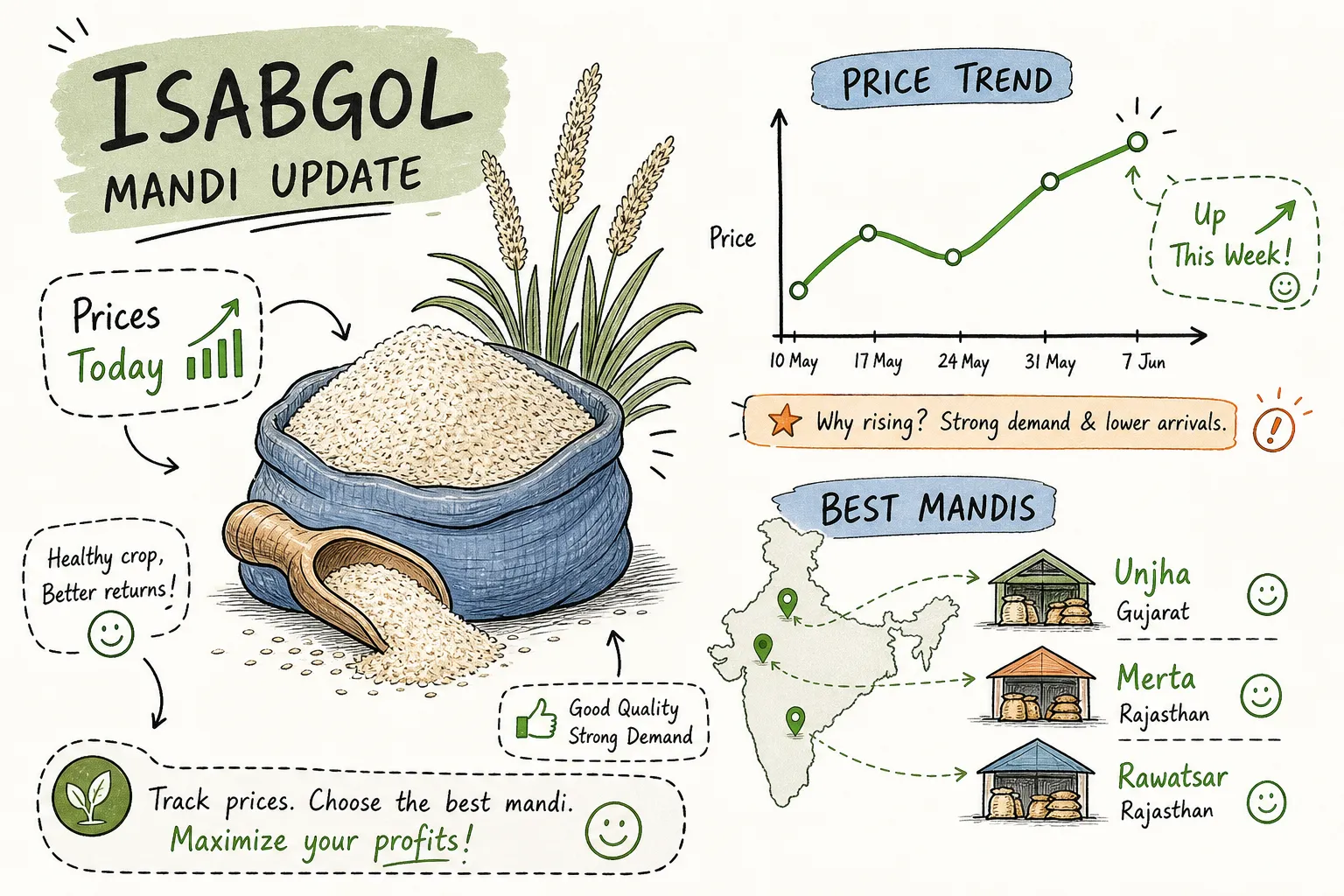
Isabgol prices follow a seasonal pattern that experienced traders and processors understand well. During peak harvest supply in March and April, prices are typically softer because market arrivals are high and buyers know supply will keep coming. As stocks deplete through May and June and export demand from pharmaceutical buyers picks up, prices tend to firm. Farmers who have dry, sealed storage can gain meaningfully by waiting 6 to 8 weeks after harvest before selling, historical APMC arrival and price data from Rajasthan's major yards shows this softening-and-recovery pattern repeating across multiple rabi seasons.
Using KhetiKisaan's mandi data to plan your isabgol sale
Tracking isabgol mandi bhav across Rajasthan's APMC yards, including Jalore, Pali, Nagaur, and Merta, gives you a clear picture of price direction before you load your produce onto a vehicle. KhetiKisaan publishes daily auction rates sourced from people physically present at live APMC bol-chaal, which means the prices you see reflect actual transaction rates from that day's bidding. A farmer who checks both the current price and the recent trend can make an informed choice: sell today, or hold for a better rate next week. On 10 quintals, a price difference of ₹1,500 to ₹2,000 per quintal between a hurried March sale and a patient May sale is the difference between a good season and a great one.
Government support available for isabgol growers
Rajasthan's crop insurance notification includes isabgol as a notified rabi crop under Pradhan Mantri Fasal Bima Yojana (PMFBY). Under PMFBY, farmers pay up to 1.5% of the insured amount as premium for rabi crops, with the remaining premium shared between the central and state governments. The Rajasthan budget also announced interest-free short-term agricultural loans and farm mechanisation subsidies that isabgol growers can access.
In Gujarat, farmers moving into processing and value addition can explore the state's agro-processing subsidy, which covers capital expenditure for agricultural product processing units. Contact your local Krishi Vigyan Kendra (KVK) or agriculture department office to check current eligibility and application requirements for these schemes.
Your isabgol cultivation plan: key takeaways
This isabgol cultivation guide has taken you through every decision point that separates a high-performing crop from an average one, soil and climate fit, land preparation, the November sowing window, split fertiliser application, stage-wise irrigation with a hard stop at the milk stage, integrated pest management, and the market timing that determines your final return. Use KhetiKisaan to track isabgol mandi bhav daily, check your eligibility for PMFBY crop insurance and state subsidies through your local KVK, and refer back to this isabgol farming guide each season to keep your practices on track.
FAQs
Related Blogs
Oct 08, 2026
by Pankaj Sihag
Sep 23, 2026
by Pankaj Sihag
Sep 19, 2026
by Pankaj Sihag

Sep 09, 2026
by Pankaj Sihag
Sep 08, 2026
by Pankaj Sihag