





Isabgol ki kheti: Complete guide for farmers

 Sep 19, 2026
 by Pankaj Sihag



Isabgol ki kheti: Complete guide for farmers
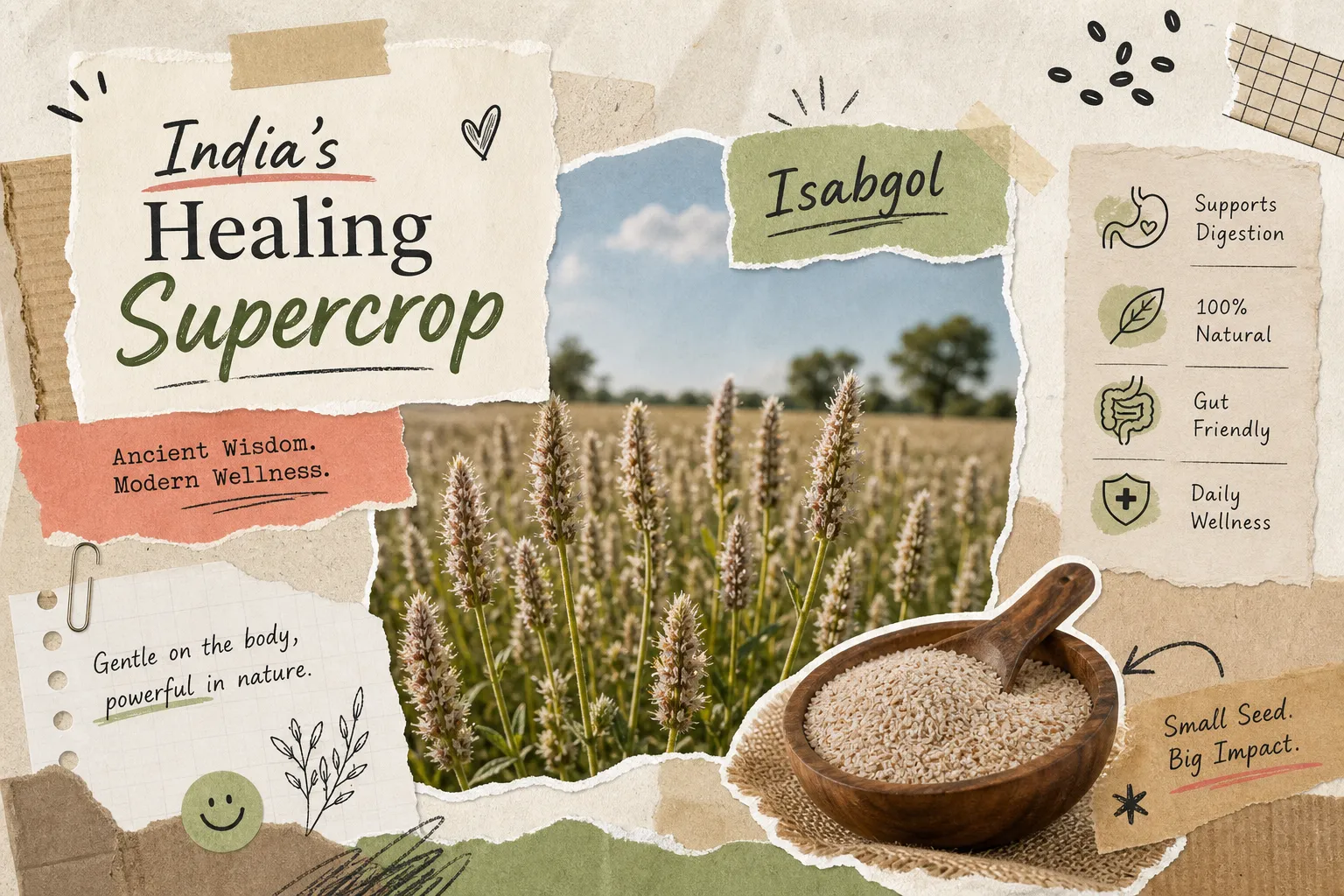
Isabgol ki kheti is one of the highest-value rabi fasals (winter crops) a Rajasthan farmer can grow, yet most small kisaans still treat it as an afterthought planted on leftover land with leftover effort. That approach leaves serious money on the table. Isabgol (psyllium husk, botanically known as Plantago ovata) commands current mandi bhav (market rates) ranging from ₹12,000 to ₹18,000 per quintal, and with India controlling roughly 80% of the world's psyllium supply, this crop has both the income potential and the export floor to reward every rupee of careful management you put into it.
This guide covers everything you need to plan a profitable isabgol season from the ground up: soil selection, field preparation, the right sowing window for Rajasthan, irrigation scheduling, fertiliser doses, pest and disease control, harvest timing, and how to read mandi bhav before you decide to sell. KhetiKisaan tracks live isabgol market rates from APMC yards across Rajasthan so you can time your sale with real price intelligence rather than guesswork. By the end of this article, you will have a complete action plan for your zameen (land) and your fasal (crop).
 Table of Contents
- Quick facts: isabgol ki kheti at a glance
- Why isabgol farming makes financial sense for kisaans
- Field selection and land preparation for psyllium cultivation
- Sowing time, variety selection, and seed rate for isabgol ki kheti in Rajasthan
- Isabgol irrigation: how much water this crop actually needs
- Fertilisation, weed management, and crop protection
- Harvesting, threshing, and storage of isabgol
- Isabgol mandi bhav and selling your crop at the right time
- Conclusion
- FAQs
Quick facts: isabgol ki kheti at a glance
Before going into detail, here is a compact reference you can return to at any point in the season. These figures are drawn from ICAR trial data and Rajasthan state agriculture department recommendations.
What kind of crop is isabgol and where does it grow best?
Isabgol is a rabi (winter season) crop that thrives in semi-arid, cool, and dry conditions. Rajasthan, Gujarat, and parts of Haryana are its natural home in India. The crop cannot tolerate frost, high humidity, or waterlogged soil, which is precisely why Rajasthan's dry, well-drained landscape suits it so well. Districts like Jalore, Barmer, Pali, and Sirohi are established isabgol belts where local knowledge of this crop runs deep.
On the global stage, India supplies the bulk of the world's psyllium husk and psyllium seed exports, with average annual exports of around 29,000 MT worth roughly ₹520 crores (APEDA). Pharmaceutical companies, food manufacturers, and health supplement brands across Europe, the US, and the Middle East are the primary buyers. This consistent export demand creates a reliable price floor that most domestic crops simply cannot match.
Key crop parameters: a quick reference table
| Parameter | Recommended Value |
|---|---|
| Crop type / season | Rabi (winter) |
| Sowing window (Rajasthan) | First week of November (late October acceptable) |
| Seed rate | 4, 5 kg per hectare |
| Row spacing | 30 cm × 5 cm (line sowing) |
| Sowing depth | 1, 1.5 cm (shallow) |
| Number of irrigations | 3, 4 light irrigations |
| Days to maturity | 110, 130 days (typically February, March) |
| Average yield | 7, 10 quintals per hectare |
| Current mandi bhav | ₹12,000, ₹18,000 per quintal |
| Recommended varieties | GI-2, RI-89, Niharika |
| Ideal soil pH | 7.0, 8.0 |
Why isabgol farming makes financial sense for kisaans
Expected returns per hectare: crunching the numbers
At an average yield of 8 quintals per hectare and a conservative mandi rate of ₹13,000 per quintal, a farmer grosses ₹1,04,000 from one hectare. Input costs, seed, fertiliser, irrigation, labour, and harvesting, typically run between ₹20,000 and ₹30,000 per hectare under standard Rajasthan conditions. That leaves a net margin of ₹70,000 to ₹85,000 per hectare, significantly higher than wheat (gehun) at comparable costs and similar to mustard (sarso) but with better price stability in good export years.
When you hit 10 quintals per hectare with better agronomy and sell at ₹16,000, ₹18,000 per quintal during a demand spike, gross returns can cross ₹1,60,000 per hectare. No other common rabi crop in Rajasthan's semi-arid belt offers this kind of ceiling without significantly higher water requirements.
Export demand and price stability for isabgol
The reason isabgol prices hold up better than most crops is structural. India controls global psyllium supply, and international buyers cannot easily substitute it. Pharmaceutical-grade demand for psyllium husk as a bulk laxative and dietary fibre supplement has grown steadily, and food and nutraceutical applications have added new buyer categories. Even in a year of good domestic production, export offtake absorbs surplus quickly.
Seasonal price spikes are common from January through March, when export shipments peak and the new harvest is just arriving at mandis. A farmer who holds stock for even two to three weeks post-harvest often catches a materially better price than one who sells immediately after threshing.
Risks to account for before you sow
Honest planning includes knowing the downside. Downy mildew disease can wipe out a significant portion of your yield if it strikes at the wrong growth stage and you are not watching for early symptoms. Prices between mandis can vary by ₹1,500 to ₹2,500 per quintal in the same week, so selling without checking rates is a costly habit. The crop is also sensitive to excess moisture at any stage, meaning a poorly drained field or a heavy irrigation flood can cause root rot or lodging. None of these risks are reasons to avoid isabgol. They are reasons to prepare properly, which is exactly what the rest of this guide helps you do.
Field selection and land preparation for psyllium cultivation
Which soil type gives the best yield for isabgol?
Sandy loam to loamy soil with excellent drainage is the ideal foundation for isabgol. The target soil pH is 7.0 to 8.0, and most fields in Jalore, Barmer, Pali, and Sirohi districts of Rajasthan fall naturally within this range. Waterlogging is the single biggest yield killer for this crop: even 24 hours of standing water at a critical growth stage can cause root rot and total crop loss. If your field has low spots where water pools after rain or irrigation, level them out or choose a different plot for isabgol.
Heavy clay soils are not suitable. If you have a silty-loam or medium-loam field with good drainage, it can work, but you will need to be more careful with irrigation quantities. The standard test is simple: pour a bucket of water on the field and see how quickly it drains. If water stands for more than 30 minutes, that plot carries a risk.
Step-by-step land preparation before sowing
Fine tilth is non-negotiable for isabgol because the seed is tiny and needs intimate contact with moist soil to germinate. Follow this sequence before sowing:
- Do a deep ploughing immediately after the previous crop is cleared, to break the hardpan and expose soil to sun.
- Do two to three cross-ploughings with a cultivator until clods are broken and the surface is fine and crumbly.
- Remove all weeds, stubble, and crop residue from the previous season; these are disease and pest reservoirs.
- Apply 10, 15 tonnes of farmyard manure (FYM) per hectare and mix it in thoroughly with the last ploughing.
- Level the field with a plank or leveller, and mark out irrigation channels (beds) of a convenient width before sowing begins.
FYM and soil amendment: what to add and when
Farmyard manure (gobar ki khaad) applied at 10, 15 tonnes per hectare during the last ploughing is the foundation of a good isabgol crop. It improves soil texture, moisture retention, and microbial activity simultaneously. Apply it two to three weeks before sowing so it partially decomposes before the seed goes in. A soil test from your local Krishi Vigyan Kendra (KVK) before the season is a sound investment: it tells you exactly how much nitrogen and phosphorus your field needs so you are not over-spending on fertiliser or leaving a deficiency unaddressed.
Liming is generally not required for Rajasthan fields. The soil pH in most isabgol-growing districts already sits in the 7.0, 8.0 range that the crop prefers. If your soil test shows a pH above 8.5, consult your local agriculture office for specific advice, but this is uncommon in the primary isabgol districts.
Sowing time, variety selection, and seed rate for isabgol ki kheti in Rajasthan
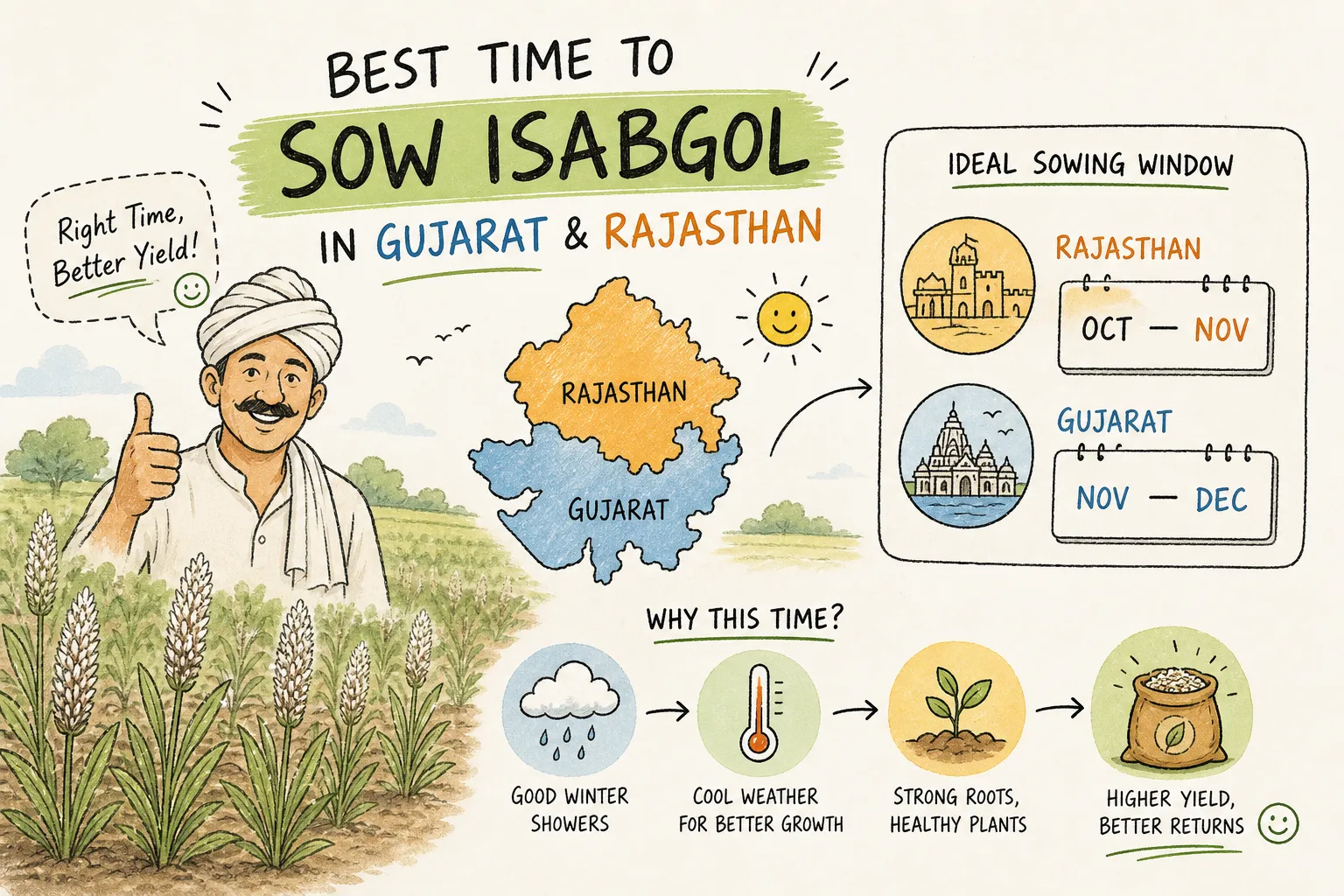
The right sowing window for Rajasthan: stick to early November
The first week of November is the optimal sowing window for Rajasthan. Isabgol needs cool, dry weather during its vegetative phase and spike development. Sowing in early November gives the crop exactly this. Late October works if your field is ready, but sowing after mid-November progressively reduces yield because the crop misses part of the cool period it needs for good spike (ear head) formation. Even a 10-day delay past mid-November can reduce your yield by 15, 20%.
The germination temperature for isabgol is ideally between 20°C and 30°C. Night temperatures in Rajasthan's isabgol belt drop usefully in November, creating the cool conditions the crop favours. Avoid sowing during foggy or overcast spells if you can, as high humidity at germination raises downy mildew risk from the start.
Which isabgol variety should Rajasthan farmers choose?
Three varieties dominate Rajasthan's isabgol cultivation: GI-2, RI-89, and Niharika. RI-89 has consistently shown the highest seed yield in comparative trials, recording 14.31 quintals per hectare in one study versus GI-2 at 13.67 quintals per hectare under identical conditions. Niharika gives a practical farm yield of 1,000 to 1,200 kg per hectare and is widely available through seed dealers in Rajasthan. All three are suited to the state's semi-arid climate.
For most small kisaans, the best choice is the variety your local KVK or progressive neighbours have used successfully in your specific district, since local performance data matters more than trial results from other agro-climatic zones. If seed availability of RI-89 is good in your area, it is worth prioritising based on yield data. For wider availability and consistent results, GI-2 remains the most commonly grown variety across Rajasthan's isabgol belt.
Seed rate, seed treatment, and sowing method
Use 4 to 5 kg of seed per hectare. Using more seed than this increases plant density unnecessarily, raises seed cost, and can actually reduce spike quality by creating excessive canopy competition. Line sowing at 30 cm row-to-row spacing and 5 cm plant-to-plant spacing is strongly preferred over broadcasting (chhidkav). Line sowing makes weeding, intercultural operations, and irrigation management easier, and it typically produces 10, 15% higher yields than broadcasting in field comparisons.
Before sowing, treat your seed with a recommended fungicide such as metalaxyl (Apron or Ridomil) at the dosage on the product label. This seed treatment significantly reduces the risk of downy mildew attacking seedlings at the most vulnerable stage. Sow at a depth of just 1 to 1.5 cm. The seed is tiny and light-sensitive: bury it too deep and germination fails. A useful practical method is to mix the seed with fine dry sand in a 1:10 ratio before sowing; this gives more even seed distribution along the row.
Isabgol irrigation: how much water this crop actually needs
Is isabgol a drought-tolerant crop? Setting realistic expectations
Isabgol is often described in popular farming circles as a low-water or drought-tolerant crop. This is partially true but misleadingly oversimplified. The crop can survive with limited irrigation, but reliable, profitable yields require well-timed, controlled irrigation at specific growth stages. Waterlogging at any stage is fatal. Severe moisture stress during flowering and spike formation reduces husk weight directly. Think of isabgol as a crop that rewards disciplined, light irrigation, not a crop you can ignore once sown.
A practical stage-wise isabgol irrigation schedule
Plan for three to four light irrigations across the season. Heavy flooding at any stage is the most common irrigation mistake Rajasthan farmers make with this crop.
- First irrigation immediately after sowing: a very light irrigation to settle the seed into the soil and initiate germination. Do not flood, the seed must not move or get buried deeper.
- Second irrigation at 20, 25 days after sowing: applied as plants establish their root system. If germination has been uneven, this irrigation helps the late-germinating patches catch up.
- Third irrigation at spike or ear head formation: this is the most yield-critical irrigation. Moisture stress at spike formation directly reduces husk content and seed weight per spike.
- Fourth irrigation (optional): only if there is an extended dry spell in the two to three weeks before maturity. Skip this if soil moisture feels adequate, as late excess moisture delays maturity and can crack spikes.
Symptoms of over-irrigation to watch for: yellowing of lower leaves, soft and waterlogged soil around roots, and a slightly foul smell from the root zone indicating the start of root rot. If you see these signs, stop irrigation immediately and allow the field to dry out.
Irrigation method: flood vs. sprinkler for isabgol
Sprinkler irrigation is well-suited to isabgol given the crop's shallow root system and sensitivity to standing water. If you have sprinkler infrastructure, use it, it allows precise, light application that mimics ideal rainfall. For farmers using flood irrigation (naali system), sow on raised beds with furrows between rows. This keeps the actual root zone elevated above the water channel and reduces waterlogging risk significantly on flatter fields.
Fertilisation, weed management, and crop protection
NPK fertiliser dose and application timing
For standard conditions, apply 20, 30 kg nitrogen (N) and 15, 25 kg phosphorus (P₂O₅) per hectare. For higher-yielding plots with good irrigation management, you can go up to 50 kg N, 25 kg P₂O₅, and 30 kg K₂O per hectare. The split application method produces the best results: apply the full phosphorus and potassium dose plus half the nitrogen as a basal dose at sowing time, mixed into the soil during the last seedbed preparation. Apply the remaining half of the nitrogen as a top dressing approximately one month after sowing, when plants are actively growing.
Avoid heavy nitrogen applications: excess nitrogen promotes leafy vegetative growth at the expense of spike formation, which directly reduces your seed yield. Stick to recommended doses and let the FYM you applied at land preparation do its work through the season.
Keeping weeds under control: timing is everything
The first weeding at 20, 25 days after sowing is the most critical intervention of the entire season. Weeds at this stage compete directly with young isabgol plants for light, moisture, and nutrients, and if left unchecked for even a week too long, they can reduce final yield by 20, 30%. Plan for two to three hand weedings or intercultural operations (between rows, using a khurpi or a wheel hoe) across the full season.
For fields with known heavy weed pressure, a pre-emergence herbicide application of isoproturon at 500 to 700 grams active ingredient per hectare, applied within 48 hours of sowing, gives additional control. This is a supplementary tool, not a substitute for timely weeding. Always read the product label and follow the recommended dilution before spraying.
Major pests and diseases to watch for
Downy mildew is the most serious disease threat for Rajasthan isabgol. It appears as a white, powdery or downy growth on the undersides of leaves and spike surfaces, and spreads rapidly in cool, humid conditions. Treat it with metalaxyl-based fungicides (Ridomil MZ at 0.2%) at the first sign of infection, and repeat the spray every 12 to 14 days until the threat passes. Seed treatment with metalaxyl before sowing gives you an important head start against this disease.
Aphids (mahu) are the main insect pest, typically appearing 50 to 60 days after sowing. For light infestations, two sprays of a neem-based formulation manage the population adequately. For heavier infestations, oxydemeton methyl at 0.025% or dimethoate at 0.2%, applied at 15-day intervals, is effective.
Fusarium wilt and Rhizoctonia wilt are soil-borne diseases that cause sudden plant death. The best defence is using healthy, treated seed, maintaining good drainage, and not over-irrigating. Powdery mildew can be managed with wettable sulphur at 0.2%, sprayed two to three times at two-week intervals.
Harvesting, threshing, and storage of isabgol
When is isabgol ready to harvest?
The crop matures in 110 to 130 days from sowing, which means Rajasthan farmers harvesting November-sown isabgol will typically cut the crop between late February and mid-March. The visual cues are reliable: spikes turn golden-brown to reddish-brown, leaves begin to dry and yellow, and when you gently press a ripe spike between your fingers, seeds come out firm and white. These are your harvest signals.
Harvesting too early, when spikes are still green or pale, gives you immature husk with lower weight and lower husk content, reducing your price at the mandi. Harvesting too late risks shattering losses, where ripe seeds fall off the spikes during cutting and handling. Watch your crop carefully in the last two weeks before harvest and cut when 80 to 90% of the spikes are showing golden-brown colour.
Threshing and cleaning the crop without losing yield
Harvest by cutting the plants close to the ground during the cool, dry morning hours. Spread the cut plants in the field to dry in the sun for three to five days, turning them once or twice for even drying. Then thresh by beating the bundles on a hard surface, or use a small thresher if one is available in your village. Winnowing (aurai) separates the chaff from the seed.
Here is a practical tip that most textbook guides miss: isabgol seed is extremely light, and winnowing on a windy day causes significant losses. Always do your winnowing and cleaning in the early morning or on a calm, still day. Even a light breeze carries isabgol seed away from your threshing floor. This single habit can save you 50 to 100 kg of harvested seed per hectare.
Post-harvest storage: protecting your isabgol before sale
Store cleaned, dry seed in gunny bags in a cool, dry, well-ventilated space. The moisture content must be at or below 8% before storage; this is also the standard the mandi expects at delivery. If moisture content exceeds 10%, buyers apply a moisture adjustment to your weight, effectively reducing your price. After harvest, spread the cleaned seed in a thin layer on a clean, dry surface and sun-dry it for one to two days before bagging.
Do not stack bags directly on damp cement or mud floors. Use wooden pallets or a plastic sheet underneath. Holding your stock for two to four weeks post-harvest to catch a price improvement is a common and sensible strategy among experienced isabgol farmers, provided storage conditions are dry and secure.
Isabgol mandi bhav and selling your crop at the right time
Where do Rajasthan farmers sell isabgol?
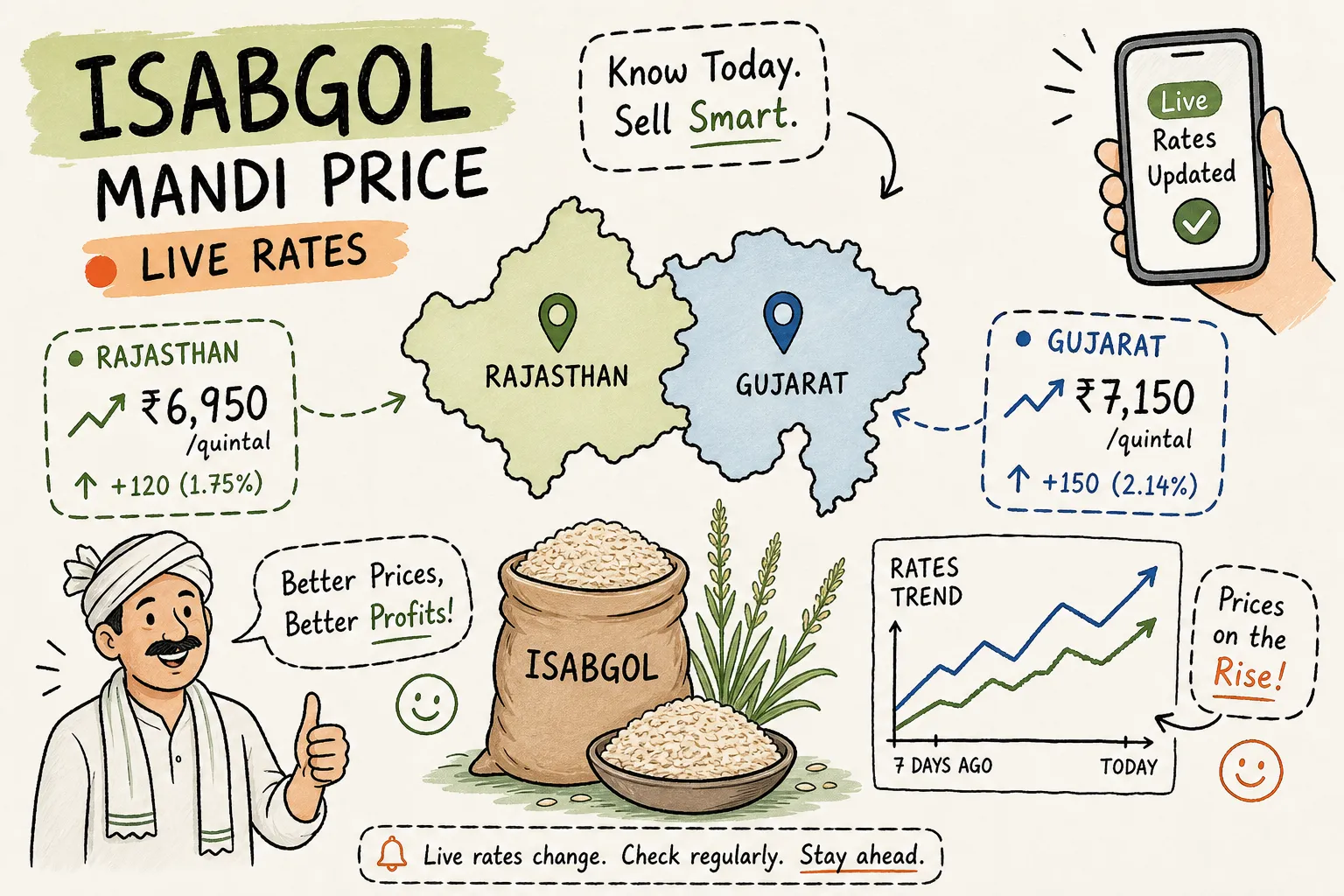
Unjha mandi in Gujarat is the dominant national wholesale market for isabgol, setting benchmark prices that flow through every smaller mandi in the country. Rajasthan farmers typically sell either at their local APMC mandi through commission agents (arhatiyas), or to travelling buyers who aggregate and move stock to Unjha. The trade chain runs from your local mandi to district-level APMC centres and then onward to Unjha-linked wholesale buyers and exporters. Understanding this chain explains why prices at your village-level market are often ₹1,000 to ₹2,000 per quintal lower than the Unjha spot price: multiple intermediaries each take their margin along the way.
How to track live isabgol mandi rates before you decide to sell
Isabgol mandi bhav can swing by ₹1,500 to ₹2,500 per quintal between weeks and between mandis, especially in the February to April window when the new harvest arrives and export demand peaks simultaneously. Selling on the wrong day or at the wrong mandi is a costly mistake that better information prevents. KhetiKisaan tracks live isabgol prices from on-ground contacts who are physically present at APMC auction yards during the actual bol-chaal (bidding), so the rates reflect real transaction prices, not delayed government feeds or estimated averages. Before you load your crop onto a vehicle, check the current isabgol mandi bhav on KhetiKisaan and compare rates across mandis. This takes five minutes and can be worth thousands of rupees.
Simple rules for timing your isabgol sale
Three practical rules serve most Rajasthan farmers well:
- Avoid selling in the first week after harvest. The initial post-harvest surge of supply from farmers who need immediate cash depresses prices temporarily. If you have storage and do not need emergency funds, wait at least one to two weeks for this glut to clear.
- Watch the January to March export demand signals. This is when international buyers place peak orders. Prices typically firm up or spike during this window, making it the best period to sell if you have storage capacity.
- Compare your local APMC rate against the Unjha spot price before accepting an arhatiya's quote. If the gap is unusually large, either negotiate harder or explore whether you can consolidate with neighbouring farmers and sell directly to a larger buyer at the district mandi for a better rate.
Conclusion
Isabgol ki kheti rewards precision more than most rabi crops in Rajasthan's agricultural calendar. Sow in the first week of November on well-drained sandy loam soil. Use 4 to 5 kg per hectare of a proven variety like GI-2 or RI-89, treated with metalaxyl fungicide before going into the ground. Follow the three to four light irrigation schedule faithfully, weed at 20 to 25 days without fail, and protect the crop against downy mildew from early in the season. Harvest when spikes turn golden-brown, and thresh on a calm day to avoid wind losses.
The difference between an average isabgol crop and a genuinely profitable one is rarely about spending more money. It is almost always about getting the timing right: sowing at the correct date, irrigating at the correct growth stages, weeding before competition damages the plant, and selling when mandi bhav reflects real demand rather than a temporary post-harvest glut. Each of these decisions is within your control.
Before you sell your isabgol stock, check the live isabgol mandi rates on KhetiKisaan. Your hard work in the field deserves to be matched by equally sharp decision-making at the mandi gate. The information is free and the difference it makes to your munafa (net profit) is real.
FAQs
Related Blogs

Sep 09, 2026
by Pankaj Sihag
Sep 08, 2026
by Pankaj Sihag