






Isabgol mandi price: Live rates across Rajasthan & Gujarat
 Aug 24, 2026
 by Pankaj Sihag



Isabgol mandi price: Live rates across Rajasthan & Gujarat
Quick Facts: isabgol mandi price at a glance
- Current price range: ₹8,900, ₹13,800/quintal (₹89, ₹138/kg) across major mandis
- Top mandis: Unjha (Gujarat), Nagaur, Phalodi, Bhinmal, Hanumangarh (Rajasthan)
- Peak arrival season: March to May (post-rabi harvest)
- Fastest way to check daily isabgol mandi bhav: KhetiKisaan , near-real-time mandi listings updated from APMC auctions, cross-checkable against Agmarknet
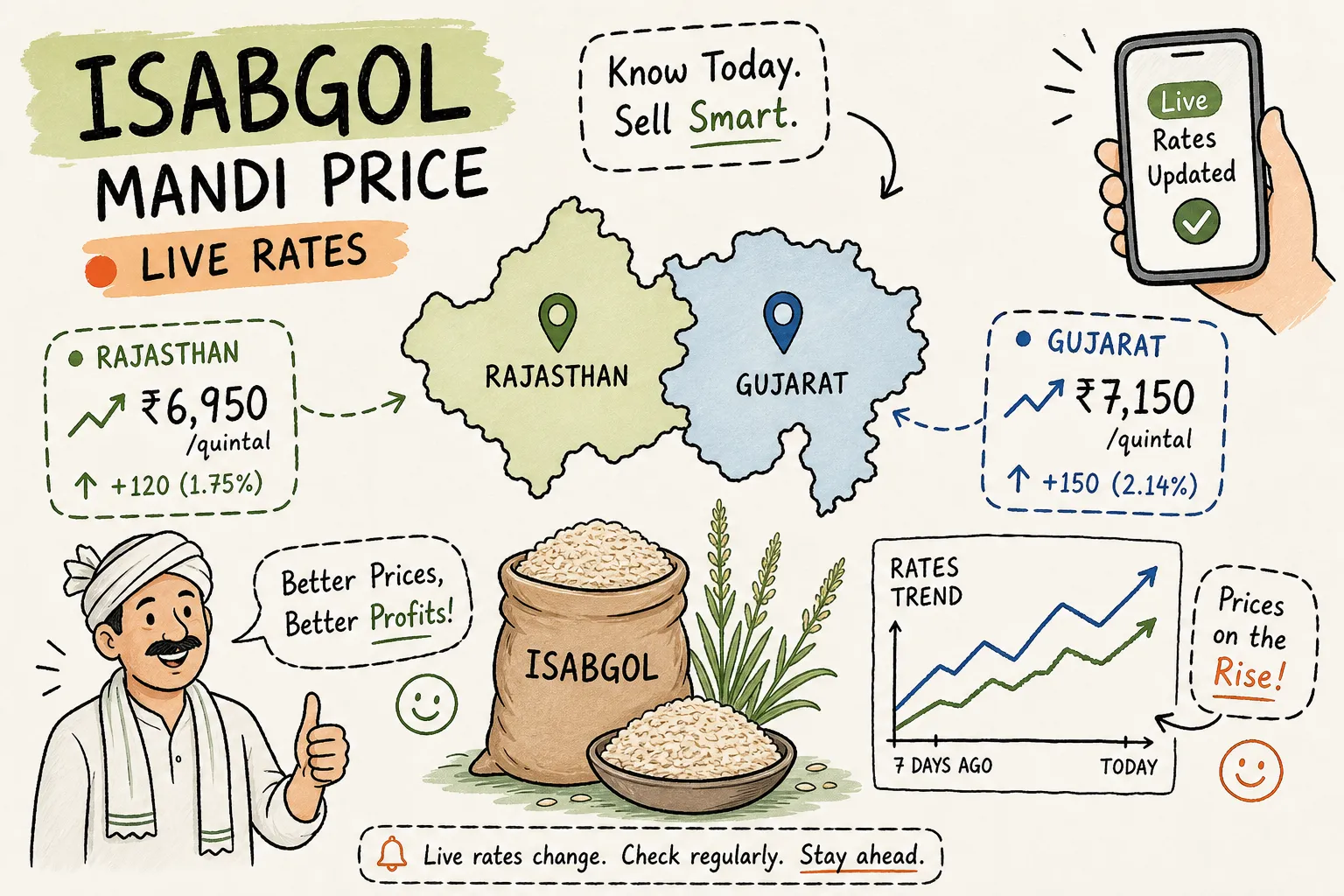
Check today's isabgol mandi price across Rajasthan and Gujarat before deciding whether to sell or store. Across major mandis, isabgol (psyllium husk) is currently trading between ₹9,700 and ₹13,800 per quintal, with Phalodi and Nagaur consistently showing stronger modal prices, while Hanumangarh and Bhinmal sit at the softer end. If you are a kisaan holding harvested fasal right now, the difference between selling today and waiting two months could be ₹800 to ₹1,500 per quintal, a figure that matters considerably when you are moving 50 or 100 quintals.
Isabgol is one of the higher-value rabi crops by price per quintal, and nearly all serious trade happens through Rajasthan and Gujarat's APMC mandis, with Unjha in Gujarat functioning as the national price benchmark. The problem most farmers face is not lack of interest in tracking prices; it is lack of access to reliable, same-day figures. KhetiKisaan addresses this directly with near-real-time mandi listings sourced from APMC auction floors, figures you can cross-check against Agmarknet for confidence before deciding where to bring your crop.
This guide covers where isabgol rates stand today across key mandis, what moves those prices, how quality grade affects what you actually receive, and where to check verified isabgol mandi bhav without calling five markets yourself.
 Table of Contents
- Which mandis actually set isabgol prices in India
- Current isabgol mandi price: what the numbers look like today
- Why isabgol mandi bhav moves: the real drivers behind price shifts
- How quality grades affect the isabgol mandi price you actually receive
- Where to check verified isabgol mandi rates online
- What to do with this information
- FAQs
Which mandis actually set isabgol prices in India
Unjha: the national price benchmark for isabgol
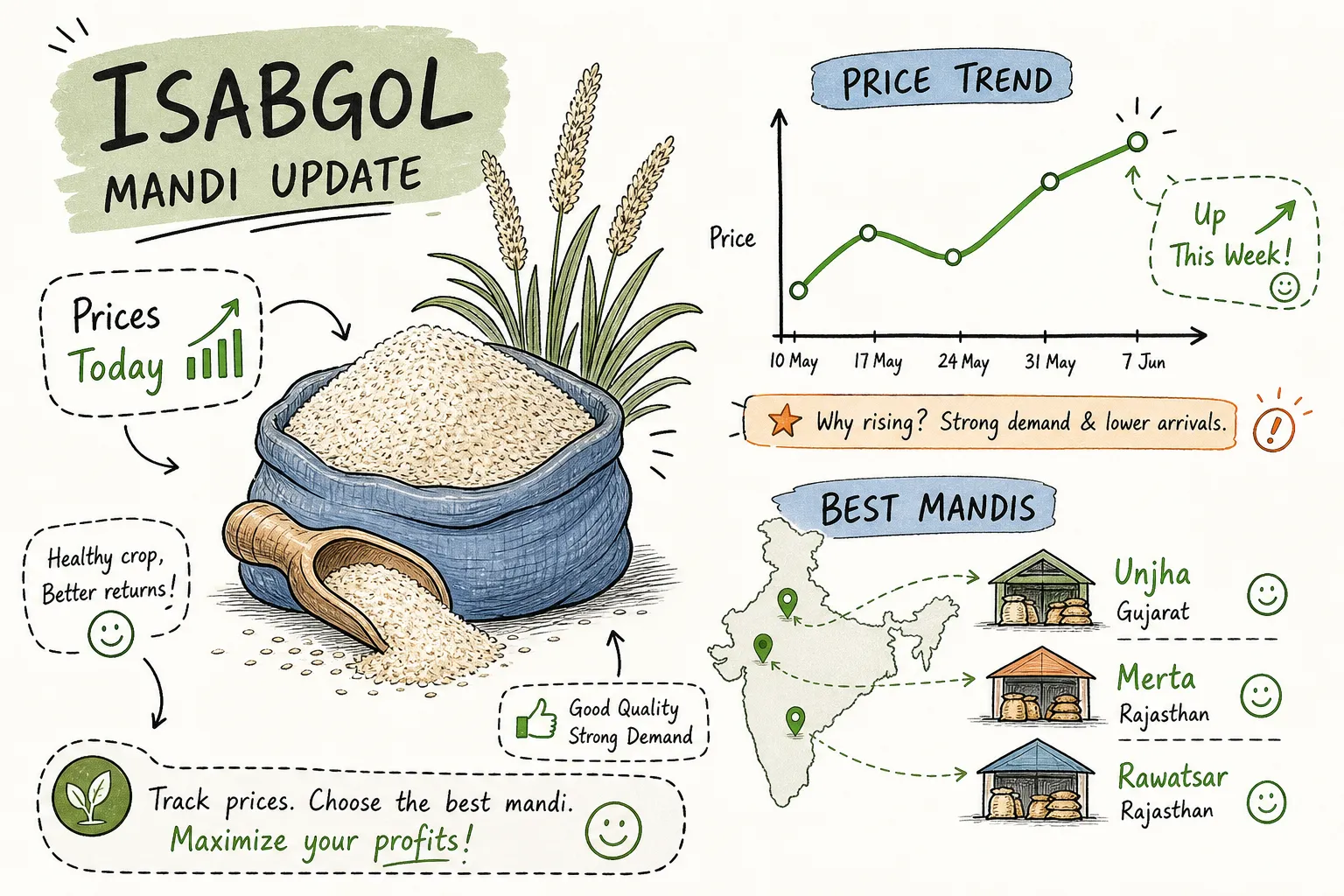
Unjha APMC in Gujarat's Mehsana district is where isabgol prices are effectively set for the entire country. The mandi draws the highest volumes of psyllium husk trade in India, with direct connectivity to pharmaceutical exporters, European and American buyers, and large nutraceutical manufacturers. When Unjha moves, Rajasthan mandis typically follow within one to two days. The current verified Unjha range sits at ₹10,000 to ₹13,625 per quintal, with a modal price around ₹12,500 depending on grade and daily arrival volumes.
Key Rajasthan mandis farmers should watch
Rajasthan is the dominant isabgol-growing state, and prices across its mandis can vary by ₹1,000 to ₹2,500 per quintal on the same day. The mandis that matter most for Rajasthan growers are Nagaur, Phalodi, Bhinmal, Bikaner, Nokha, Hanumangarh, and Jodhpur. This variation is driven by local arrival volume, transport proximity to Gujarat buyers, and how aggressively traders at each yard are competing for stock. KhetiKisaan covers mandi-wise listings for these key centres, so farmers do not have to make individual calls to each market committee before deciding where to bring their crop.
Why two mandis quote different rates on the same day
Arrivals volume is the most immediate driver of intra-day price differences. A mandi receiving heavy arrivals on a given morning will see softer prices because buyers have more choice. Transport costs from farm to mandi add another layer: a farmer near Phalodi who can deliver cheaply to that yard can accept a slightly lower gross rate and still net more than one paying heavy freight to reach Nagaur. Quality variation across lots also widens the gap between the minimum and maximum price at any single mandi on the same day.
Current isabgol mandi price: what the numbers look like today
Price ranges across Unjha and Rajasthan APMCs
|
Mandi |
Min (₹/qtl) |
Modal (₹/qtl) |
Max (₹/qtl) |
Min, Max (₹/kg approx.) |
|---|---|---|---|---|
|
Unjha (Gujarat) |
₹10,000 |
₹12,500 |
₹13,625 |
₹100, ₹136 |
|
Phalodi (Rajasthan) |
₹11,500 |
₹12,800 |
₹13,800 |
₹115, ₹138 |
|
Nagaur (Rajasthan) |
₹9,000 |
₹12,000 |
₹13,500 |
₹90, ₹135 |
|
Nokha (Rajasthan) |
₹9,800 |
₹11,200 |
₹12,500 |
₹98, ₹125 |
|
Bhinmal (Rajasthan) |
₹9,500 |
₹9,732 |
₹9,950 |
₹95, ₹100 |
|
Hanumangarh (Rajasthan) |
₹8,900 |
₹9,438 |
₹9,800 |
₹89, ₹98 |
|
Rajasthan state average |
~₹11,300/quintal (30-day figure) |
~₹113 |
Note: Figures are indicative, based on recent APMC auction data (source: Agmarknet and APMC committee listings), and vary by date and quality grade. Always verify the current day's isabgol mandi price on KhetiKisaan or Agmarknet before transporting your fasal. The lowest figure in the table (₹8,900 at Hanumangarh) represents that mandi's recorded minimum; the overall trading band across mandis runs from ₹9,700 to ₹13,800 at the modal level.
Converting quintal rates to per-kg and per-bag units
The conversion is straightforward: divide the ₹/quintal rate by 100 to get the ₹/kg price. So ₹12,000 per quintal equals ₹120 per kg. Isabgol is typically packed in standard jute bags of 40 to 50 kg each. At ₹12,000 per quintal, a 50 kg bag realises ₹6,000 gross before deductions. Knowing this figure before you load the tractor lets you cross-check quickly whether the arhatiya's (commission agent's) final settlement looks right.
How prices have shifted over the last year
In mid-2024, many Rajasthan mandis were quoting isabgol at ₹12,200 to ₹13,600 per quintal across Phalodi, Bhinmal, and Bajju. By mid-2026, the market has broadly softened, with most mandis trading in a ₹9,700 to ₹12,800 range and some centres like Hanumangarh sitting near ₹9,400. The 30-day Rajasthan state average of around ₹11,300 per quintal confirms this year-on-year moderation. This context matters directly for storage decisions: if you are holding grain from the last harvest expecting 2024-level isabgol mandi prices, the current data does not support that assumption.
Why isabgol mandi bhav moves: the real drivers behind price shifts
Seasonal sowing and harvest cycle effect on rates
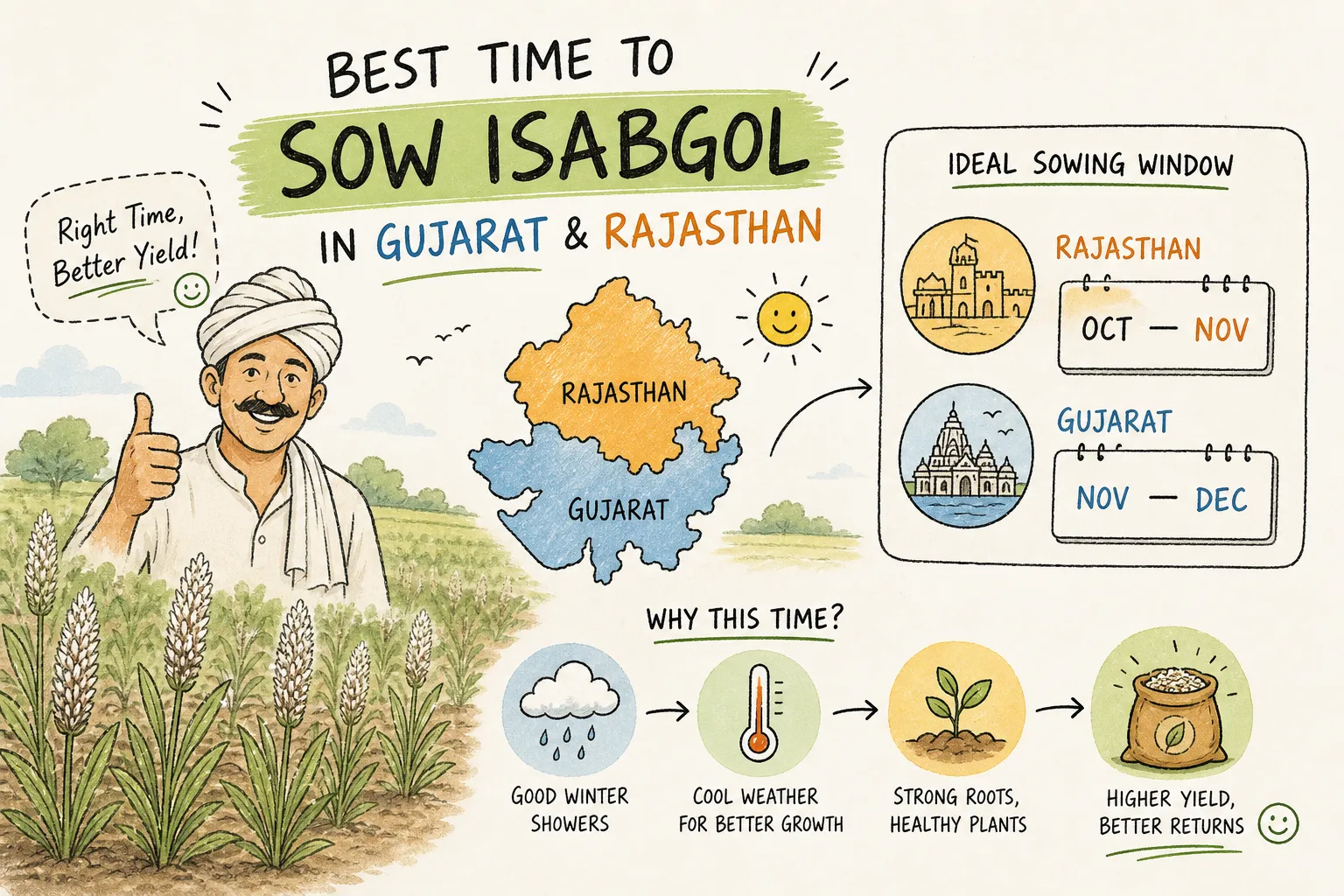
Isabgol is a rabi crop sown in November, with the first two weeks of November considered the ideal sowing window in both Rajasthan and Gujarat. Harvest runs through March to May. As fresh fasal floods mandis during this window, prices typically soften due to heavy arrivals. Once harvest-season supply is absorbed and stocks begin depleting heading into the kharif season, prices firm up. Understanding this cycle gives you the broad direction: sell during arrival peaks only if storage costs or moisture risk make holding impractical; the post-harvest months tend to reward patience.
Pharmaceutical and food industry demand
Psyllium husk is not a commodity in the usual sense. It is a pharmaceutical raw material for laxatives, bowel-regulation drugs, and dietary supplements, which means large institutional buyers run offtake contracts that smooth, but can also amplify, demand at the mandi. The India isabgol market is currently growing at roughly 7% CAGR, driven by digestive health awareness and nutraceutical product expansion across capsules, tablets, and flavoured fibre powders. When a large pharma exporter increases procurement ahead of a European health-food season, Unjha reacts within days and Rajasthan mandis follow. Keeping one eye on export news is a practical forward indicator for the kisaan making storage decisions.
Export volumes and currency effect on wholesale isabgol rates
India supplies over 85% of the world's psyllium husk, exporting roughly 52,000 to 55,000 tonnes annually to buyers in the United States, Germany, the United Kingdom, and the UAE. When the rupee weakens against the dollar, Indian isabgol becomes cheaper for foreign buyers, which lifts export demand and pushes Unjha prices higher. Conversely, a rupee-strengthening phase can soften exporter appetite. Tracking the dollar-rupee rate alongside mandi arrivals data gives a useful two-variable picture of where isabgol rates may head in the short term.
How quality grades affect the isabgol mandi price you actually receive
Understanding the Special, Standard, and General grade classification
APMC mandis use the IS 13662 grading standard for isabgol husk, which classifies produce into Special, Standard, and General grades based on moisture content, total ash, acid-insoluble ash, and organic extraneous matter. Special grade requires moisture below 10%, with very low ash and minimal extraneous matter. General grade allows moisture up to 11.5% and organic extraneous matter up to 12.5%. In practical terms, better drying and cleaning at harvest translate directly into a higher grade at the mandi, and that is not a technicality; it is money.
Commercial purity grades and their price premium
In actual wholesale trade, buyers classify isabgol husk by purity percentage: 85%, 95%, 98%, and 99% pure. The price difference between 95% and 99% purity husk is roughly ₹50 to ₹80 per kg, representing a 25 to 45% premium on the base price (based on market trade quotations; official APMC grade-wise price schedules are not publicly available). At current rates, that difference on 100 quintals of produce amounts to ₹5,00,000 to ₹8,00,000 in additional income for the same quantity of crop. Proper drying to control moisture and thorough cleaning to remove extraneous matter before bringing the fasal to mandi is among the highest-return activities a psyllium husk grower can undertake.
What deductions eat into your mandi price
The quoted mandi rate is never the amount that reaches your hand. Standard deductions on isabgol sales in Rajasthan mandis typically include a 0.50% farmer welfare cess, arhatiya (commission agent) commission of approximately 2%, plus packing, loading, and freight to the mandi. Note that some mandis may levy additional APMC charges as separate line items; confirm the full schedule with your local market committee. Together, these costs are estimated to reduce your net realisation by ₹500 to ₹1,000 per quintal below the quoted rate (illustrative, based on typical freight and packing assumptions). At a ₹12,000 modal price, your net receipt is likely closer to ₹11,000 to ₹11,500 per quintal after all deductions. Work out this number before accepting a quote, not after.
Where to check verified isabgol mandi rates online
KhetiKisaan: near-real-time isabgol mandi price listings
KhetiKisaan is built specifically for this problem. The platform provides near-real-time isabgol mandi price listings sourced from APMC auction floors across Rajasthan and Gujarat, covering Nagaur, Bikaner, Phalodi, Bhinmal, Jodhpur, and related centres, all in one place, without requiring a single phone call to each market committee. For a kisaan deciding whether to load today or wait, having current, mandi-wise data changes real decisions. Cross-check any figure that looks unusually high or low against Agmarknet to confirm you are acting on solid information.
Agmarknet and official APMC portals as cross-checks
Agmarknet, maintained by the Government of India, is the most authoritative publicly available source for mandi arrival data and prices. Its key advantage is that it shows arrival quantities alongside rates, which tells you whether a quoted price reflects heavy competitive trading or a thin-volume day where one buyer set the rate. Use Agmarknet alongside KhetiKisaan when a price looks unusually high or low. If both sources broadly agree, you can act with confidence. If they diverge significantly, the official committee-linked figure is usually the safer reference.
A quick note on NCDEX and futures pricing
NCDEX does list an isabgol index, but active futures trading in this commodity remains thin, with many sessions showing no trades. For physical sellers making day-to-day decisions, spot mandi rates from live APMC auctions are far more actionable than futures quotes. Track NCDEX for general directional awareness, but base your sell-or-hold decision on what the actual auction yards in Unjha, Nagaur, or Phalodi are transacting at on the day you plan to bring your fasal to market.
What to do with this information
The current isabgol mandi price range runs from ₹8,900 to ₹13,800 per quintal across major Rajasthan and Gujarat mandis, with modal trading mostly between ₹9,700 and ₹13,800. Phalodi and Nagaur show the strongest modal rates; Hanumangarh and Bhinmal sit at the softer end. Unjha remains the national benchmark. Year-on-year, the market has softened compared with 2024 peaks, which makes storage timing, quality preparation, and mandi selection more important than ever.
The single highest-return habit a psyllium husk grower can build is checking the isabgol mandi price daily in the two to three weeks before and after harvest. Grade your produce carefully, control moisture during storage, and compare at least two or three mandis before deciding where to take your fasal. The price differences between mandis on the same day are real and can run to thousands of rupees per quintal.
Bookmark KhetiKisaan for daily isabgol mandi rates sourced from APMC auction floors across Rajasthan and Gujarat, and cross-check with Agmarknet when it matters most. When you sell with current market intelligence rather than last week's rumour, the extra income per quintal adds up to a number worth caring about.
FAQs
Related Blogs

Oct 08, 2026
by Pankaj Sihag

Sep 23, 2026
by Pankaj Sihag

Sep 19, 2026
by Pankaj Sihag


Sep 09, 2026
by Pankaj Sihag
Sep 08, 2026
by Pankaj Sihag