





Best Time to Sow Isabgol in Gujarat and Rajasthan
 Sep 08, 2026
 by Pankaj Sihag



Best Time to Sow Isabgol in Gujarat and Rajasthan
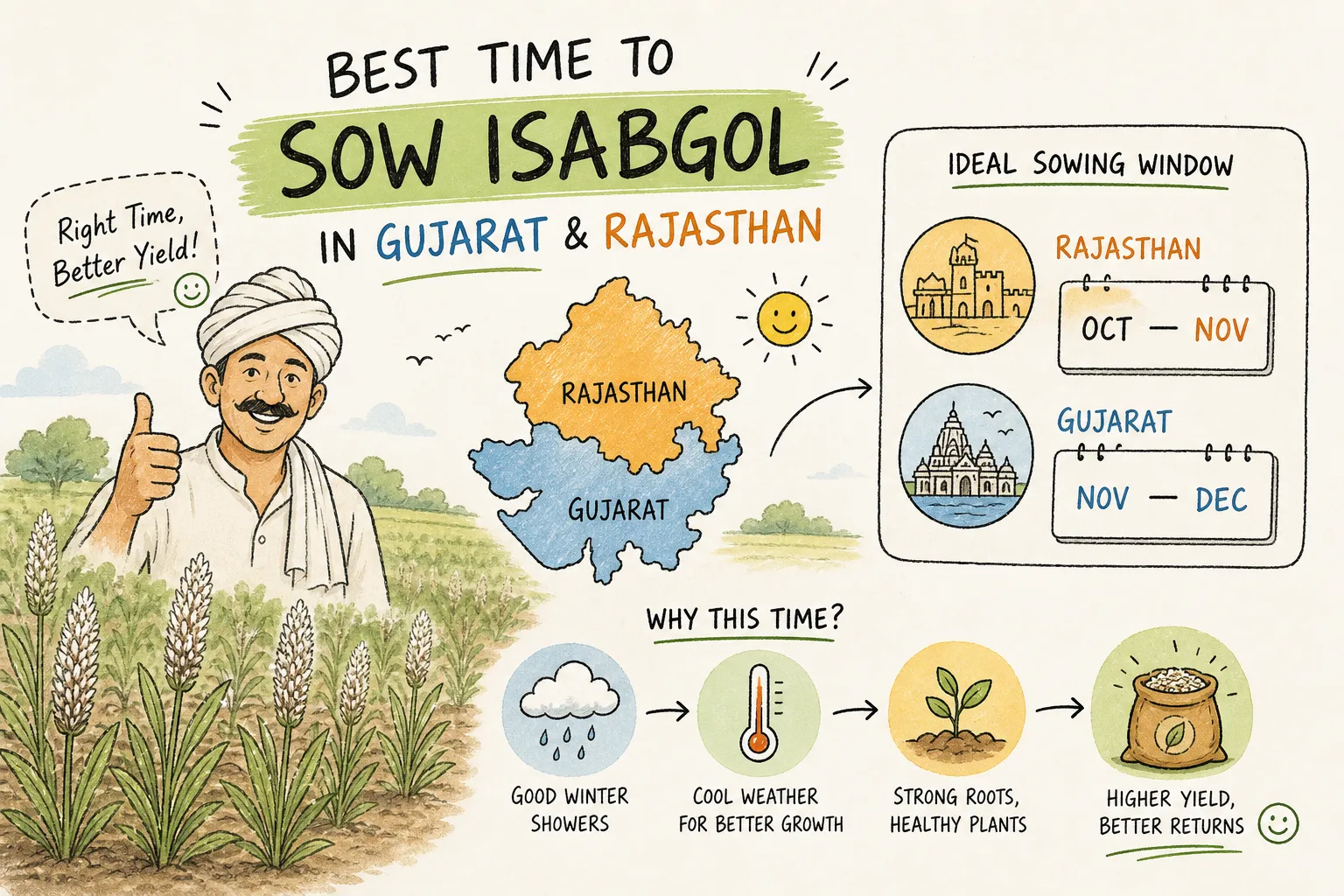
What is the best time to sow isabgol in Gujarat and Rajasthan? The answer is November, with the core optimum window falling between the first and third weeks of November across most growing districts. That said, both states have distinct agro-climatic zones, so "November" is not a blanket answer for every farmer. The right window in Banaskantha looks slightly different from Bikaner, and what works in Jodhpur's arid belt needs adjustment for wetter districts like Kota or Bundi.
At KhetiKisaan, we work closely with kisaans (farmers) across North Gujarat and Rajasthan's isabgol belt, and the single most common question we receive before every Rabi season is exactly this: when should I sow? This article gives you a zone-specific sowing calendar for both states, a clear breakdown of what early and late sowing actually costs you in yield, variety guidance for GI-1 and GI-2, and the key agronomic conditions your field must meet before the seed goes in.
 Table of Contents
- Why the sowing window is everything for isabgol fasal
- What is the best time to sow isabgol in Gujarat and Rajasthan?
- Rajasthan's zone-wise isabgol sowing calendar
- What early sowing before November actually costs you
- Why December sowing hurts yield and increases seed shattering
- Selecting the right isabgol variety for your agro-climatic zone
- Soil preparation and field conditions for strong crop establishment
- Plan your sowing now, protect your profit at harvest
- FAQs
Why the sowing window is everything for isabgol fasal
Isabgol is a cool-season, dry-weather Rabi crop with almost no tolerance for unseasonal rain or humidity, especially as it approaches maturity. Understanding why the timing matters so much is just as important as knowing the dates themselves, because a farmer who understands the logic can adapt when the season behaves unexpectedly.
Quick facts: isabgol at a glance
| Parameter | Details |
|---|---|
| Crop type | Rabi (winter season) |
| Scientific name | Plantago ovata |
| Major growing states | Gujarat, Rajasthan |
| Crop duration | 110, 130 days |
| Core weather requirement | Cool, dry conditions from sowing through harvest |
| Typical harvest period | Late February to March |
| Recommended varieties | Gujarat Isabgol-1 (GI-1), Gujarat Isabgol-2 (GI-2) |
The 110, 130 day growth cycle and how it fixes your sowing date
Isabgol takes 110, 130 days to mature from the day you put seed in the ground. Count backward from the safe harvest window of late February to early March, and you arrive directly at November as the only logical sowing month. If you sow on 10 November, your GI-1 or GI-2 crop is ready around late February to early March, exactly the cool, dry window these varieties need for harvest without seed shattering or moisture damage.
If the crop matures into warm, humid, or pre-monsoon conditions in March and April, seed shattering loss can cause very large and sometimes catastrophic losses before you even load the tractor. The sowing date is the one decision that determines whether your harvest window lands in safe weather or dangerous weather.
Why rain and dew are the crop's biggest enemies
Isabgol seeds are tiny and sit in open spikes. These spikes shatter on contact with moisture, whether it is a light rain shower or even heavy dew in the early morning. This biological sensitivity is why the entire agronomic strategy around isabgol is designed to keep the crop dry from start to finish. Even small moisture events near maturity can cause significant and irreversible yield loss.
What is the best time to sow isabgol in Gujarat and Rajasthan?
For North Gujarat farmers, the best time to sow isabgol in Gujarat and Rajasthan's comparable arid zones is between the second week of November and the second week of December, with the peak optimum falling in calendar Weeks 46, 48 (roughly 14 to 29 November). This window is consistently supported by Gujarat agronomy research and extension guidance, not a rough estimate.
North Gujarat: Banaskantha, Mehsana, and the Rabi heartland
Banaskantha and Mehsana are the dominant isabgol-producing districts of North Gujarat. The recommended sowing window here is mid-November to mid-December, with the strongest recommendations pointing to the second and third weeks of November as the core optimum. Soil temperatures in many isabgol-growing pockets in this region typically approach the 20, 25°C range by late October through November, as noted in local extension advisories, post-kharif soil moisture is largely spent, and a dry winter lies ahead, precisely the combination isabgol needs for healthy establishment and growth.
From a mid-November sowing date, you are looking at harvest readiness in late February to early March, which is 110, 115 days out for GI-1 and GI-2. Farmers who sow in the first week of November should start monitoring harvest indicators by late February. Do not wait for the field to look fully brown; check individual spikes for seed development and dryness before committing to harvest.
A practical sowing calendar for Gujarat
| Sowing window | Calendar weeks | Approximate dates | Recommendation |
|---|---|---|---|
| Optimal | Weeks 46, 48 | 14 to 29 November | Strongly recommended |
| Acceptable | Weeks 49, 50 | 30 November to 14 December | Acceptable with care |
| Risky / not recommended | Week 51 onwards | 15 December and later | Avoid if possible |
Note: Calendar week numbers follow ISO week convention. Week 46 begins on or around 14 November in a standard year; refer to your local KVK or extension advisory for exact dates in any given season.
What the harvest timeline looks like from a November sowing
A sowing on 15 November puts your crop at harvest readiness around 3 to 5 March, squarely within the dry, cool window. A sowing on 10 November pushes that back slightly to late February. Both dates work well. The earlier you go within the November window, the more buffer you have before warm weather arrives. That buffer is your insurance against any unexpected delay in harvest operations due to labour availability or equipment.
Rajasthan's zone-wise isabgol sowing calendar
Rajasthan's state government extension guidance states it plainly: sow isabgol from 1st to 31st November. That is the state-level guidance. But Rajasthan covers multiple agro-climatic zones with meaningfully different rainfall, humidity, and temperature profiles, so the zone-level adjustments matter.
Arid and hyper-arid northwest: Bikaner, Nagaur, Churu, Jodhpur
This is Rajasthan's traditional isabgol belt. The short, cool, dry winter here is tailor-made for the crop. Sowing in early to mid-November is recommended, and farmers in these districts should aim to finish sowing by the third week of November at the latest. The compressed cold period in this region means the crop needs every available growing day. Pushing sowing to late November or December here shortens an already tight winter window and directly reduces yield potential.
Semi-arid eastern plains: Jaipur, Ajmer, Dausa, Tonk
This zone is slightly cooler and receives marginally more winter moisture than the northwest belt. Mid-November sowing works well here, and the zone is a little more flexible than the arid belt. Even so, completing sowing before 20 November gives the best results. Farmers in this zone who delay past the third week of November are effectively accepting a reduced yield ceiling without gaining any agronomic advantage.
Sub-humid and humid southern zones: Udaipur, Kota, Bundi, Baran
Isabgol is not the dominant crop in these wetter districts, but where it is grown, the first two weeks of November are strongly preferred for sowing. Higher humidity and a greater risk of unseasonal late-season moisture make delayed sowing genuinely dangerous here. These farmers should treat the 15 November deadline as firm, not flexible.
| Agro-climatic zone | Key districts | Recommended sowing window |
|---|---|---|
| Arid / hyper-arid northwest | Bikaner, Nagaur, Churu, Jodhpur | Early to mid-November (by 20 November) |
| Semi-arid eastern plains | Jaipur, Ajmer, Dausa, Tonk | Mid-November (by 20 November) |
| Sub-humid / humid southern zones | Udaipur, Kota, Bundi, Baran | First two weeks of November only |
What early sowing before November actually costs you
Some farmers sow isabgol in October, thinking they are getting ahead of the season. The agronomic evidence is clear: October sowing generally produces more vegetative growth, higher lodging risk, and greater downy mildew incidence, often with lower or less reliable yields than November sowing. Earlier is not better for this fasal.
Excess vegetative growth and lodging risk
When isabgol is sown in October, warmer soil temperatures push the plant towards lush, leafy vegetative growth rather than reproductive development. This makes the stem structurally weak and the crop prone to lodging, where plants fall over under their own weight or in wind. Lodged crops are significantly harder to harvest mechanically, and seed recovery rates drop. The extra vegetative mass does not translate into extra seed yield; it works against you.
Downy mildew: the disease that thrives on early sowings
Downy mildew (Peronospora isabgolicola) is the most damaging disease in isabgol cultivation, and it thrives in exactly the conditions that October sowing creates: warm temperatures, higher relative humidity, and a young, lush crop canopy. Once the pathogen establishes itself in the early vegetative stage, it is difficult to reverse even with fungicide applications. The recommended management involves seed treatment with metalaxyl at 4 g/kg seed and foliar sprays of metalaxyl at 0.2% at 15-day intervals starting from first appearance of symptoms. Prevention through correct sowing timing is far more effective and cheaper than a reactive spray programme.
Is November the best month to sow isabgol in Gujarat and Rajasthan?
Yes, and the yield data is consistent. Trials conducted at institutions including SAU Anand (Gujarat) and CAZRI Jodhpur (Rajasthan) show that early November sowing produces the highest or near-highest seed yields per hectare, while October sowing produces lower and less stable results. The reason is straightforward: the crop is designed to grow in cool, dry conditions, and forcing it into warm, humid October conditions invites every major stress it cannot handle. A November-sown crop works with the season; an October-sown crop fights it.
Why December sowing hurts yield and increases seed shattering
Sowing after mid-December shortens the effective winter growing period and increases the risk of the crop maturing into warm, increasingly humid conditions in March and April. Both effects directly reduce your profit per quintal in ways that no amount of extra irrigation or inputs can compensate for.
How a shorter growing period limits yield potential
Isabgol needs 110, 130 cool-weather growing days to develop fully and fill its seed spikes. A December sowing compresses this window at both ends: the crop starts in cooler-than-optimal soil temperatures, and it finishes in warming weather. The result is underdeveloped spikes, lighter seed weight, and lower total yield per hectare. Even a two-week delay past the optimum sowing date produces a measurable and documented drop in output.
Seed shattering: the hidden cost of late maturity
A December-sown crop matures in late March or April, when temperatures are rising and pre-monsoon humidity can build. The isabgol spike is extremely sensitive at maturity: contact with moisture, whether from a light shower, dew, or high ambient humidity, causes the tiny seeds to shatter and fall before you can harvest them. This is direct, irreversible yield loss. Unlike a lower germination rate or a smaller spike, shattering loss happens in hours and cannot be recovered once it starts.
The window is firm: what the research says about December sowing
Study findings across multiple locations in Gujarat and Rajasthan are consistent: sowing beyond early December is associated with a marked and reliable decline in yield. This is not a marginal risk that a favourable season might offset. It is a documented pattern that repeats across different soil types, districts, and years. The sowing window is firm because the biology of the crop is firm.
Selecting the right isabgol variety for your agro-climatic zone
For both Gujarat and Rajasthan, Gujarat Isabgol-1 (GI-1) and Gujarat Isabgol-2 (GI-2) are the primary recommended varieties, both maturing in 110, 115 days. Variety selection is not just about yield potential; it directly determines how your chosen sowing date maps to your harvest window.
Gujarat Isabgol-1 (GI-1) and Gujarat Isabgol-2 (GI-2): the go-to choices
GI-1 and GI-2 are the most widely recommended varieties for isabgol cultivation across both states. Both mature in 110, 115 days, which directly confirms why a first-to-third week November sowing is ideal. Counting forward 110, 115 days from 10 November lands squarely in late February to early March, exactly the dry, cool harvest window these varieties need to deliver their seed yield without shattering risk. This alignment between variety maturity and sowing date is not coincidental; it is the agronomic design you should work with, not around.
Gujarat Isabgol-3 (GI-3): a brief note
GI-3 is a Gujarat-bred line that some farmers in the region have started exploring. Confirmed maturity data and state-specific sowing recommendations for GI-3 are less established than for GI-1 and GI-2. Before committing seed money to GI-3, consult your nearest Krishi Vigyan Kendra (KVK) for the latest district-specific performance data and whether it has been formally recommended for your block.
How to back-calculate your sowing date from your variety's maturity period
Use this two-step framework every season regardless of which variety you choose:
- Identify your target harvest window based on your district's typical weather. For most isabgol-growing districts in Gujarat and Rajasthan, this is the last week of February to the second week of March.
- Subtract your variety's maturity period (110 to 115 days for GI-1 and GI-2) from your latest acceptable harvest date to arrive at your latest acceptable sowing date.
If your latest safe harvest date is 10 March and your variety matures in 115 days, your latest sowing date is around 15 November. This logic works for any variety and any zone, and it empowers you to adapt each season without depending on generic advice.
Soil preparation and field conditions for strong crop establishment
Even a perfectly timed sowing fails without the right field conditions. Isabgol is a small-seeded crop with specific requirements for soil, drainage, temperature, and moisture management. Getting these conditions right before sowing is as important as getting the date right.
Soil type and drainage: sandy loam is non-negotiable
Isabgol performs best in well-drained sandy loam or light sandy soils. Waterlogging at any growth stage is damaging and increases both fungal disease risk and root stress significantly. Fields with heavy clay, poor internal drainage, or hardpan layers close to the surface should be avoided for this crop. If your available fields have moderate drainage limitations, attend to them before sowing with deep tillage or field levelling rather than trying to manage the problem after the seed is in the ground.
Ideal germination temperature: the 20, 25°C window
Seed germination is most reliable at soil temperatures of 20, 25°C. This temperature range is one of the main biological reasons why mid-November sowing makes such consistent agronomic sense: soil temperatures in many isabgol-growing pockets across both states typically approach this range during late October and November, based on local extension advisories. Sowing in October means germinating in warmer soil, and sowing in December means germinating in cooler-than-ideal soil, both of which reduce establishment reliability.
Managing dew and early-season moisture risk
To reduce dew-related establishment problems, choose slightly elevated, well-aerated plots rather than low-lying fields where cold air and moisture pool overnight. Avoid sowing immediately after irrigation into overly wet soil. Keep the field free of excessive crop residue from the previous kharif crop, as residue traps moisture and creates microclimatic conditions that favour damping-off and downy mildew in the early seedling stage.
Once the isabgol crop is established and growing steadily in cool, dry winter conditions, moisture risk drops significantly until it rises again near harvest. The establishment phase and the harvest phase are your two most critical moisture-management windows, plan field preparation and monitoring around both.
For line sowing in sandy loam soils, use approximately 4 kg seed per hectare at a row-to-row spacing of 30 cm. This spacing allows adequate airflow between rows, which further reduces humidity buildup and disease pressure.
Plan your sowing now, protect your profit at harvest
The action is clear. For Gujarat farmers, complete isabgol sowing between the second week of November and the second week of December, with the first to third week of November as the true optimum. For Rajasthan farmers, the 1 to 31 November window holds as the state-level guidance, adjusted to the first two weeks of November for wetter southern districts and with a firm mid-November deadline for the traditional arid northwest belt. GI-1 and GI-2 are your most reliable variety choices across both states.
Keep two main risks in mind throughout the season. October sowing invites downy mildew and lodging, both of which cut into your yield before the crop even flowers. December sowing shortens the cool growth period and pushes maturity into warming, potentially humid weather, increasing seed shattering risk at exactly the point when you need the field to stay dry. Both errors cost real money per quintal, and both are avoidable with disciplined sowing timing.
A well-timed isabgol fasal sown in November gives you a healthy crop standing in your field in late February, ready for harvest in March's cool, dry conditions. So, if you ask what is the best time to sow isabgol in Gujarat and Rajasthan, sow in November, with district-level adjustments as described above. At that point, the agronomic work is done and the market work begins. Knowing the live isabgol mandi bhav across Rajasthan and Gujarat mandis before you load your produce becomes as important as any decision you made in the field. KhetiKisaan gives you both: the right sowing knowledge and the right price information to see the season through from field to sale.
FAQs
Related Blogs

Oct 08, 2026
by Pankaj Sihag
Sep 23, 2026
by Pankaj Sihag
Sep 19, 2026
by Pankaj Sihag

Sep 09, 2026
by Pankaj Sihag