







Narma vs Desi Kapas: Which Cotton Pays More in Haryana?
 Sep 02, 2026
 by Pankaj Sihag



Narma vs Desi Kapas: Which Cotton Pays More in Haryana?
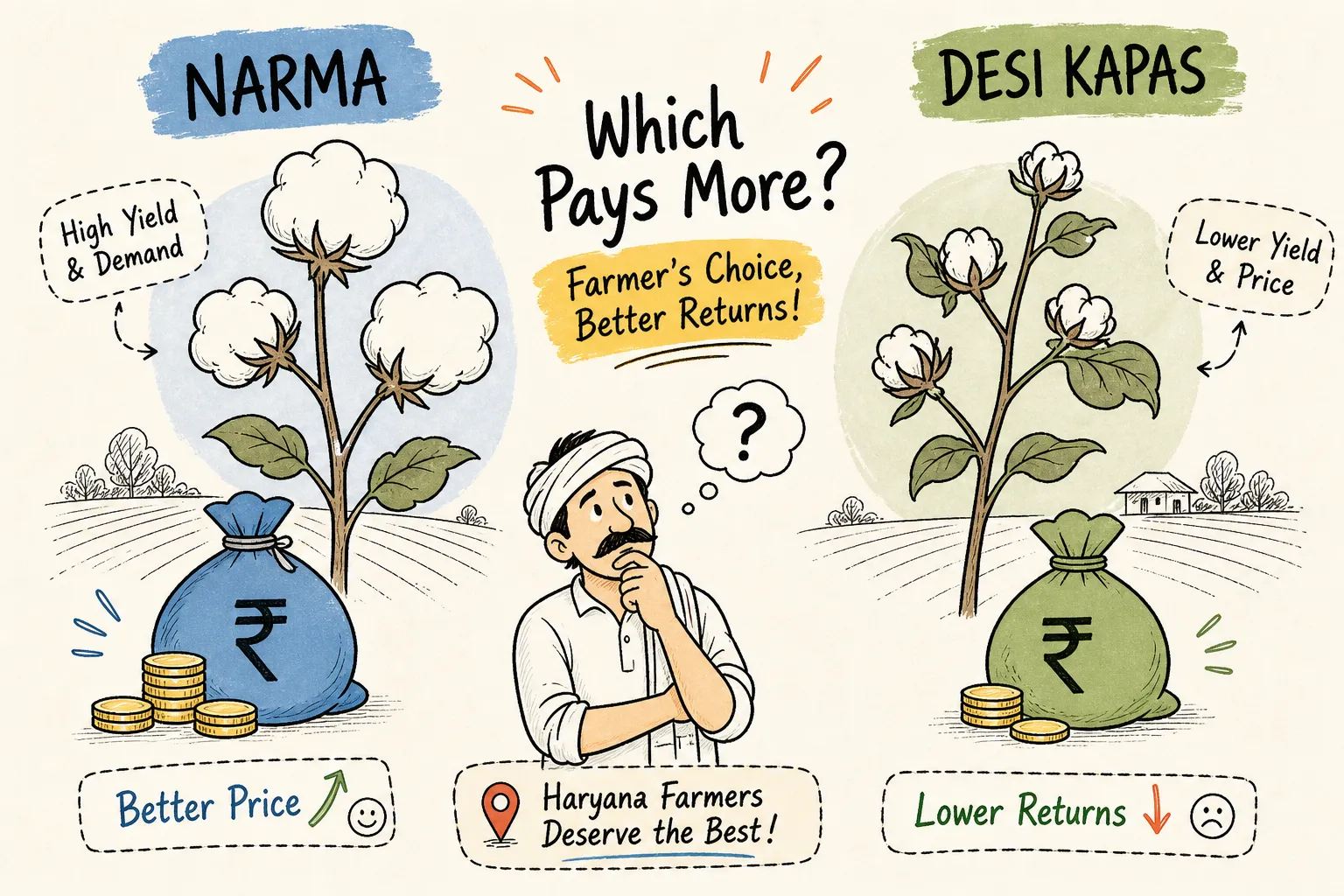
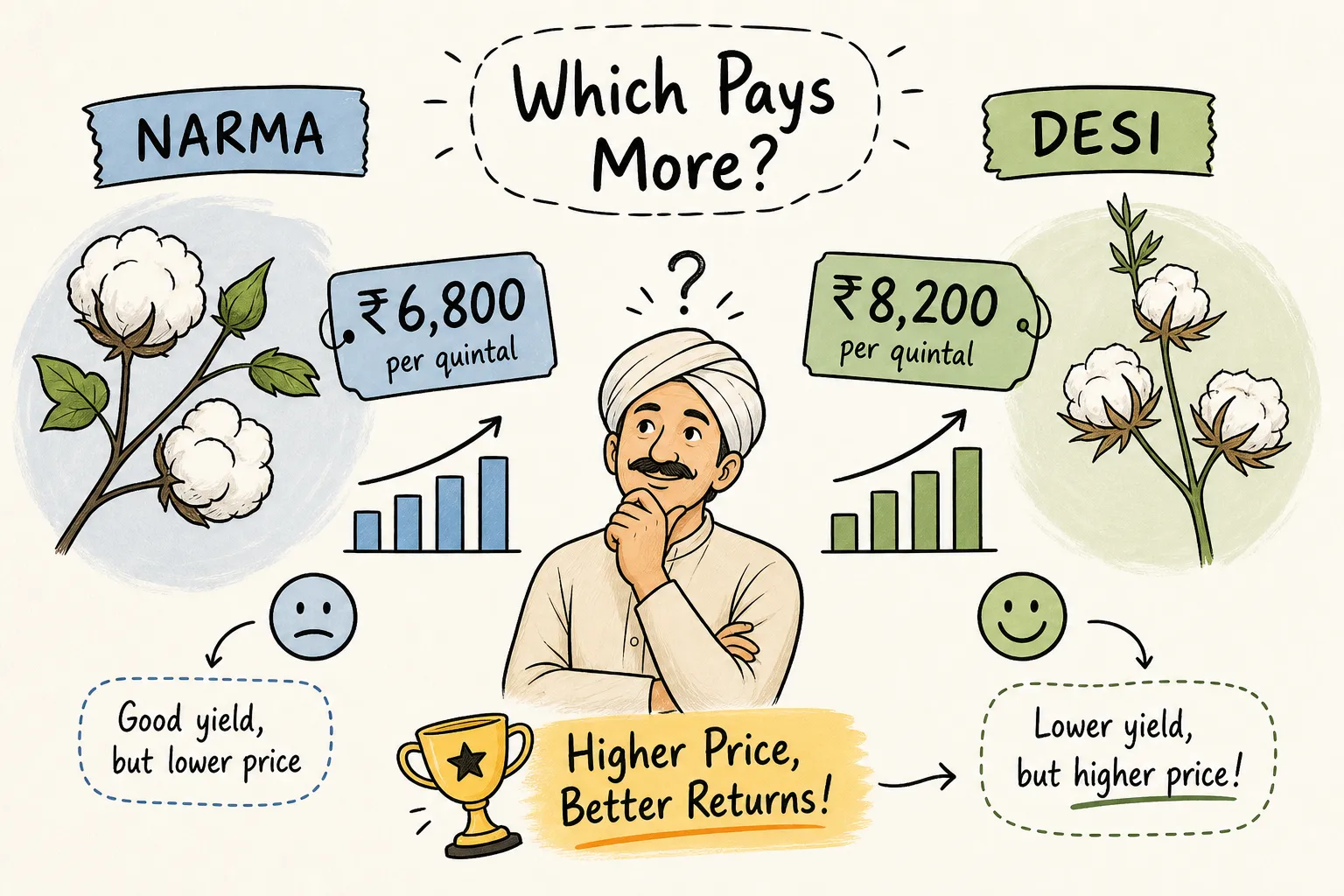
If you grow cotton in Haryana and want to know which cotton variety gives better price, Narma or desi cotton in Haryana mandis, the honest answer is: it depends on the day, the mandi, and what you bring in your trolley. The price relationship between the two varieties is not fixed. In these mandis, it often flips by season and arrival volume, Narma can command premiums on many lean-month dates, but desi kapas sometimes trades at a modest premium during peak-arrival periods when Narma lot quality is inconsistent. Desi kapas also carries a higher government MSP and attracts niche premiums in specific conditions that Narma simply cannot access.
This article breaks down both varieties on price, fibre quality, buyer preference, and timing so you can walk into the next auction with a clear plan rather than hoping for the best.
| Parameter | Narma (BT Cotton / G. hirsutum) | Desi Kapas (G. arboreum / G. herbaceum) |
|---|---|---|
| MSP 2026-27 | ₹8,267/quintal (medium-staple) | ₹8,667/quintal (long-staple, CACP classification) |
| Typical staple length | 28 to 32 mm | 19 to 29.3 mm (mean ~24.1 mm) |
| Micronaire (fineness) | 3.8 to 4.5 (fits mill spec) | 5.0 to 5.6 (coarser, outside mill spec) |
| Fibre strength | 28 to 32 g/tex | 20 to 26 g/tex (variable) |
| Primary buyers | Ginners, spinning mills | Handloom, khadi buyers, local ginners |
| Key growing districts (Haryana) | Sirsa, Fatehabad, Dabwali | Smaller pockets; border areas near Rajasthan |
 Table of Contents
- What separates Narma and desi kapas as crops in Haryana
- Cotton MSP in Haryana: the price floor you must know before auction day
- Which cotton variety gives better price in Haryana mandis: actual auction data
- Fibre quality: why staple length directly affects your bid price
- Why spinning mills and ginners keep bidding harder for Narma
- When desi kapas commands a premium: the organic and handloom opportunity
- Seasonal timing: when to bring your cotton to auction
- Check live kapas mandi bhav on KhetiKisaan before you load your trolley
- FAQs
What separates Narma and desi kapas as crops in Haryana
Narma, known commercially as American cotton or BT cotton, is the dominant kharif cotton crop across Sirsa, Fatehabad, and the Dabwali belt in Haryana. Most Narma cultivation here uses BT hybrid seeds, which offer higher yields per acre than desi varieties and better pest resistance against bollworm. The shift to BT Narma happened rapidly across Haryana's cotton belt because yield gains were immediately visible and the variety matched ginner procurement standards without extra effort.
Desi kapas is a different story. The plant is shorter, matures faster, and tolerates lower-fertility soils better than most BT Narma hybrids. Desi varieties tend to be more pest-resistant, which can reduce pesticide use for many growers, particularly against sucking pests, and this lower input requirement appeals to farmers in Haryana's border districts and nearby Rajasthan areas. The draw is clear: lower risk, lower investment, and a market in the handloom and khadi sectors that does not exist for Narma.
Cotton MSP in Haryana: the price floor you must know before auction day
The government-declared MSP for cotton in 2026-27 is ₹8,267 per quintal for medium-staple cotton (Narma) and ₹8,667 per quintal for long-staple cotton (desi kapas, under CACP grading classification, though the mean fibre length of desi kapas is shorter than commercial Narma). This surprises many farmers because desi kapas carries a ₹400/quintal higher floor price than Narma on paper. The reason is that CACP (Commission for Agricultural Costs and Prices) uses a staple-length classification in its quality hierarchy: the long-staple regulatory grade commands a higher MSP.
In practice, the MSP is a floor, not a guarantee. If a Narma lot in Sirsa attracts strong mill demand on a specific day, it can comfortably sell above ₹8,000/quintal. But if arrivals are heavy during peak October to November, or if a lot has moisture damage, bids can fall well below MSP for both varieties. When that happens, the Cotton Corporation of India (CCI) and state procurement agencies such as HAFED operate procurement under MSP support operations in Haryana. If your bid is below MSP, approach the nearest CCI or HAFED procurement centre rather than accepting a distress price from a private trader. Document your lot quality and moisture content before presenting it, as procurement agencies assess quality before acceptance.
Which cotton variety gives better price in Haryana mandis: actual auction data
The price gap between Narma and desi kapas does not behave consistently across mandis or across seasons. For real-time price details, visit khetikisaan narma bhav.
What this data tells you is straightforward: the price relationship between Narma and desi kapas flips depending on season, arrival volumes, and lot quality. During post-harvest peak arrivals in October to November, desi kapas sometimes holds a modest premium because Narma lots arriving with rain damage or mixed quality drag down the overall Narma bid. In lean months from April to June 2026, Sirsa data shows Narma commanding a strong premium of ₹500 to ₹1,300/quintal over desi kapas as mill demand pushes Narma bids higher.
Fibre quality: why staple length directly affects your bid price
Mandi bol-chaal (bidding) is not random. A buyer inspecting your lot at the mandi is estimating fibre quality by appearance, hand feel, and often a simple HVI reading from his ginner's previous experience with your village's cotton. Three quality parameters determine where your lot lands in the day's bidding range: staple length, micronaire, and fibre strength.
Desi kapas fibre typically ranges from 19 to 29.3 mm in staple length, with a mean of about 24.1 mm across cultivated types. Commercial quality cotton that spinning mills actively bid for is expected in the 28 to 32 mm range. Narma BT cotton generally meets this specification. The price consequence is direct: each extra millimetre of staple length adds approximately ₹100 to ₹150 per quintal to the bid. A desi kapas lot averaging 23 mm staple versus a Narma lot at 30 mm therefore represents a potential gap of ₹700 to ₹1,050 per quintal from staple length alone, before any other quality factor is considered.
Micronaire measures fibre fineness and maturity. Spinning mills in North India prefer a micronaire band of 3.5 to 4.5, with 4.0 to 4.5 considered optimal. Desi cotton typically shows micronaire values of 5.0 to 5.6, which falls outside this preferred range and signals coarser fibre. When a ginner processes desi kapas for a mill with modern ring-spinning equipment, the coarser fibre creates more yarn breakages and higher waste. The commercial result: ginners will either discount their bid or skip the lot entirely. Fibre strength is the third factor: mills prefer 28 g/tex and above, while desi cotton commonly falls in the 20 to 26 g/tex range. Better desi lines or unusually clean lots can reach the lower end of the acceptable strength band, but this is not consistent across fields.
Why spinning mills and ginners keep bidding harder for Narma
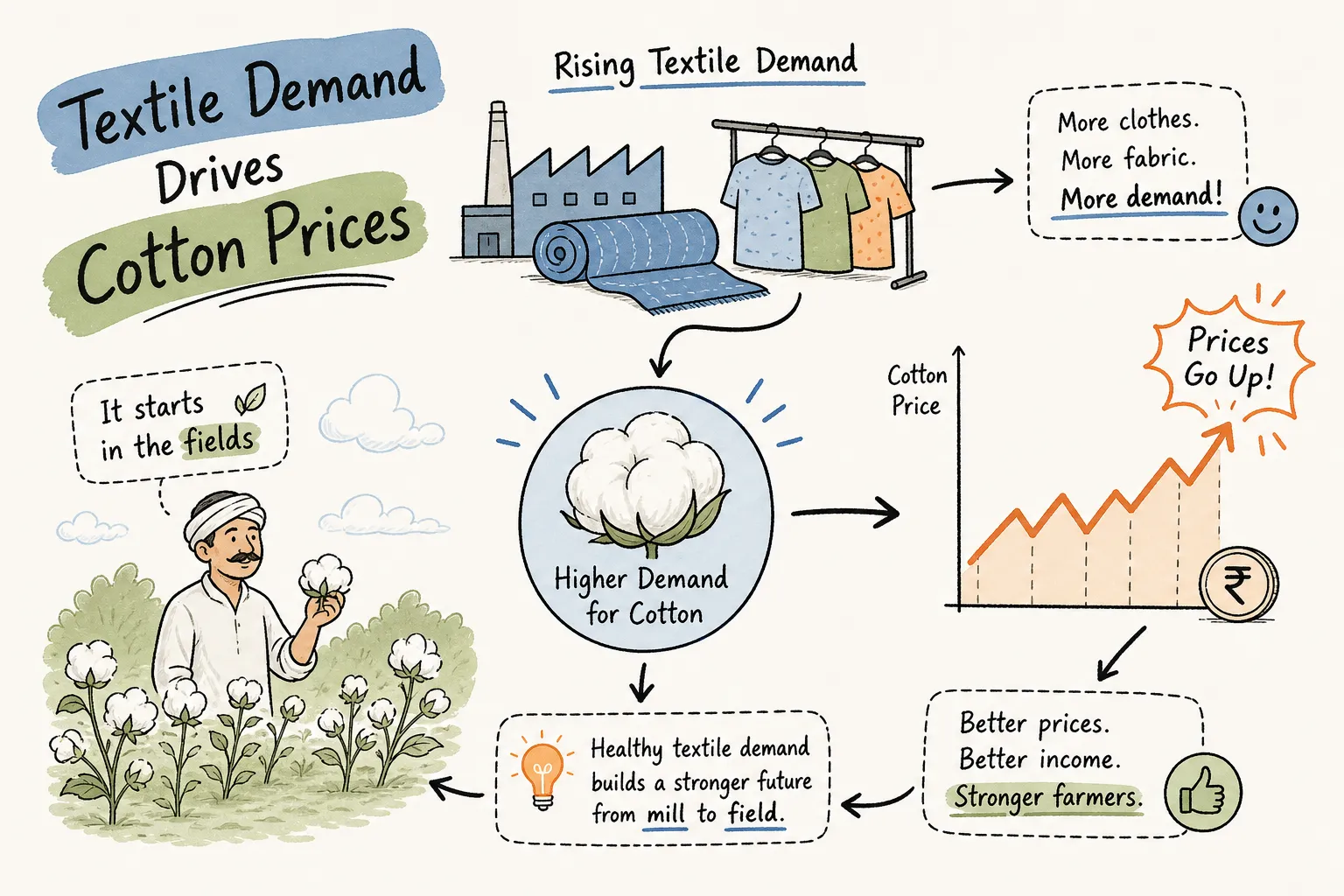
The majority of cotton demand in Haryana mandis comes from ginners who supply North Indian spinning mills. Their fibre specifications are set by their mill customers, and those specifications do not flex easily. Modern ring-spinning and open-end spinning machinery is calibrated for 28 to 32 mm staple length with micronaire between 3.5 and 4.5 and strength above 28 g/tex. Narma BT cotton fits this profile. Desi kapas, with its shorter staple and higher micronaire, does not fit the same machines without accepting higher waste percentages and more frequent yarn breaks.
This buyer preference has a direct effect on the bol-chaal process at your mandi. When more ginners and mill agents compete for the same Narma lot, the bid climbs faster and settles higher. A desi kapas lot in the same auction may attract only one or two bids from local buyers, which limits how high the price can go. More bidders per lot equals better price realisation for the farmer, which is why Narma's mill-friendly profile translates into a stronger auction outcome on many days, even when the MSP for desi kapas is technically higher.
When desi kapas commands a premium: the organic and handloom opportunity
Desi kapas has one market advantage that Narma simply cannot access: the organic cotton and handloom segment. G. arboreum is naturally more resistant to sucking pests than BT Narma, which means many farmers grow it with fewer or zero chemical pesticide applications. This makes it far easier to certify as organic or pesticide-free, and that opens a completely different buyer category.
Handloom weavers, khadi-sector procurement agencies, and export-facing organic textile units pay significantly above standard mandi rates for certified or traceable desi lots. Available 2026 market data suggests handloom and khadi buyers pay in the range of ₹8,000 to ₹12,000 per quintal, and organic cotton premiums at the farm gate can reach 40 to 60 per cent above conventional mandi rates, implying realisations of ₹11,000 to ₹14,000 per quintal for properly certified lots. The catch is that this channel requires direct buyer linkage and does not work through the standard APMC auction route. You need a buyer relationship before you grow the crop, not after.
Even within the regular mandi, desi kapas can surprise. When Narma arrivals surge and lot quality is mixed due to rain damage, a clean and dry desi kapas lot stands out. The ₹540/quintal desi premium recorded at Sri Ganganagar in October 2024 was driven partly by this dynamic: Narma lot quality was inconsistent on that date, while the desi lots available were uniform. Farmers who time their sale of desi kapas to such counter-seasonal windows benefit from a relative scarcity premium.
Seasonal timing: when to bring your cotton to auction
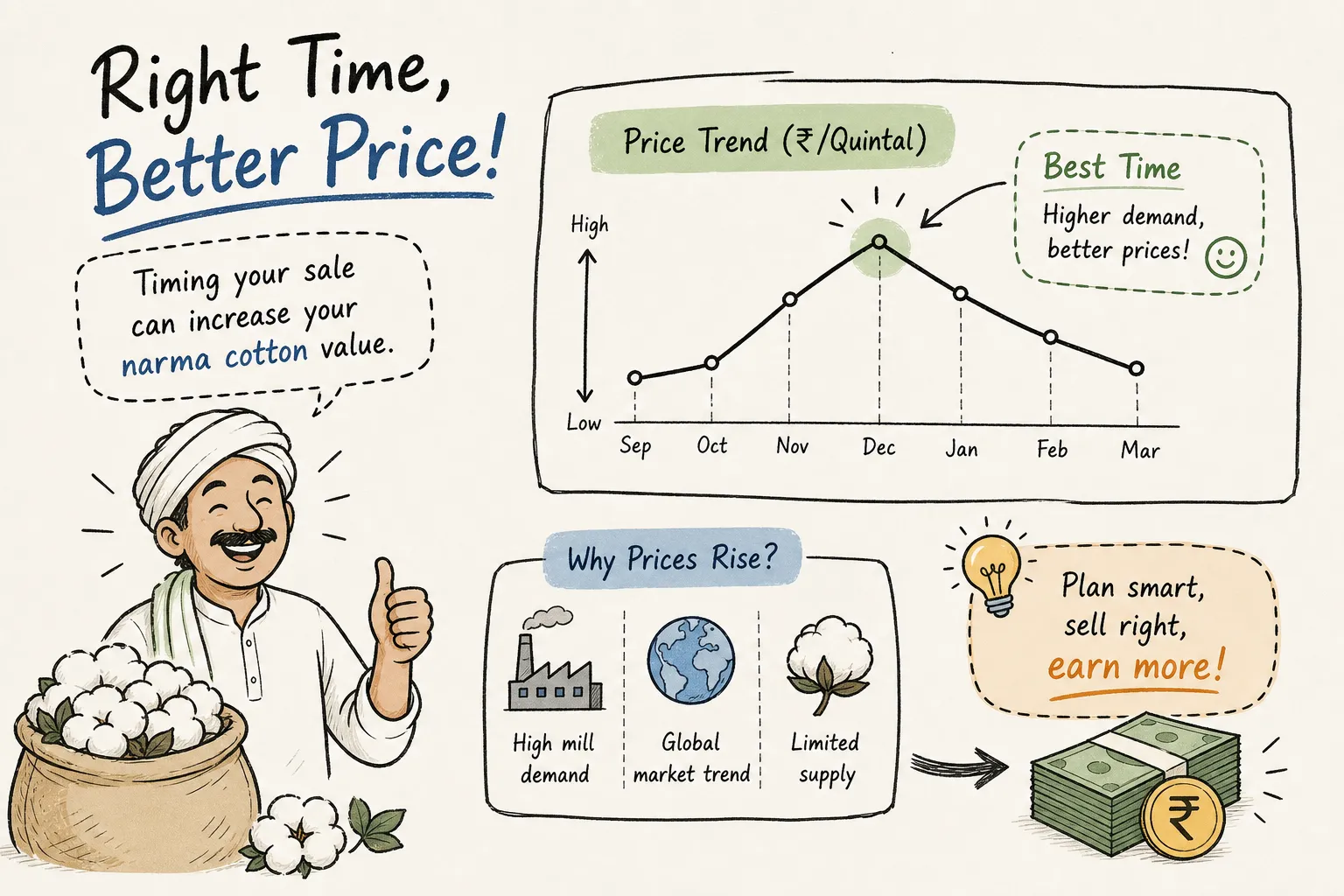
Timing your mandi sale is as important as which variety you grow. Haryana cotton mandis follow a predictable arrival calendar: October to January is peak arrival season, and prices are typically at their weakest during this window. Arrivals begin rising sharply in October, reach peak volume in December, and start easing only in January. During this period, ginners have plenty of choice and bids are competitive only for the best-quality lots.
Farmers who bring rain-damaged or mixed-quality lots during peak arrivals often accept distress prices below ₹6,500/quintal. The Sirsa data from October 2025 shows Narma touching ₹6,000 at the lower end of the day's range, well below the MSP of ₹8,267. The contrast with late-season prices is stark: Sirsa Narma was quoting ₹8,070 on 9 April 2026 and ₹8,700 at the upper end of the range in May to June 2026, as mill demand continued and arrivals thinned out.
If you have access to dry pucca storage, a well-sealed kothi or a registered warehouse, holding your harvest from October until January to March consistently produces better net realisations for both Narma and desi kapas. Based on observed Sirsa price movements, the improvement over a three-to-four month hold has in some instances reached ₹500 to ₹1,500/quintal, though the actual gain depends on your storage cost, moisture control, and market timing in that particular season. The condition is non-negotiable: the cotton must be dry at the time of storage (below 8 per cent moisture) to avoid quality deterioration. Wet cotton stored even for two weeks can lose significant fibre quality and attract a large moisture discount at auction.
- October to November: avoid selling unless quality is excellent and your trolley is first in line on a good-demand day.
- December: prices remain under arrival pressure; sell only if storage is not available.
- January to February: arrivals ease and prices begin to firm, a practical selling window if storage costs are becoming a concern.
- March to April: lean supply period; typically the strongest prices of the season for both varieties.
Check live kapas mandi bhav on KhetiKisaan before you load your trolley
All the patterns above are useful context, but your decision on loading day depends on what the mandi is actually doing that morning. A ₹300 to ₹500/quintal difference between two mandis on the same day is not unusual, and on 50 quintals of Narma, that gap is ₹15,000 to ₹25,000 in your pocket or out of it.
KhetiKisaan sources cotton mandi bhav through on-ground contacts who are physically present at live APMC auctions during actual bol-chaal bidding in Haryana mandis, including Sirsa and Fatehabad. According to the platform's stated data-collection practice, the rates reflect what was actually transacted at the day's auction, not delayed government feeds or state-level averages. For a farmer deciding whether to load the tractor that evening or wait for the next market day, this difference matters considerably.
A practical scenario: you are in Sirsa with 50 quintals of Narma kapas. You check KhetiKisaan the evening before auction day and see that Fatehabad is quoting ₹300/quintal higher for similar-quality lots. The additional transport cost to Fatehabad is ₹50/quintal. Your net gain from choosing the right mandi is ₹250/quintal, which adds ₹12,500 to your total realisation without changing anything about your crop. Similarly, if you have a desi kapas lot and want to know whether the handloom buyer premium is active this week, checking the platform's price trend before committing to a date gives you the information you need to decide between selling now or holding for a better opportunity.
Beyond live mandi bhav, KhetiKisaan also covers MSP updates, crop guides for both Narma and desi kapas, weather alerts for the Haryana cotton belt, and information on government procurement schemes, all in one place. Reach out to the KhetiKisaan team directly if you need guidance specific to your district or crop variety.
FAQs
Related Blogs

Oct 02, 2026
by Pankaj Sihag

Sep 12, 2026
by Pankaj Sihag
Aug 27, 2026
by Pankaj Sihag

Apr 11, 2026
by Pankaj Sihag
Apr 08, 2026
by Pankaj Sihag