







Where to Check Daily Narma Ka Bhav Online in India
 Oct 02, 2026
 by Pankaj Sihag



Where to Check Daily Narma Ka Bhav Online in India
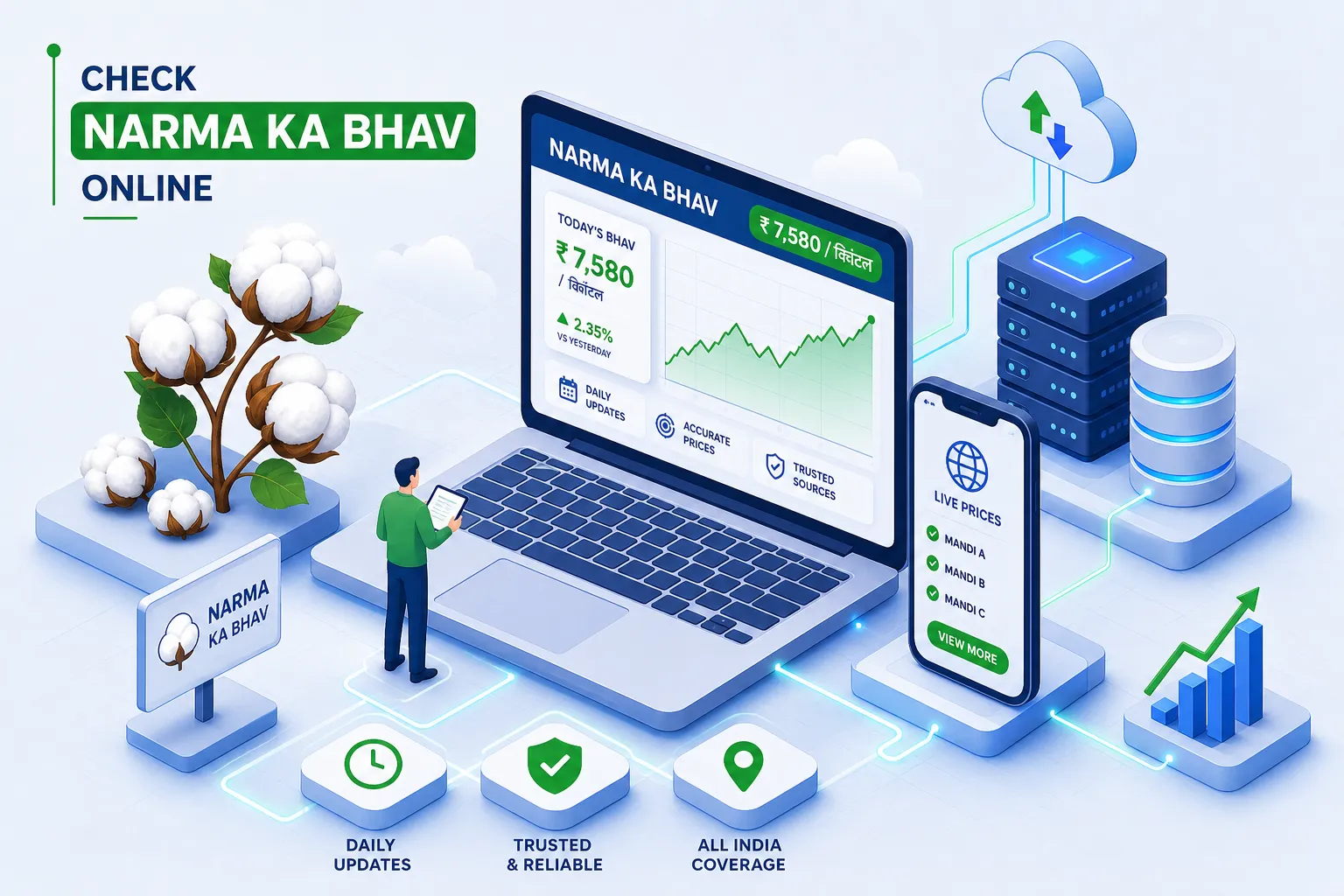
Picture this: it is 5 in the morning, your trolley is loaded with narma, and you are about to head to the mandi. But you have no idea whether today's rate will be ₹8,400 or ₹8,700 per quintal. That ₹300 gap on 50 quintals is ₹15,000, not a small amount. If you have been wondering where can I check daily narma ka bhav updates online, the answer is that several reliable platforms now carry this information, with services like KhetiKisaan pulling rates directly from live APMC auction yards in Rajasthan. By the end of this article, you will know exactly which sources to trust, how to check daily narma ka bhav updates online across each one, and how to read any price quote correctly before you make a selling decision.
Narma (also called kapas in many mandis) is a widely grown cotton variety across North India's agricultural belt, covering Rajasthan, Haryana, and Punjab. During peak kharif marketing season in October, arrivals at a mandi like Hanumangarh can touch 7,000 quintals per day. With that much supply moving daily, prices shift quickly. A rate from two days ago is practically useless for a same-day selling decision. Getting your bhav information from the right source, at the right time, in the right unit is the difference between a good season and a disappointing one.
- Narma (kapas) prices are quoted per quintal (100 kg) at APMC mandis
- Key North Indian narma mandis: Hanumangarh, Sri Ganganagar, Nohar, Pilibanga
- Main online sources to check daily narma ka bhav: AGMARKNET, KhetiKisaan, NaPanta,e-NAM, local WhatsApp groups
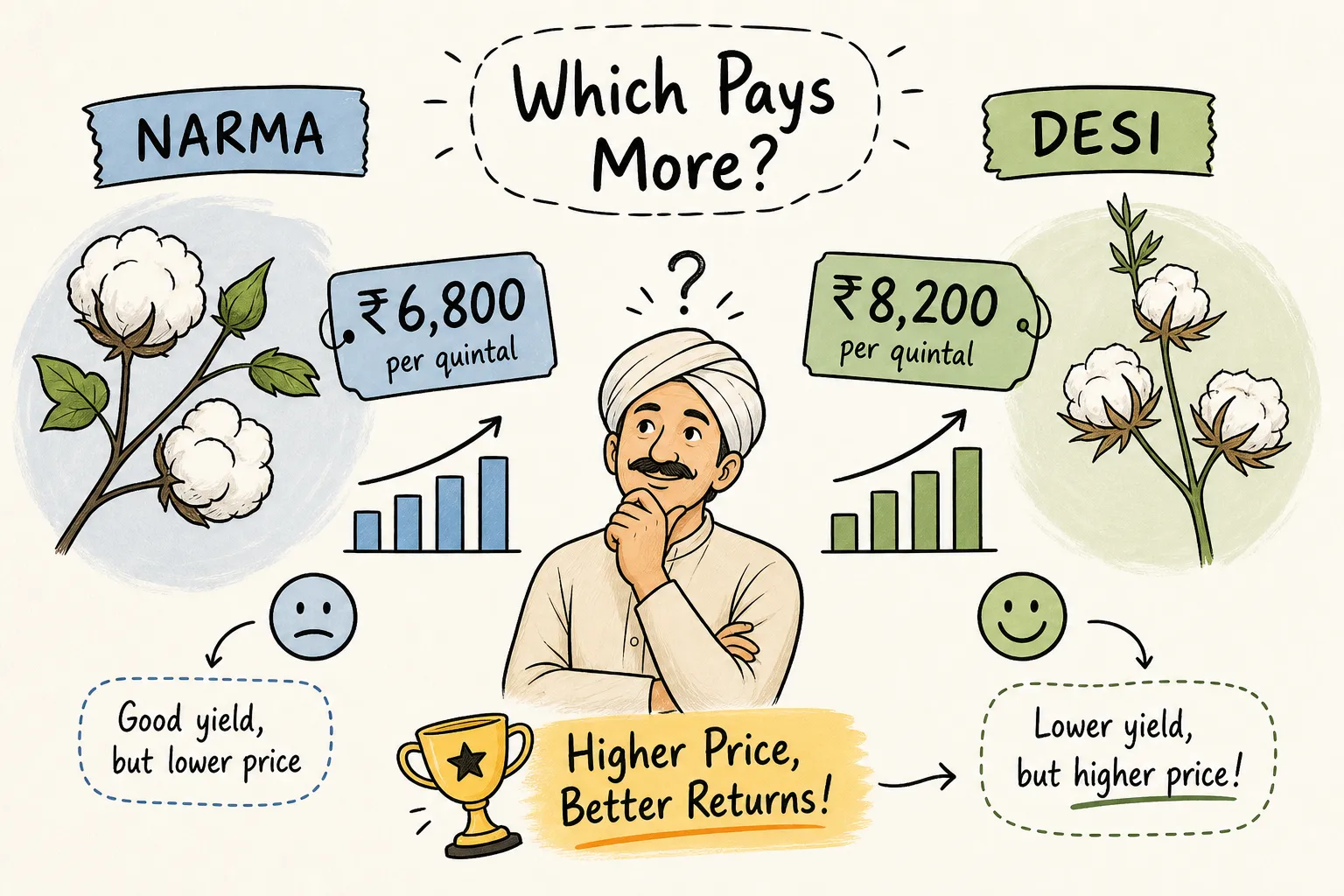
- Narma BT hybrid fetches about ₹300, ₹600 more per quintal (commonly ₹400, ₹600) than desi kapas at North Indian mandis this season, depending on mandi and quality
- MSP for narma (medium-staple cotton) for the 2026, 27 kharif season is ₹8,267 per quintal
- Always verify the date, unit, mandi name, and variety before acting on any quoted rate
 Table of Contents
- Why the source you use for narma bhav directly affects what you earn
- Where can I check daily narma ka bhav updates online? Government portals first
- KhetiKisaan: check daily narma ka bhav updates online from inside the auction yard
- Other private apps and platforms worth checking
- WhatsApp groups and local mandi networks: useful but verify everything
- Narma price units decoded: quintal, candy, and how to read any quote correctly
- How to verify if a narma bhav quote is actually reliable
- Make every quintal count this season
- FAQs
Why the source you use for narma bhav directly affects what you earn
Two farmers in the same village can realise very different prices for the same narma on the same day. The one who checked a reliable, current rate walked into the mandi knowing his leverage. The other guessed, or trusted a forwarded screenshot, and settled for whatever the buyer offered. This is a common situation in many major narma mandis during peak harvest weeks, and it is entirely avoidable once you know where to check daily narma ka bhav updates online.
Narma prices can vary by ₹200, ₹400 per quintal across nearby mandis on the same day. Sri Ganganagar, Nohar, and Hanumangarh can each quote a different rate on the same morning depending on how heavy the arrivals are and how many active buyers are present at the auction. Acting on stale data does not just leave you uninformed; it removes your ability to negotiate, choose the right mandi, or decide whether to hold your stock for one more day.
The problem with guessing mandi rates
The traditional approach, asking your neighbour or your arhatiya (commission agent) for the going rate, has a built-in problem. An arhatiya earns a commission on the transaction. The rate they quote you may be their best estimate, or it may be slightly below the actual modal price to manage your expectations and keep the deal moving. This is not always dishonest; sometimes they genuinely do not know the exact modal rate until bidding closes. But it creates a conflict of interest that farmers who rely solely on this channel rarely notice until they compare notes with someone who checked an independent source.
What "live" vs "reported" narma rates actually mean
A live narma rate is one collected at the auction yard during or immediately after bol-chaal (the bidding process). A reported rate is one that the mandi records, submits to the state, and eventually uploads to government portals. That reporting process takes anywhere from a few hours to a full day. During peak arrival season, when 6,000, 7,000 quintals are changing hands at a major mandi in a single day, prices can shift by ₹100, ₹200 between the morning and afternoon session. A rate reported to AGMARKNET that afternoon may already be out of date by the time you read it the next morning. This distinction matters more than most farmers realise.
Where can I check daily narma ka bhav updates online? Government portals first
Government portals are free, officially maintained, and give you a reliable baseline. AGMARKNET 2.0, managed by the Directorate of Marketing and Inspection under the Ministry of Agriculture and Farmers Welfare, is the primary official source for daily APMC mandi prices across India. It shows minimum, maximum, and modal prices filtered by state, district, mandi, commodity, and variety. For narma in Rajasthan, search under "Cotton" since AGMARKNET uses that label for most North Indian mandis rather than "Narma" or "Kapas" as a primary commodity name.
The data.gov.in platform republishes the same AGMARKNET records as a machine-readable daily dataset titled "Current Daily Price of Various Commodities from Various Markets." This is useful if you track cotton prices over time using a spreadsheet or want to pull historical narma bhav data for multiple mandis at once. The dataset includes fields for state, district, market, commodity, variety, grade, arrival date, and minimum, maximum, and modal prices.
How to find narma rates on AGMARKNET
Follow these steps to pull narma ka bhav from AGMARKNET:
- Go to the AGMARKNET portal and select the "Price" or "Market Report" option
- Choose your state: Rajasthan, Haryana, or Punjab
- Select the district and then the specific mandi (e.g., Hanumangarh, Sri Ganganagar)
- Choose "Cotton" as the commodity; check variety/grade fields for any narma-specific entry
- Select today's date and generate the report
- Read the modal price, not the maximum, modal is the rate at which most transactions actually happened
AGMARKNET also lets you export results to Excel, which is useful if you want to track narma bhav trends across mandis over the season and decide the best time to sell remaining stock.
e-NAM and the Textile Commissioner: what they cover
e-NAM (National Agriculture Market) provides a live price dashboard for participating markets. Not all narma mandis in Rajasthan are on e-NAM, so coverage can be patchy for this specific crop in specific districts. The Office of the Textile Commissioner publishes raw cotton price reports, but these are weekly reports, not daily. They are useful for understanding the broader cotton market direction but not suitable for same-day selling decisions at your local mandi.
The honest limitation of government portals
AGMARKNET data typically carries a 12, 24-hour reporting lag. Individual mandis upload their data at different times, and some mandis report inconsistently. Not every variety-wise price split is always updated, and arrivals data is sometimes missing. These portals are excellent for cross-checking and for building a historical picture of narma bhav trends. For same-day selling decisions, however, they should not be your only source.
KhetiKisaan: check daily narma ka bhav updates online from inside the auction yard
KhetiKisaan operates differently from government portals and many private aggregators. Instead of waiting for mandi committee uploads, KhetiKisaan uses a network of on-ground contacts physically present at APMC auction yards in Hanumangarh, Sri Ganganagar, and Nohar during live bol-chaal bidding. Rates are captured as bidding closes, not the next morning from a government portal upload. For a farmer who needs to check daily narma ka bhav updates online before deciding whether to head to the mandi or wait another day, this distinction is critical. Note that KhetiKisaan presents these as live auction-level quotes from the ground; the official min/max/modal trio as published on AGMARKNET is a separate, government-collated record.
Narma bhav and kapas bhav are updated daily, per quintal, and labelled with the specific mandi and date. The platform covers North India's major cotton mandis as well as a range of other Rabi and Kharif crops relevant to farmers in the same belt.
What makes KhetiKisaan's narma rates different from other aggregators
Many price aggregators, including services backed by solid technology, such as NaPanta and Mandi Central, pull data from APMC reports after they are officially submitted. KhetiKisaan's narma rates are collected during the auction itself. This means that when arrivals are heavy one morning and prices soften by ₹150 mid-session, KhetiKisaan's rate reflects that reality, while a portal relying on the mandi's end-of-day report may still show the previous day's figure. The rates are also mandi-specific: a farmer in Hanumangarh sees Hanumangarh's rate, not a blended North India average that has no bearing on what the buyer sitting in front of him will actually offer.
Best apps to check daily narma ka bhav updates online: KhetiKisaan step by step
Checking narma ka bhav on KhetiKisaan takes less than a minute. Here is how:
- Visit the KhetiKisaan website or open the app on your Android phone
- Navigate to the narma or cotton price section
- Select your mandi from the list, Hanumangarh, Sri Ganganagar, Nohar, or other covered yards
- Read the quoted rate per quintal displayed alongside the mandi name and date
- Verify both the mandi name and the date before using the rate for any selling decision, if either is missing, treat the quote with caution
Beyond narma: what else KhetiKisaan covers for cotton farmers
Farmers in the narma belt typically grow other crops alongside cotton. KhetiKisaan covers sarso bhav, guar bhav, chana rates, and several other North Indian crops, all from the same ground-verified, APMC-sourced network. The platform also publishes crop guides, government scheme updates (including PM-KISAN and crop insurance), and weather alerts. If you are already using KhetiKisaan to check narma ka bhav each morning, the rest of this information is one click away. Bookmark the narma bhav page and make it your first stop before heading to the mandi.
Other private apps and platforms worth checking
Several other platforms track daily cotton and narma rates in India. Each has genuine strengths, and using them alongside KhetiKisaan's ground-verified rates gives you a fuller picture before making a selling decision.
NaPanta: good for variety-wise alerts
NaPanta covers mandi-wise cotton varieties including American cotton, Narma BT, RCH-2, and Desi Kapas across Punjab, Rajasthan, and other states. Its free price-alert feature is its strongest differentiator: you can set an alert for a specific variety and mandi and receive a notification when a new rate is reported. The limitation is that NaPanta aggregates APMC reports, which carry the same reporting lag as government feeds. Use NaPanta as an alert trigger, then verify the rate against a ground-sourced platform like KhetiKisaan before acting. NaPanta's broader coverage of 3,000+ APMCs nationally also makes it useful for comparing narma rates across distant markets.
Mandi Central and ACROP: broader trackers with cotton coverage
Mandi Central covers daily APMC and bilty rates including cotton bhav across India and is available on both Android and iOS. ACROP offers WhatsApp-based daily APMC alerts by location, which works well for farmers who prefer receiving updates directly on WhatsApp rather than opening an app. Both are useful for a general North India cotton price pulse and as a secondary cross-check. Neither provides the mandi-specific, auction-level detail that narma farmers in Hanumangarh or Sri Ganganagar need for same-day trading decisions.
WhatsApp groups and local mandi networks: useful but verify everything
Many kisaans in Rajasthan and Haryana rely on WhatsApp groups run by local arhatiyas, mandi committees, or cotton traders for instant narma bhav updates. These groups have one undeniable advantage: speed. A message in your mandi's WhatsApp group can reach you within minutes of bidding closing. The risk is equally real: these rates are unverified, sometimes forwarded multiple times with errors, and occasionally shared without full context by traders who may have an interest in managing farmer price expectations. Exercise caution with any unattributed forwarded quote.
How to use WhatsApp mandi groups responsibly
WhatsApp groups for your local mandi give you a real-time feel for the day's conditions. Is the arrival heavy or thin today? Are buyers from out-of-district mills present? Is there a strong mood (tezi) or a weak one (mandi) in the bidding? This contextual information is genuinely valuable and hard to get from any portal. The rule is simple: use the WhatsApp group for market mood, then cross-check the rate against AGMARKNET's modal price or KhetiKisaan's verified quote before making your decision to sell.
Red flags in forwarded narma bhav screenshots
Watch for these warning signs in any forwarded narma bhav message or screenshot:
- No date mentioned, or a date that is more than one day old
- No mandi name specified, "North India rate" is not a usable quote
- No unit stated, is it per quintal of raw kapas or per candy of ginned lint?
- A price that is ₹400, ₹600 above what other sources are showing for the same mandi on the same day
- No source attribution, forwarded screenshots that say "received from a friend" carry no accountability
A trustworthy narma bhav quote will always carry a named mandi, today's date, and the unit. If any of these three elements are missing, do not act on that rate.
Narma price units decoded: quintal, candy, and how to read any quote correctly
One of the most common reasons farmers compare incorrect rates is a unit mismatch. Narma/kapas at the APMC mandi is quoted per quintal (100 kg) of raw, unginned seed cotton, what you bring to the mandi on your trolley and what the buyer bids on during bol-chaal. Ginned cotton lint, traded between ginners, traders, and textile mills further down the supply chain, is quoted per candy. A quintal and a candy are not the same weight, and raw kapas and ginned lint are not the same product. Comparing the two directly without conversion leads to completely wrong conclusions about whether a price is good or bad.
Quintal vs candy: the most common source of confusion
One quintal equals 100 kg. One candy equals 356 kg. When you see a mandi quote of ₹8,500 per quintal, that refers to 100 kg of raw, unginned narma kapas, the product you sell at the APMC. When you see ₹60,000 per candy in a trade publication or trader group, that refers to ginned lint after the cotton has been processed through a ginning factory. These two quotes are for different products at different stages of the supply chain. Never compare them directly without understanding what each represents.
The simple conversion formula every cotton farmer should know
The basic weight conversion is: 1 candy = 3.56 quintals. So, ₹ per quintal × 3.56 = ₹ per candy equivalent by weight. Using this formula: if narma is ₹8,500 per quintal, the weight-based candy equivalent is ₹8,500 × 3.56 = ₹30,260 per candy. But this is a weight conversion only. A quintal of raw kapas does not produce a quintal of ginned lint, ginning outturn and seed removal mean the lint yield is substantially less. Any comparison between raw kapas quintal rates and ginned lint candy rates must account for ginning outturn, seed value, and processing costs. When in doubt, ask your buyer to confirm whether the quoted price is for raw kapas or ginned lint, and verify the unit before comparing with any other source.
Modal price vs maximum price: use the right number
AGMARKNET reports minimum, maximum, and modal prices for each mandi. KhetiKisaan provides live auction-level quotes that reflect actual transaction prices from that day's bidding. The maximum price on AGMARKNET represents premium-quality lots: the best narma from the most favoured farmers on that particular day. The modal price represents the rate at which most transactions actually happened. For realistic planning and comparison, always use the modal price. If you consistently compare your expected realisation against the maximum price, you will be disappointed at the mandi counter every time.
How to verify if a narma bhav quote is actually reliable
A reliable narma bhav quote will always specify the mandi name, the date, the unit (per quintal of raw kapas, or per candy of ginned lint), and the source. If any of these four elements are absent, the quote may still be correct, but you have no way to verify it. Before selling, run a quick three-step check on any rate you find online.
A quick three-step check before you sell
- Confirm the date. A rate from two days ago is nearly useless during peak arrival season when prices shift daily. During October, when Hanumangarh sees 6,000, 7,000 quintals per day, the rate can move ₹100, ₹150 between one morning and the next. Same-day data is the only data that matters for same-day decisions.
- Confirm the unit. Is the quoted rate for raw kapas per quintal or for ginned lint per candy? This is not always obvious in forwarded messages. If the rate seems unusually high compared to other sources, a unit mismatch is often the explanation.
- Cross-check across two or three sources. Pull today's rate from KhetiKisaan for your mandi, then check AGMARKNET for the modal price at the same mandi. If your local WhatsApp group has a rate as well, compare all three. If they broadly align within ₹100, ₹150, you have a reliable picture. A gap of ₹400 or more between sources almost always means one of them is outdated or incorrect.
How arrivals data helps you read beyond the headline rate
A narma bhav quote without arrivals context is only half the story. When arrivals at a mandi spike over several consecutive days, prices tend to soften even if the national cotton market is holding steady, more supply with the same number of buyers means lower bids. When arrivals are thin, because farmers are holding stock or the harvest in that belt was delayed, local rates can stay firm or even move up, even if MCX cotton futures are dipping. AGMARKNET publishes arrivals data alongside price data. Check both. A firm rate accompanied by rising arrivals is likely to soften in the next day or two. A rate that looks low but is accompanied by thin arrivals may recover before the week is out.
Make every quintal count this season
There are multiple reliable places to check daily narma ka bhav updates online, and using two or three of them in combination gives you the clearest, most actionable picture before you sell. AGMARKNET is the official cross-check: free, government-backed, and comprehensive across mandis, but with a reporting lag that makes it a verification tool rather than a first-call source. NaPanta adds useful price-alert functionality and wide mandi coverage. WhatsApp groups give you speed and local market mood, but every rate they carry needs verification before you act.
For North Indian kisaans growing narma in Rajasthan, Haryana, or Punjab, KhetiKisaan's ground-verified, APMC auction-sourced rates from mandis like Hanumangarh, Sri Ganganagar, and Nohar are the most practical daily starting point. The rates come from people physically present at the bol-chaal, they are labelled with the mandi name and date, and they reflect what buyers actually paid that morning, not what a portal reported the following afternoon.
Bookmark the KhetiKisaan narma bhav page and check it every morning before loading your trolley. One rate check before you load up can recover ₹200, ₹300 per quintal you would otherwise leave on the table. Across a crop of 80, 100 quintals, that difference adds up to a meaningful sum by the end of the season, money that stays in your pocket rather than being absorbed in the information gap between you and the buyer.
FAQs
Related Blogs

Sep 12, 2026
by Pankaj Sihag
Sep 02, 2026
by Pankaj Sihag
Aug 27, 2026
by Pankaj Sihag

Apr 11, 2026
by Pankaj Sihag
Apr 08, 2026
by Pankaj Sihag