





Isabgol Husk or Isabgol Powder — What's the Real Difference?
 Oct 10, 2026
 by Pankaj Sihag



Isabgol Husk or Isabgol Powder — What's the Real Difference?
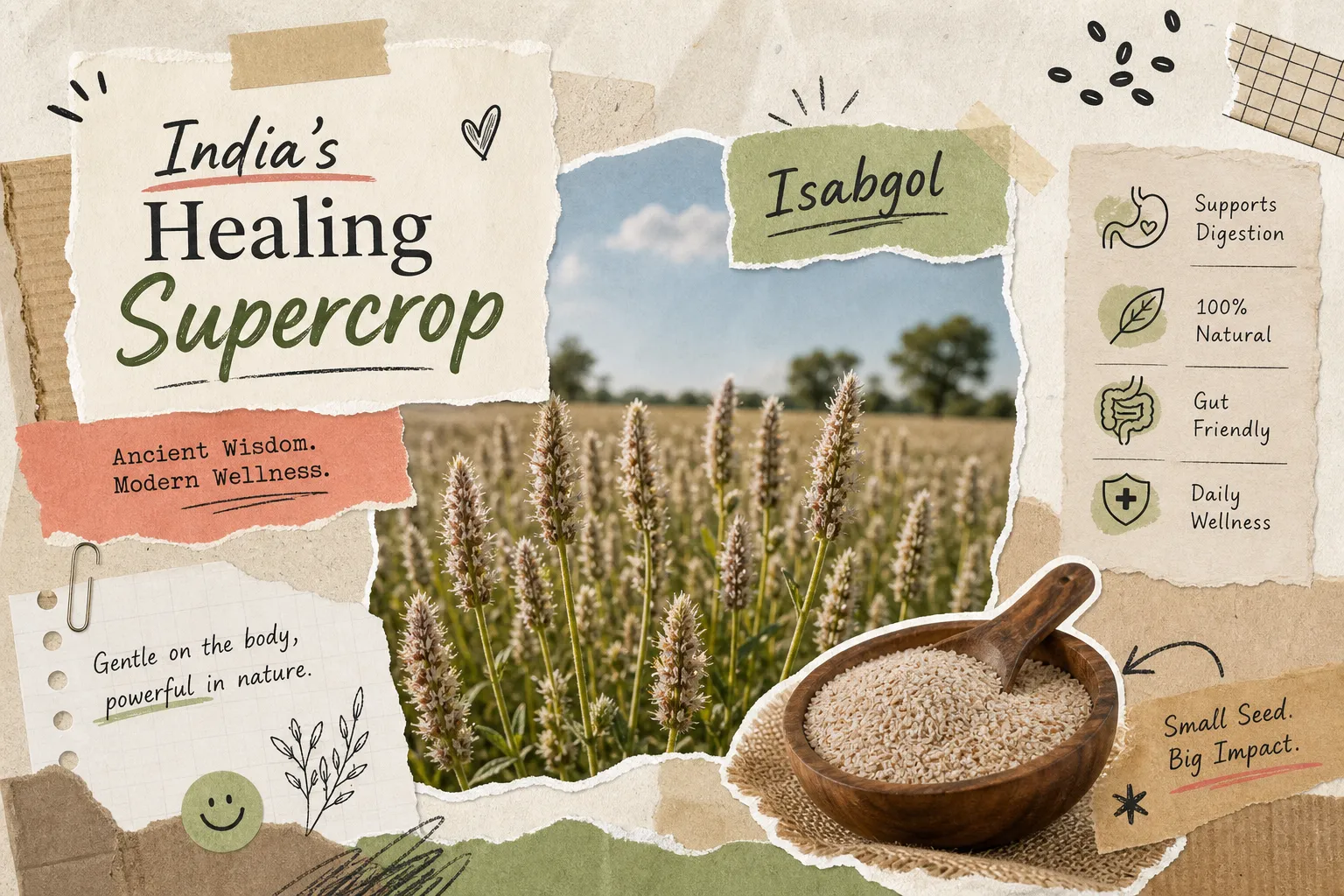
Isabgol husk vs isabgol powder, which is better for your digestion, your daily routine, or your farming income? It is a question most people never stop to ask, because bhusi (husk) and powder are treated as completely interchangeable on the chemist shelf and at the mandi alike. They are not quite the same thing, and the differences matter in practical ways. Isabgol, known internationally as ispaghula or psyllium, holds a unique position in Indian life. It sits in the kitchen medicine cabinet alongside jeera and ajwain, trusted for generations to sort out digestive trouble. At the same time, it drives serious income for farmers across Rajasthan and Gujarat, where Plantago ovata is a major Rabi cash crop that commands considerable mandi bhav (market price) at APMC auction yards.
Processing, hydration speed, shelf life, retail cost, and mandi pricing all differ between the two forms in ways that affect both your health decisions and your farming income. This guide covers every meaningful difference: how each form is made, how it performs in water, which health conditions it suits best, how to dose it safely, and what price each commands from Sri Ganganagar APMC to your local medical store.
| Quick Facts | Isabgol at a Glance |
|---|---|
| Source plant | Plantago ovata (grown mainly in Rajasthan and Gujarat) |
| Active component | Soluble isabgol fibre (arabinoxylans), present in both forms |
| Key difference | Processing, not chemistry, drives most practical differences |
| Simple definition | Husk = separated seed coating; Powder = finely milled husk |
 Table of Contents
- What isabgol husk and powder actually are
- Isabgol fibre content and medicinal value: is there a real nutritional difference?
- Isabgol husk vs isabgol powder: which is better for constipation and IBS?
- Taste, texture, and how each form behaves in water or food
- Isabgol husk vs isabgol powder: mixing and dosage guide
- Side effects, risks, and who should avoid isabgol
- Husk vs powder pricing: from APMC mandis to the retail shelf
- The bottom line: isabgol husk vs isabgol powder, which is better?
- FAQs
What isabgol husk and powder actually are
Isabgol husk and isabgol powder come from the same plant and the same part of the seed. Only particle size and processing steps separate them.
How husk is separated from the seed
The processing happens in milling units across Rajasthan. Seeds of Plantago ovata go through a multi-step mechanical process: pre-cleaning removes dust, stones, and foreign material, then abrasive milling through emery mills or rotating rollers loosens the outer seed coat without crushing the inner kernel. Air aspiration lifts the lighter husk away from the heavier seed body, and sieving grades the separated bhusi (husk) by particle size. No chemicals are involved. The result is the familiar light, off-white, translucent flake that Indian households have used for decades.
What the powdering process adds (or removes)
Isabgol powder is husk taken one step further through additional milling into a fine, flour-like consistency. Most reputable products labelled "99% psyllium husk powder" are exactly this: pure husk ground to a finer particle size. However, some commercial products grind the whole seed rather than isolated husk, which changes the composition substantially by adding seed proteins, fats, and other solids. Always check the label for "99% pure psyllium husk" or an equivalent purity statement. A label that simply reads "psyllium powder" without a purity claim may be a different product with far lower fibre content per gram.
Husk vs powder: a quick comparison
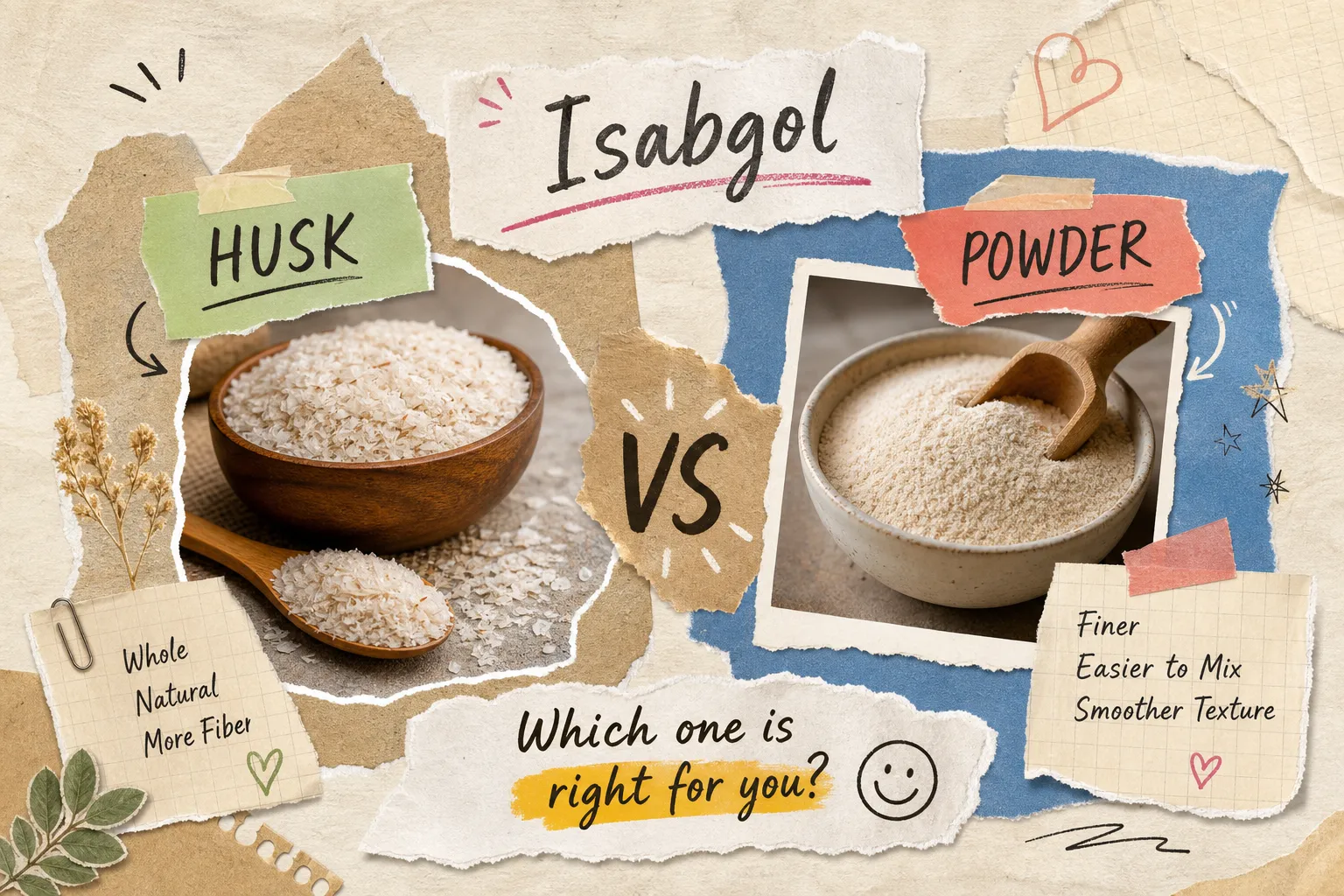
| Feature | Isabgol husk (bhusi) | Isabgol powder |
|---|---|---|
| Physical form | Light, flaky, translucent | Fine, flour-like |
| Particle size | Coarse flakes | Fine (40, 100 mesh for premium grades) |
| Hydration speed | Slower gel formation | Faster; thickens within seconds |
| Bulk density | Less dense; less fibre by volume | More dense; more fibre per teaspoon |
| Typical purity | 95, 99% | 95, 99% (label check essential) |
| Best application | Daily water/chaas use; longer shelf life | Smoothies, curd, recipes; faster mixing |
Isabgol fibre content and medicinal value: is there a real nutritional difference?
When both products are made from 100% psyllium husk, the nutritional difference is negligible. The active compound, soluble arabinoxylan fibre, is present in both forms at comparable levels. Processing changes particle size and hydration kinetics, not the fundamental chemistry.
Soluble vs insoluble fibre breakdown
Isabgol husk contains roughly 70% soluble fibre and 30% insoluble fibre. The soluble fraction forms a thick gel in water (the mucilage) that drives most of the digestive and metabolic benefits: easing constipation, binding bile acids, and slowing glucose absorption. This ratio holds across both husk and powder when purity is equivalent. Where the comparison gets complicated is with whole-seed psyllium powder, which contains far less total fibre per gram (around 20, 25 g per 100 g) compared to 100% husk products (around 77, 90 g per 100 g). This is why purity labelling is not a formality; it is the most important number on the packet.
Does particle size change how the fibre works in the body?
Finer powder disperses faster and hydrates quickly, creating a thicker gel almost immediately after mixing. Coarser husk hydrates more slowly and gives a slightly different texture. Clinical evidence, including meta-analyses covering cholesterol reduction and blood glucose control, does not show that powdered psyllium is more or less effective than whole husk. What matters is the total amount of psyllium soluble fibre consumed each day, consistent use, and adequate fluid intake, not the particle form in your packet.
Isabgol husk vs isabgol powder: which is better for constipation and IBS?
For most conditions, either form works equally well if the dose of isabgol fibre is the same. Practical differences in texture, mixing speed, and convenience make one form more suitable in specific situations.
Constipation, IBS, and daily digestive use
Both forms improve stool frequency, stool water content, and constipation symptoms. For daily kabz (constipation) management, whole husk mixed in water is the traditional method and fully effective. Clinical trials examining IBS-C (constipation-predominant irritable bowel syndrome) have studied psyllium husk specifically; no reliable head-to-head trial directly compares husk to powder. The key rule that applies to both forms is: mix and drink immediately. Letting either form sit in the glass too long produces a thick gel that is difficult to consume and less pleasant to drink.
Cholesterol reduction and blood sugar control
Soluble isabgol fibre binds bile acids in the gut, which reduces LDL cholesterol, and slows glucose absorption after meals, which lowers post-meal blood sugar spikes. Meta-analyses cover psyllium generally, not husk versus powder as separate interventions, so there is no evidence that one form outperforms the other for these conditions. For people managing Type 2 diabetes or high cholesterol, the variable that matters is consistent daily fibre intake. Powder blends more smoothly into curd (dahi) or a morning smoothie, which makes it easier to take consistently every day, and consistency is what produces results.
Taste, texture, and how each form behaves in water or food
Husk has a slightly grainy, fibrous mouthfeel; powder is smoother and more versatile in recipes. Neither has a strong flavour, but poor-quality powder can taste stale or faintly bitter.
How each form behaves in water and chaas (buttermilk)
Husk hydrates slowly and gives a gel that is slippery and familiar to Indian users who have grown up taking isabgol in paani (water) or chaas. Powder disperses almost immediately and thickens faster, which means you have a shorter window to drink it before it becomes uncomfortably thick. If you are using powder, stir and drink within 30 seconds of mixing. Both forms must be consumed promptly; neither should be prepared in advance and left to stand.
Using isabgol in food and recipes
Powder is better suited for blending into yogurt, smoothies, dal, dough, or baked goods because its fine texture distributes evenly without visible clumps. Husk can appear as visible flakes in food, which some people find off-putting in a prepared dish. For the traditional "mix in a glass of water" approach to daily use, husk is just as effective and usually more affordable.
Shelf life and storage
Husk typically lasts 24, 36 months in sealed, dry packaging. Powder has a larger surface area, making it more vulnerable to moisture, clumping, and odour absorption after opening; typical shelf life is 12, 24 months. Store both in airtight containers away from humidity, especially during Rajasthan's monsoon months when ambient moisture can degrade an open packet quickly. If your product smells musty, clumps unusually, or fails to swell in water, discard it regardless of the expiry date printed on the label.
Isabgol husk vs isabgol powder: mixing and dosage guide
For adults, the standard starting dose is 5 g (roughly 1 level teaspoon) once daily, mixed in 200, 250 mL of water, taken before the gel thickens. Dosing instructions differ between husk and some branded powders; always follow the product label, it takes priority over general guidance.
Recommended doses by age group
| Age group | Typical dose | Notes |
|---|---|---|
| Adults and children over 12 years | 5, 10 g once or twice daily | Start with 5 g; increase gradually if needed |
| Children 6, 12 years | 2, 5 g daily | Only with paediatrician advice; use appropriate fluid volume |
| Children under 6 years | Do not give routinely | Only if specifically prescribed by a clinician |
Step-by-step mixing instructions
For husk (bhusi):
- Measure the dose (start with 1 level teaspoon, around 5 g).
- Stir briskly into 200, 250 mL of water, milk, or chaas.
- Drink immediately before the gel thickens.
- Follow with another full glass of water.
For powder:
- Measure the dose as per your product label (powder is denser than husk, so do not substitute by the same teaspoon volume, go by grams).
- Stir into 200, 250 mL liquid (or the volume stated on the label).
- Drink within 30 seconds of mixing; powder hydrates faster and clumps quickly.
- Follow with another full glass of water.
Critical safety rules that apply to both forms
Never dry-swallow isabgol husk or powder. The choking and obstruction risk is real and potentially serious. Isabgol can also reduce the absorption of oral medicines, so separate any medicine dose by at least 1, 2 hours before or 3, 4 hours after taking isabgol. If you are on any regular prescription medicine, confirm the exact timing with your doctor or pharmacist. Finally, introduce isabgol gradually, starting with half a teaspoon and building up over one to two weeks significantly reduces initial gas and bloating.
Side effects, risks, and who should avoid isabgol
The risk profile of husk and powder is essentially identical because both are psyllium fibre and swell the same way when they contact fluid. The key risk variables are insufficient fluid intake, dry ingestion, and individual medical history, not which physical form you choose.
Common side effects and how to minimise them
Bloating, gas, and abdominal cramps are the most common complaints, particularly in the first week of use. These are usually self-resolving as the gut adjusts. Diarrhoea is possible if the dose is too high; paradoxically, constipation can worsen if fluid intake is inadequate. Starting with a small dose and building up gradually, while drinking plenty of paani (water) throughout the day, is the most reliable way to avoid these issues.
Contraindications and groups who need medical advice first
Do not use isabgol, or seek medical advice before starting, if any of the following apply to you:
- Difficulty swallowing or narrowing of the oesophagus
- Suspected bowel obstruction or faecal impaction
- Unexplained abdominal pain, rectal bleeding, or persistent change in bowel habit
- Known allergy to psyllium (including people who work in isabgol processing units, where occupational allergy is documented)
- Phenylketonuria, as some flavoured powder products contain phenylalanine
- People taking diabetes medication, thyroid medicine, or other time-sensitive drugs (isabgol can lower glucose and delay drug absorption)
Does the husk vs powder form change the risk?
Powder hydrates faster and can clump more aggressively if mixed with insufficient liquid, making inadequate fluid intake a slightly higher practical risk with powder specifically. Coarser husk is equally dangerous if swallowed dry. The underlying contraindications are form-neutral: they apply to any psyllium product regardless of particle size. If a medical reason prevents you from using one form safely, the same reason almost certainly prevents you from using the other.
Husk vs powder pricing: from APMC mandis to the retail shelf
Raw isabgol husk (bhusi) commands a lower per-quintal price at the mandi compared to processed powder, but the price premium on powder is driven by processing cost and export demand, not by superior nutritional value.
How isabgol is priced at APMC markets like Sri Ganganagar
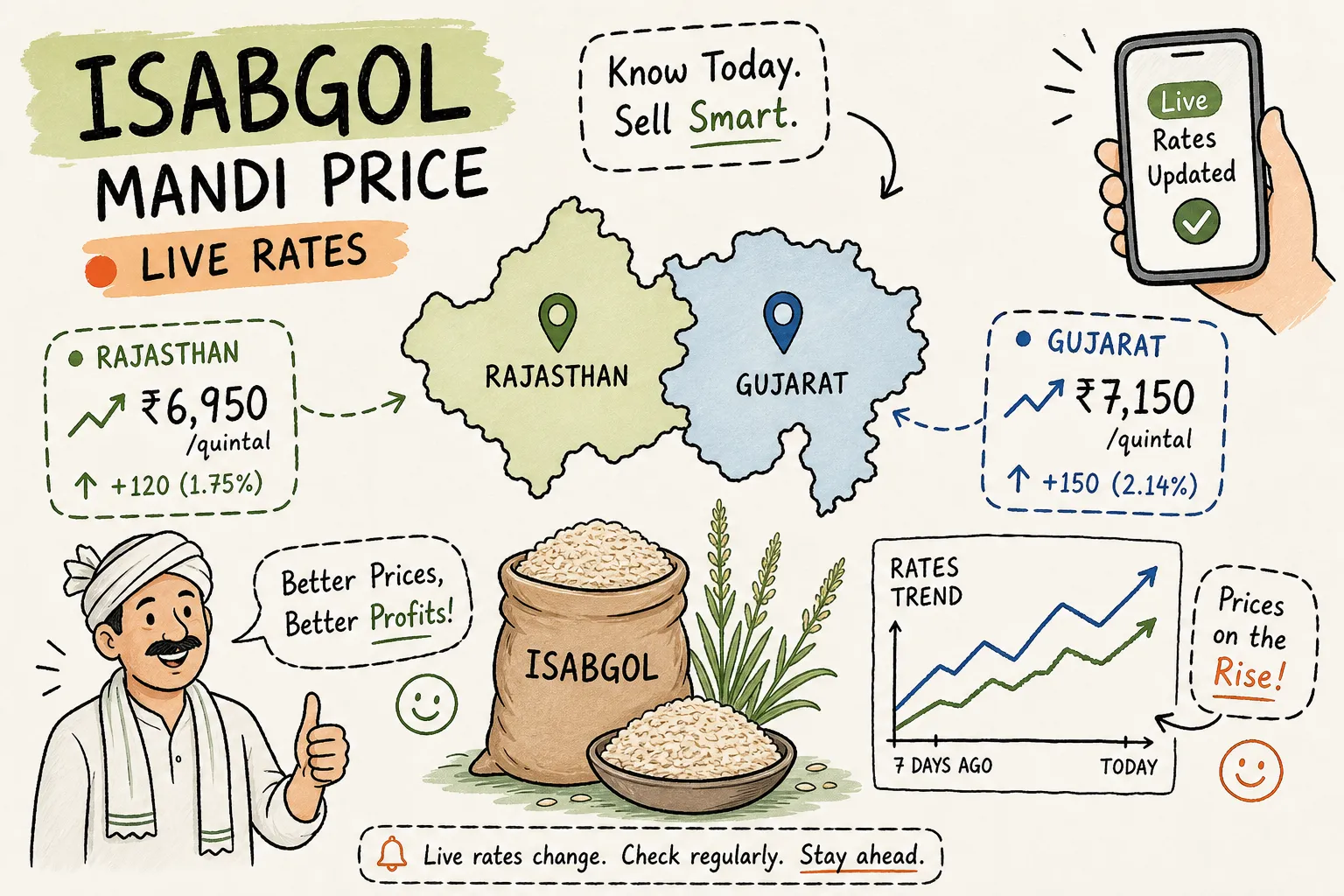
Rajasthan dominates India's isabgol production, with major APMC centres in Sri Ganganagar, Jodhpur, and Barmer handling most of the auction volume. Isabgol bhusi is the form most commonly auctioned by farmers at these mandis during the live bol-chaal (bidding process). As of October 2026, Sri Ganganagar APMC is currently reporting isabgol rates of around ₹11,500 per quintal, with broader India-level prices ranging from ₹11,275 to ₹13,200 per quintal depending on grade and origin. Mandi prices fluctuate with season, crop output, and export orders from buyers in the United States, Germany, and the United Kingdom, all of which are major importers of Indian psyllium.
Checking live isabgol mandi bhav data before heading to the auction yard is essential. KhetiKisaan tracks isabgol bhusi prices from ground-level contacts physically present at APMC auction yards during live bidding, giving farmers and traders a verified rate to negotiate with rather than accepting the first number offered by the arhatiya (commission agent).
Why processed powder commands a premium in domestic and export markets
Milling husk into powder requires additional machinery, sieving, quality control, and finer packaging. Exporters buying psyllium for pharmaceutical and food-grade applications in Europe and North America typically prefer standardised powder for consistent particle size and purity. This demand translates into a meaningful price difference at the processor and export level. Indicative export figures show raw husk at approximately US$3.50, $3.95 per kg, while premium-grade processed powder reaches US$4.80, $5.50 per kg, a difference of roughly US$100, $200 per quintal before freight and documentation costs. In Indian retail, whole husk typically sells at around ₹300, ₹500 per kg, while powder retails at ₹445, ₹650 per kg.
What this means for farmers deciding how to sell
A kisan growing isabgol in Rajasthan faces a practical choice: sell raw bhusi at the APMC for immediate liquidity, or supply to a processor who converts it to powder for a potentially better margin. The right answer depends on transport cost to the processing unit, on-farm storage capacity, the current price differential at the mandi, and how quickly the farmer needs the income. Tracking live isabgol mandi bhav on KhetiKisaan before any sale gives farmers a data point to negotiate from a position of knowledge, rather than discovering the market rate only after reaching the mandi yard.
The bottom line: isabgol husk vs isabgol powder, which is better?
When weighing up isabgol husk vs isabgol powder, which is better comes down to particle size and practical convenience, not a fundamentally different substance. Both deliver the same soluble ispaghula fibre; the choice depends on texture preference, cost, and what you plan to do with it. Husk is the better everyday value option for most people: it is cheaper, has a longer shelf life, and is equally effective when mixed and consumed correctly in water or chaas.
Powder earns its slight price premium through faster mixing, smoother texture, and flexibility in recipes, curd, and beverages. For farmers and traders, the processed price differential between bhusi and powder is real money. Checking live isabgol mandi bhav on KhetiKisaan before heading to the APMC gives you the market intelligence to avoid selling at a disadvantage. And for anyone managing a chronic condition such as diabetes, high cholesterol, or IBS, consult a clinician before adding any form of isabgol to your daily routine, particularly if you are already on prescription medication.
FAQs
Related Blogs
Oct 08, 2026
by Pankaj Sihag
Sep 23, 2026
by Pankaj Sihag

Sep 19, 2026
by Pankaj Sihag

Sep 09, 2026
by Pankaj Sihag
Sep 08, 2026
by Pankaj Sihag